14th January – 5th February
14th January – Travel Out
We flew with Emirates Airlines from Heathrow via Dubai to Colombo. A very civilised departure time of 1430 from Terminal 3 but a slightly less civilised arrival time in Dubai of 0030 with a 2 hours stop over before catching the 0230 connection to Colombo. As ever we got on the flight with a determination not to eat every meal that was placed in front of us and failed! With a 5hr30min time difference to Uk we landed at 0800 in the morning. Customs was very efficient, having obtained our e-visa before leaving UK. Luggage was awaiting us on the carousel and we were met by Nick and Carole, the hosts from Not Out.
15th January 2025 – Nagombo Hotel Jetwing Blue
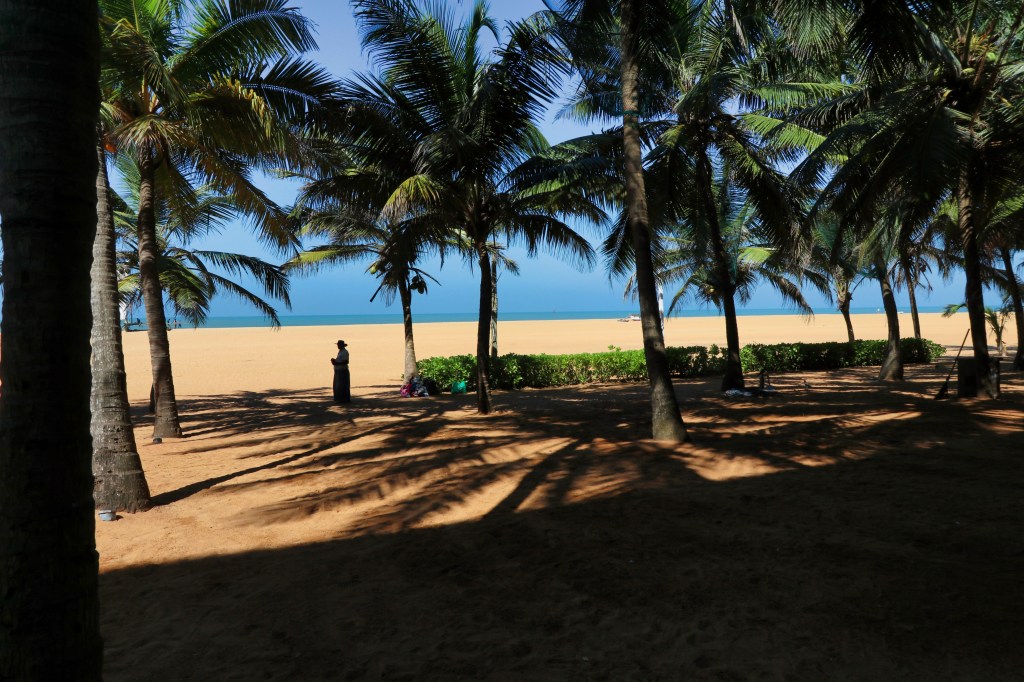
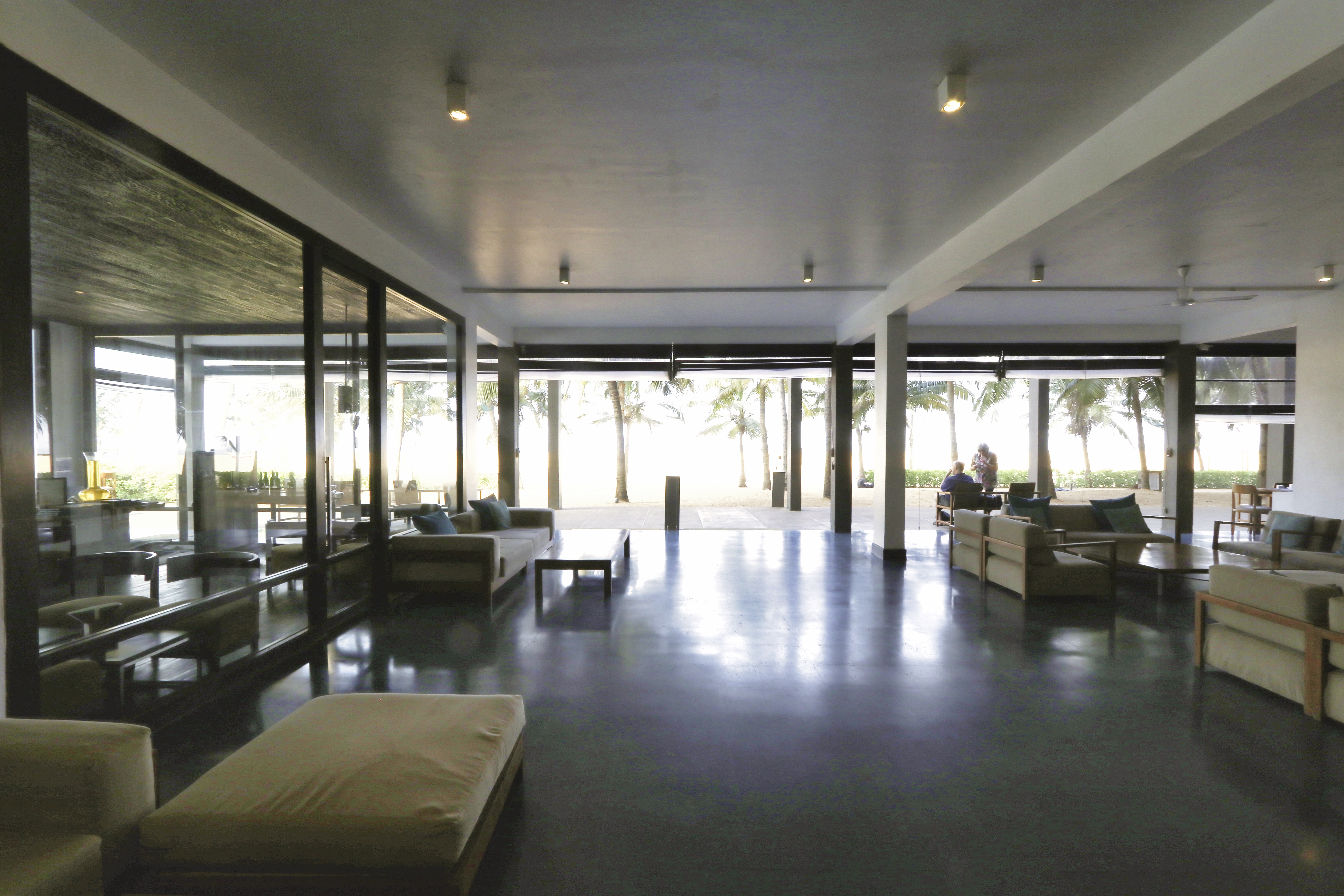
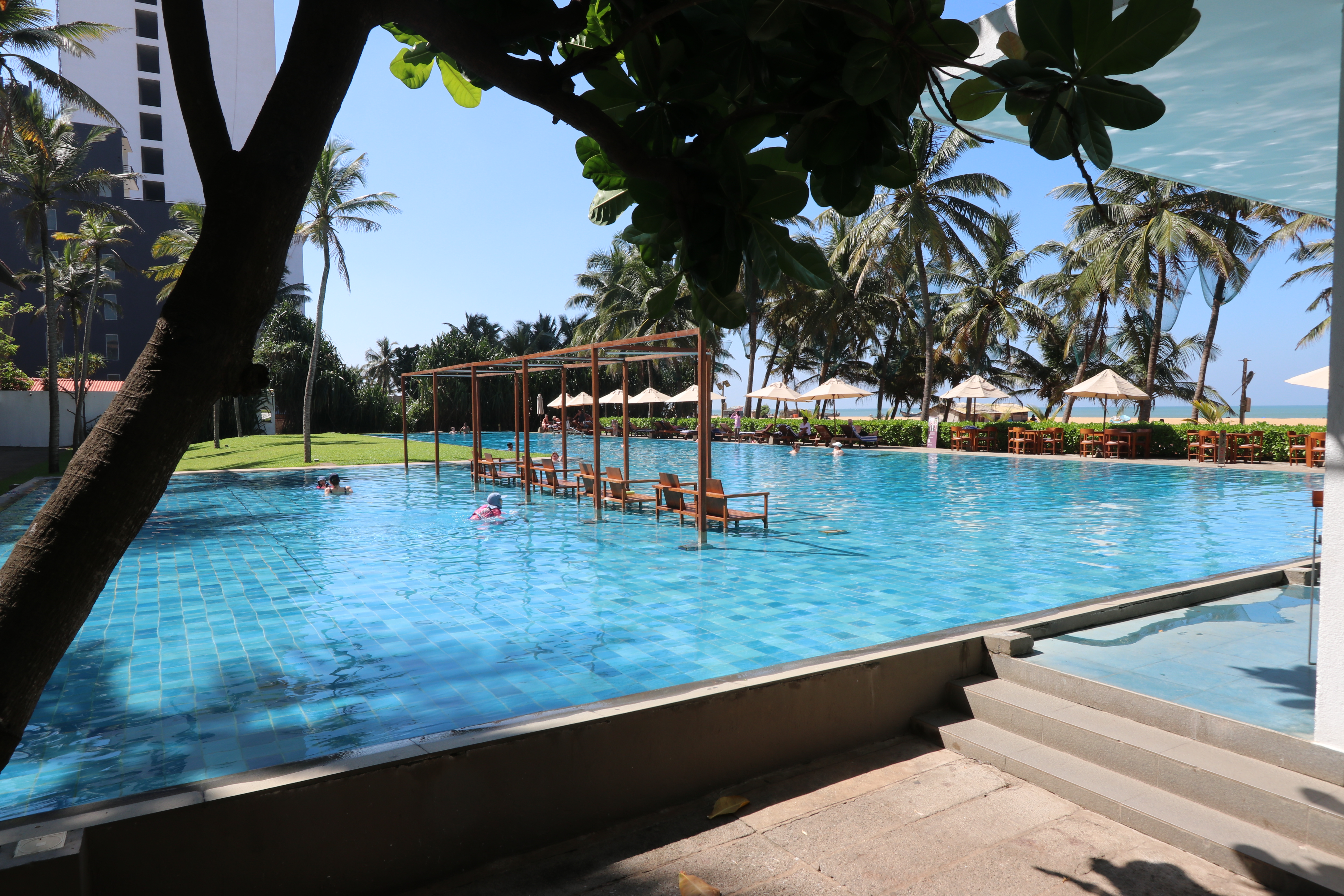
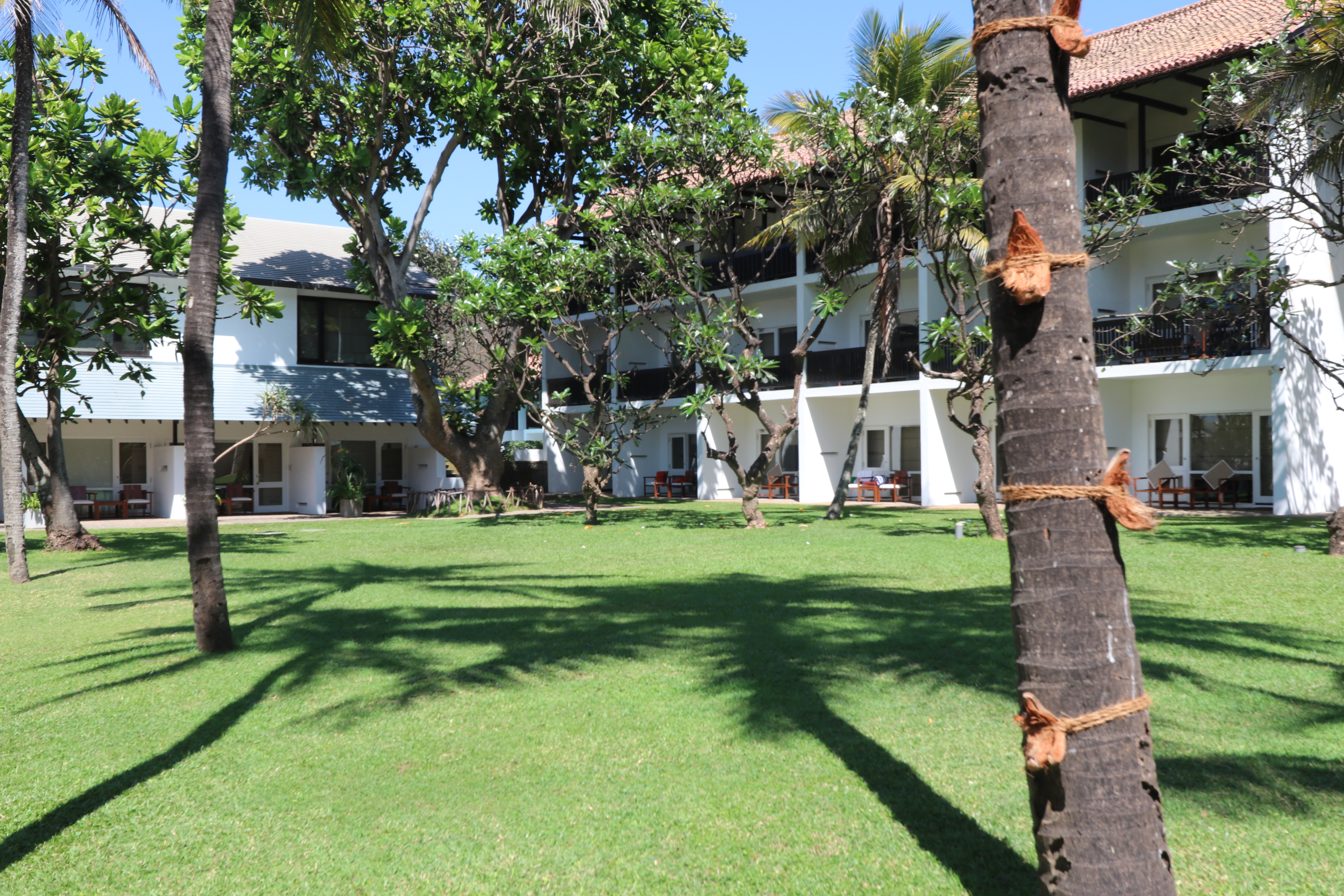
The hotel was located in Negombo just north of Colombo on the western coast. There is always the choice to make having got off a long haul flight with little sleep sitting upright in economy class whether to have a ‘quick sleep’ which inevitably turns into a long sleep or battle through. It was only 1100hrs when we got to the hotel so we went across the road to the Lord’s Pub/Cafe/Restaurant. A good decision. We share a local curry for lunch before going back to the hotel with the intention of walking along the beach. However the sand was so hot that even walking on it in sandals was too uncomfortable. So we did then succumb to a short doze before sitting outside by the pool to catch the sun set over the Indian Ocean. A glorious sunset.
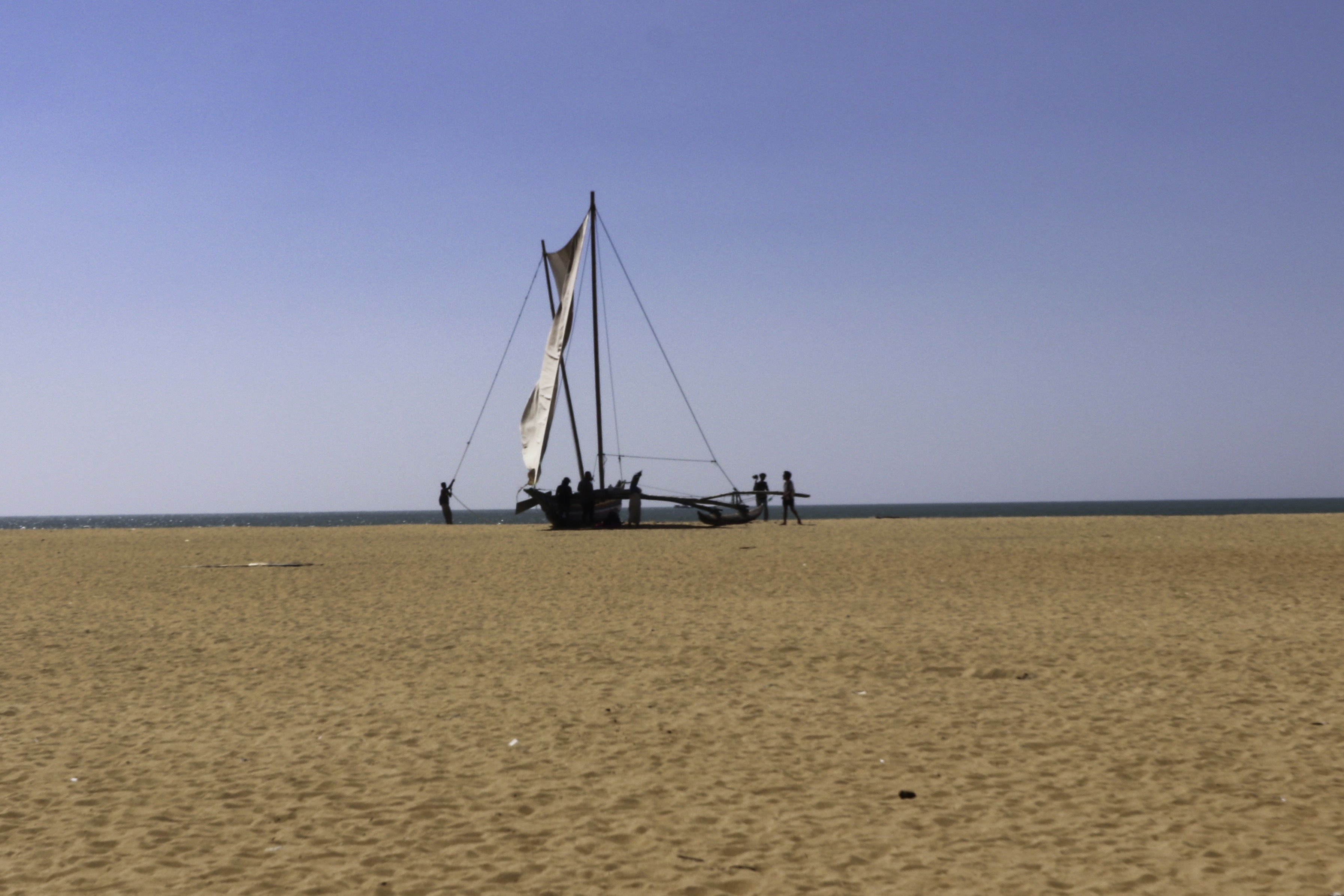
Many of the locals as well as those on holiday gathered on the beach to see the golden ball sink below the horizon. There was a gentle SW breeze and shook that sail of the sailing boat beached on the sand. After leaving UK with the temprature at -3 deg, this was bliss.
Supper was at Lord’s where we again shared a chicken and cashew nut curry, meeting the rest of the tour group for this phase of the tour and our tour guide Manorge. We spent time with Tony and Linda who were from Birmingham.
16th January – Travel to Dambulla and Anurdhapura
We decided on an early start – 0600 – to pack rather than pack the night before. A combination of too much rice, alcohol and long flight made the for a difficult start to the day. With bags outside our door at 0700 we had a pleasant breakfast overlooking the sea. Daal and noodles for breakfast with Ceylon prepared us well for the day ahead.
This phase of the trip was the cultural week. We drove 4 hours north west to the first capital of Sri Lanka – Anurdhapura. We had a stop for a few minutes to ease springs which turned out to be a supermarket which had a single toilet. We aroused some curiosity from the locals we descended the coach and marched into the supermarket. We did pass storm damage from the recent cyclone which had killed around 1.000 but the true number will perhaps never be known. Sri Lanka is not a rich country and still one that has not fully recovered from a very long civil war between the Tamils (Hindu) and the Sinhalese
Isurumuniya Rock Temple 3c BC
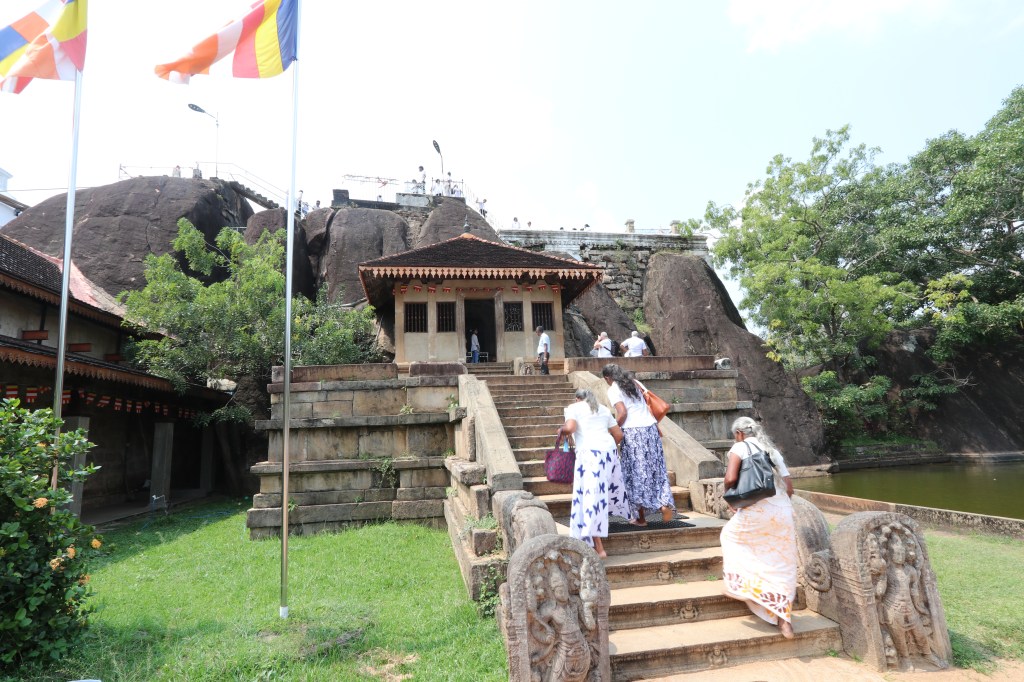
There are a series of temples that date back to 3BC to around 6AD which was the height of the Anuradhapura Kingdom. They were renowned for designing and building irrigation networks allegedly as far as Egypt. Buddhism was introduced around 3 BC from India and as a result of this large and complex temples were created for the rulers and Buddhist monks. Two of the remaining temple complexes are World Heritage Sites. However by 9AD the Anuradhapura Kingdom fell apart as a result of invasions from the Chola armies of India who are that time had one of the largest empires in Southeast Asia. Most of the temples were destroyed it is the ruins that now remain.
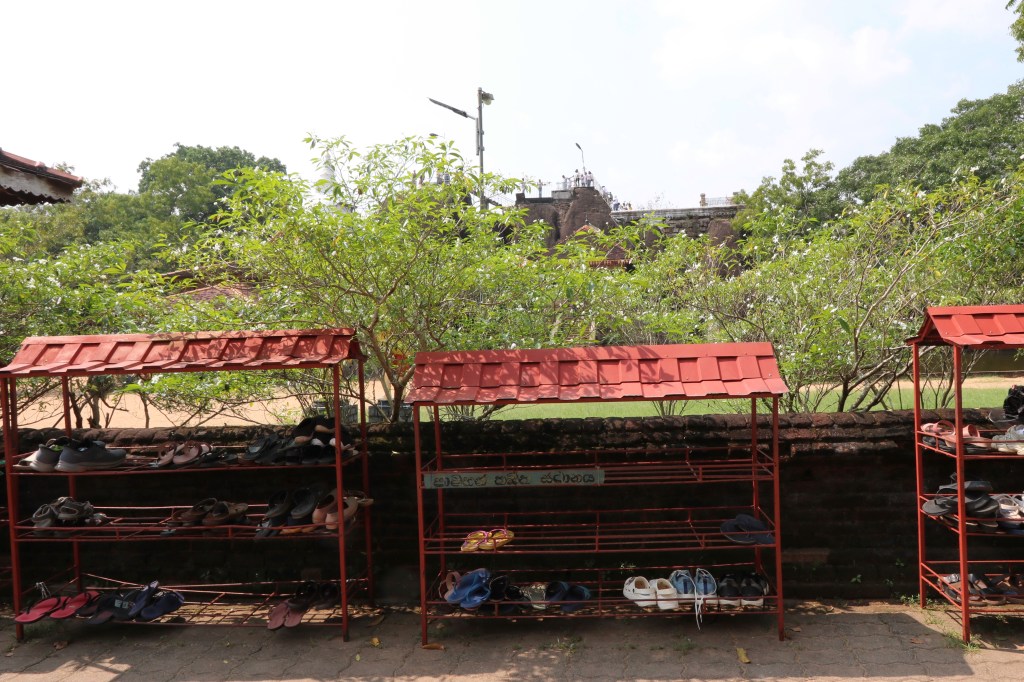
The Isurumuniya Rock Temple has the bathing pools of the King and Queen and then monks nearlyby – Kuttam Pokuna. To visit the temples requires everyone to remove shoes and hats. Normally this is at the temple door, however here it covers the whole complex. Soft western feet were not used to walking and climbing stairs and rock barefoot!
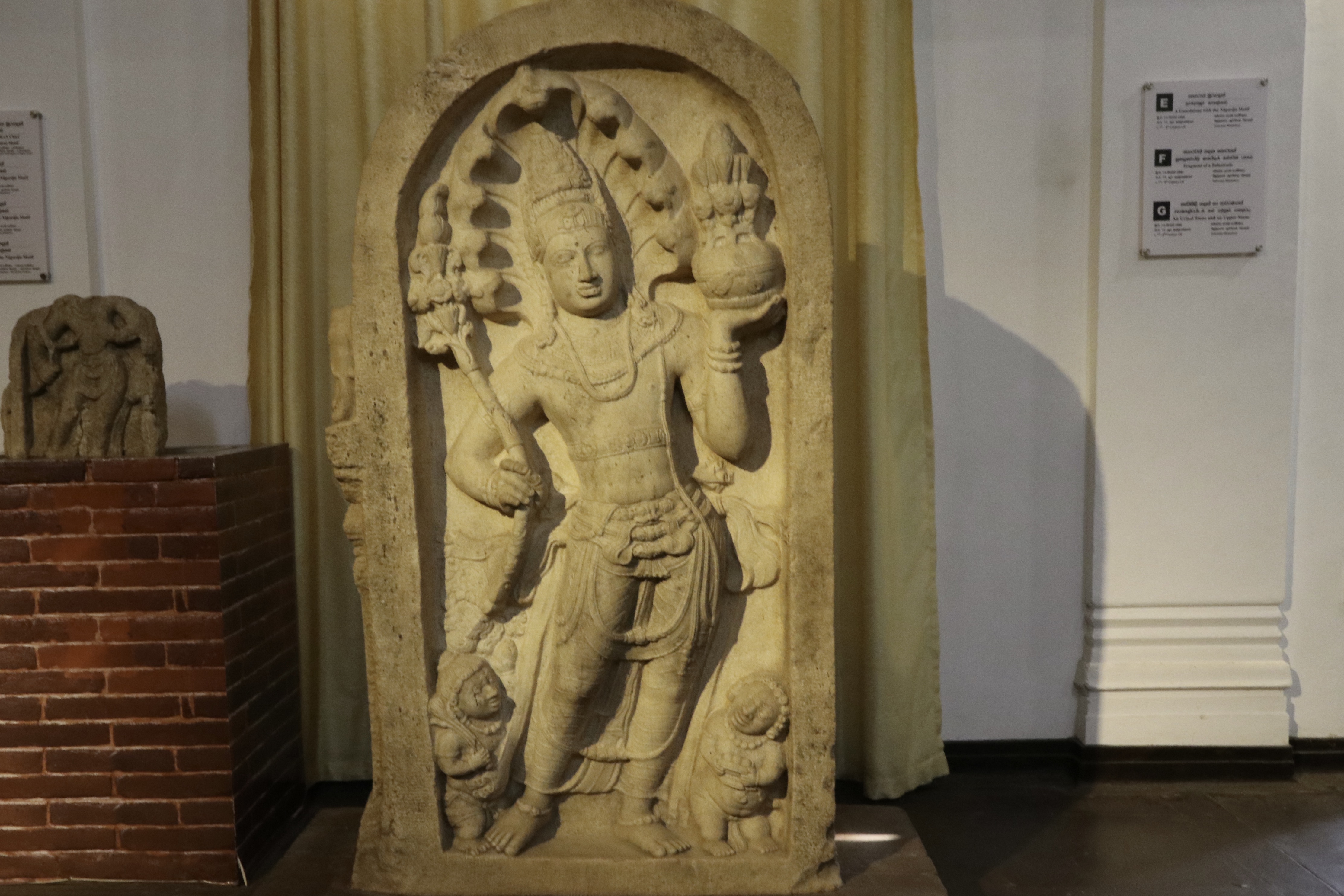
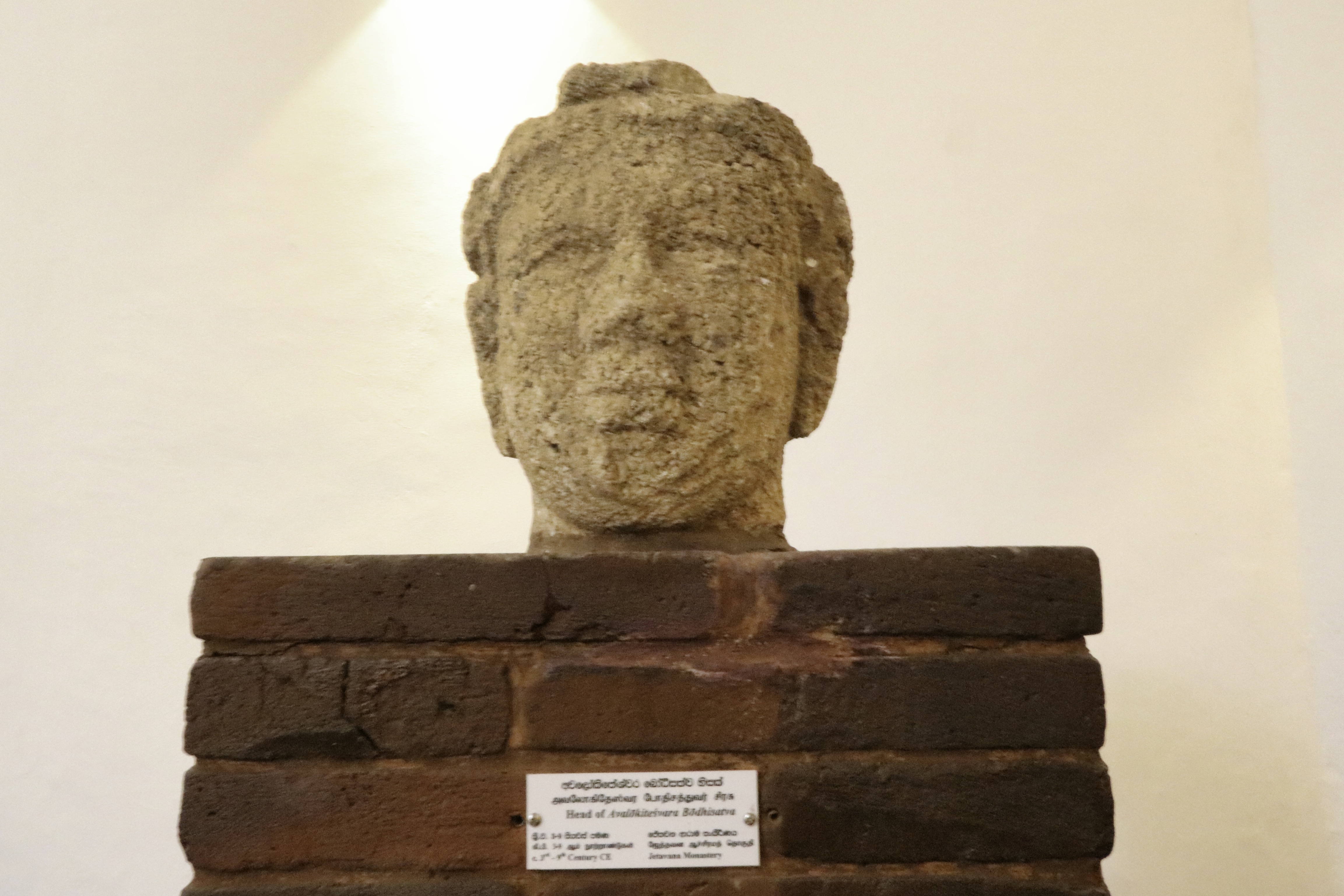
The next stop was to Jetavanarama Museum which housed collection of objects excavated dating back to 3cBC-6cAD. The Jetavanarama Dagoba lies within the vast grounds around the museum and is one of the best-preserved monuments in the ancient city of Anuradhapura. The stupa towers over 89 metres, shorter than its original 121 metres. The foundations were laid on bedrock, stamped down by elephant feet, and the dome was built from strong sand bricks. The stupa was then covered in lime plaster. Overall the process took around 15 years to complete and required skillful brick workers, layers and stonemasons. Until 1909, the colossal stupa was covered in jungle. It was then that Monk Jumbuke Dhammarama gained approval to clear the building. Excavations revealed that Sri Lanka was the primary location for trade activity connecting the Indian rim countries with the Mediterranean and the Far East.
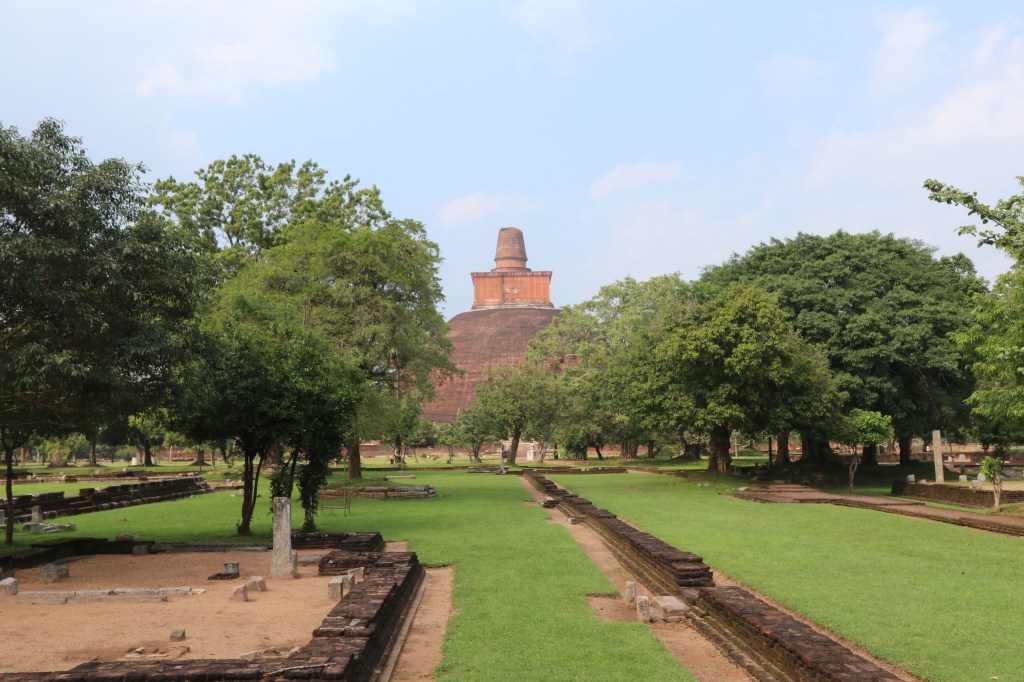
Unfortunately we only got to see it from a distance as we were running short of time and the guide was keen to pull into the programme as many sites as he could!
We had lunch at a local restaurant. Expensive for what was essentially rice and dhal with some fish or chicken. But it filled a gap and gave us all a bit of a rest
From here we moved to Ruwanweliseya 2cBC. It originally was a perfect dome and has been reconstructed but they have not been able to replicate the beauty of the original Stupa.
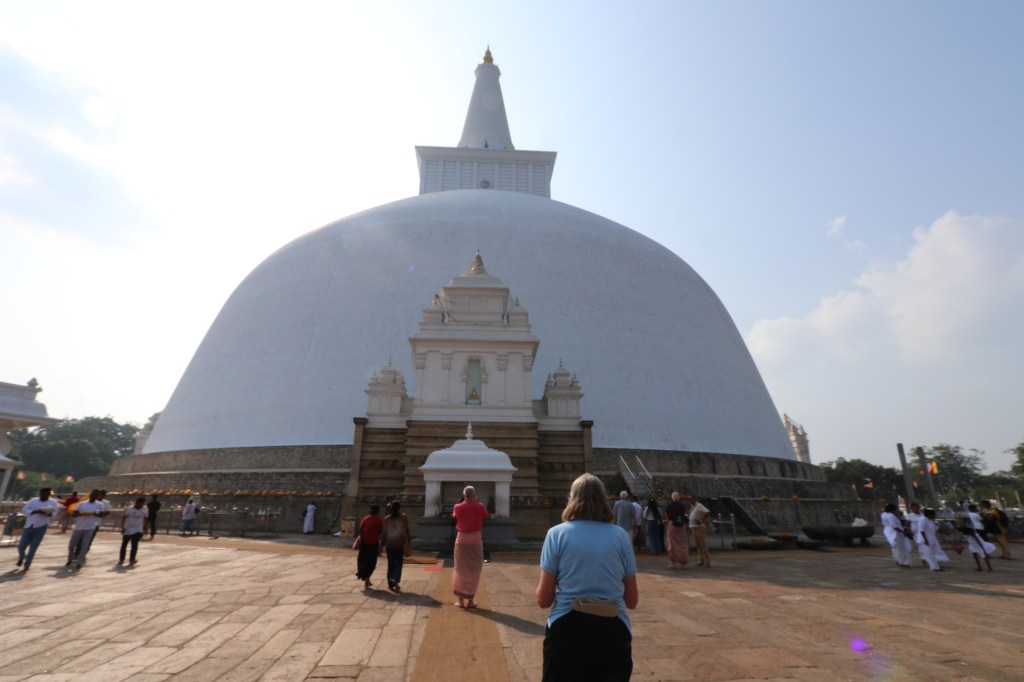
As with the other temple sites we had to remove our shoes to walk around. It was quite a long walk on very hot tiles – 500m. Where the tiles were particularly hot it was a bit of a race to get across without them being burnt and seek some shade. POst the visit I did read that it was suggested Westerners wore socks! Gillian decided not to come and go back to the bus – however it had left – so she raced back to catch us up but we had departed. After trying to enter via a ‘Monk’s only’ entrance she was directed by the Police to the correct entry point. She eventually caught up with the group looking hot and bothered. Whilst there a ceremony was taking place which involved wrapping the entire circumference of the Stupa in an orange ribbon. It was fascinating to watch and sense as well as see the complete dedication and faith of the followers of Buddha.
Having retrieved our shoes we then walked to the oldest recorded tree in the world. About 2,600 years ago, Lord Gautama Buddha sat with his back against an Esathu (Aśvattha) tree on the banks of the Neranjana River in Bodhgaya, India. It was at this moment, as he sat against the tree, that the Buddha is said to have achieved enlightenment. In doing so, the tree also gained a venerated status. It became known as the Bodhi tree, and pilgrims came to see it even within the lifetime of the Buddha. Later, in 236 BC, the Buddhist nun Sanghamitta Maha Theri was sent by Emperor Asoka from India to Sri Lanka. With her, she carried a southern branch of the original sacred fig. This branch was ceremoniously presented to Devanampiya Tissa, one of the earliest kings of Sri Lanka whose reign was notable for the arrival of Buddhism. In 236 BC, Tissa planted the branch of the Bodhi tree in his Royal Park in Anuradhapura. The Jaya Sri Maha Bodhi, as it became known, has since been cared for and protected by Buddhist monks and dedicated kings.
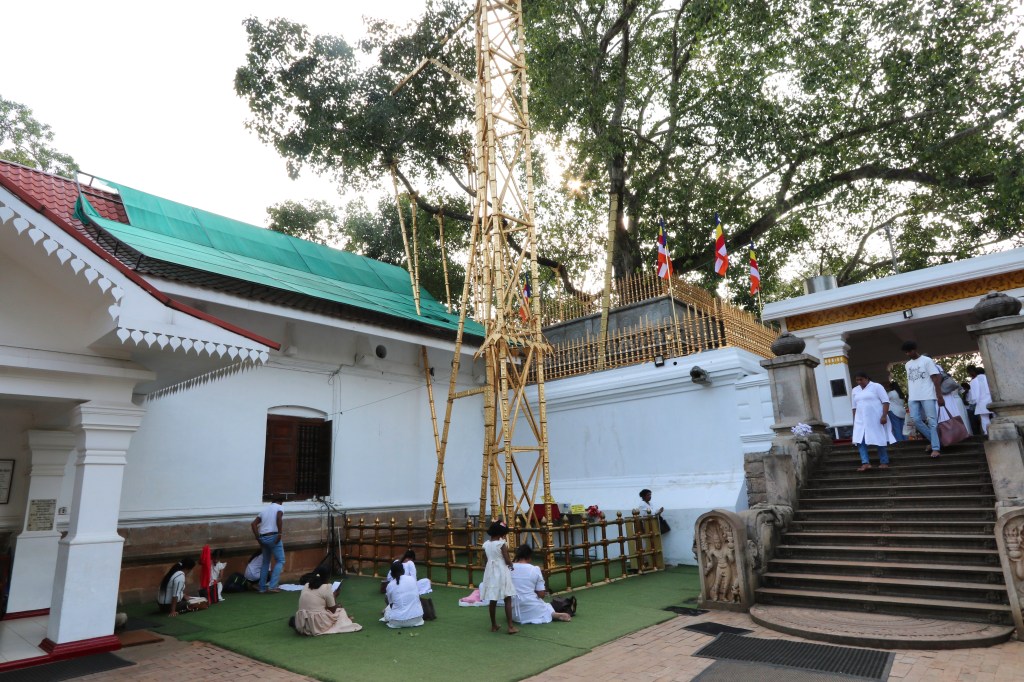
The photo is of a group of worshippers who study beneath the tree and hope a leaf migh fall which they are allowed to take home with them.
After a long day we arrived at our next hotel Jetwing Lake Dambulla – about 1.5hrs drive. Set around a lake surrounded by jungle it was a beautiful setting. It had been a long day and after a shower and change we had a communal meal in the dining room. The buffet supper was fantastic and whilst Gillian was restrained I had too much! After dinner we sat around a table outside with a paraffin lamp to keep the mosquitos away having a drink and chat with Tony and Lin.
17th January – Jetwing Lake Hotel – Danbulla
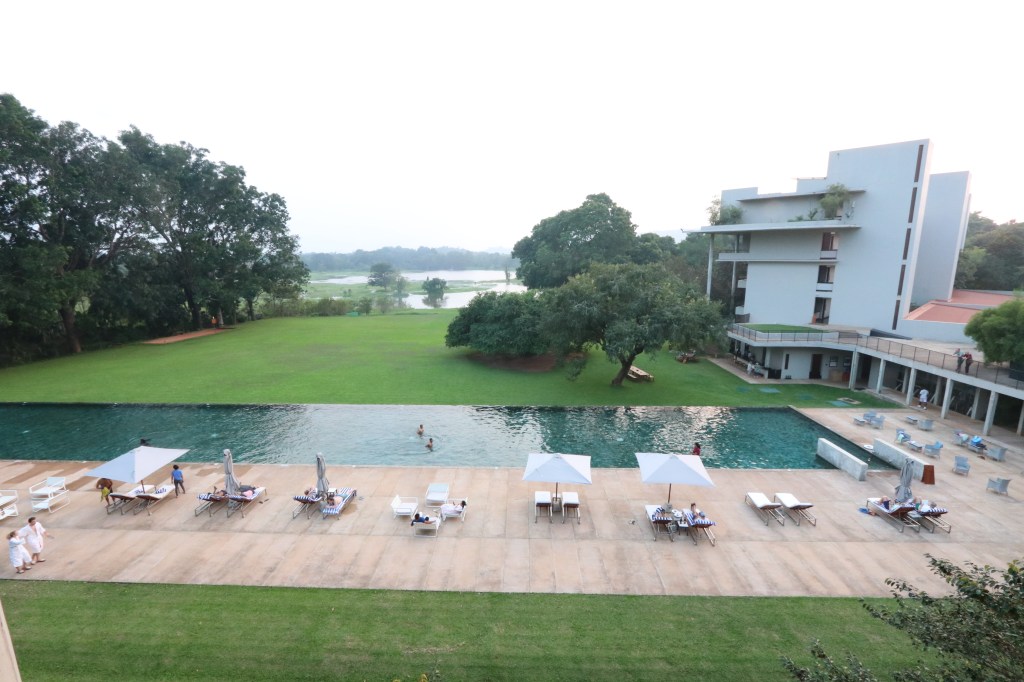
The hotel was the best we had stayed in. It was surrounded by jungle with an extraordinary long swimming pool, magnificent rooms with great views over the lake and a nice restaurant that served a la carte as well as a buffet. The previous day had been long, hot and hectic. Whilst there was an organised tour to some temples and a rock cave we decided to have a rest day and relax by the pool to take advantage of the hotel, its setting and to recover. That evening we met up with Angus and Ian for supper in the Chinese restaurant at the top of the hotel. A pleasant and relaxing meal to end the day.
18th January – Visit Sigiriya (Lion Rock) and Village
Lion Rock
Sigiriya was one of the highlights of this week. Probably one of the most famous and visited locations in Sri Lanka. It was built around 5cAD, taking 7 years to create this magnificent palace atop a huge rock that with 3 acres on top. Despite the truly Herculean effort to create, it was only inhabited for 14 years and once King Kashyapa died, the palace was abandoned and became a monastery intil the 13th Century. It was then rediscovered in 1831 when Major Jonathan Forbes of the 78th (Highlanders) Regiment of Foot of the British Army, while returning on horseback from a trip to Pollonnuruwa, encountered the “brushwood-covered summit of the rock of Sigiri. It would take another book to describe this UNESCO World Heritage Site and I will certainly not do it justice here.
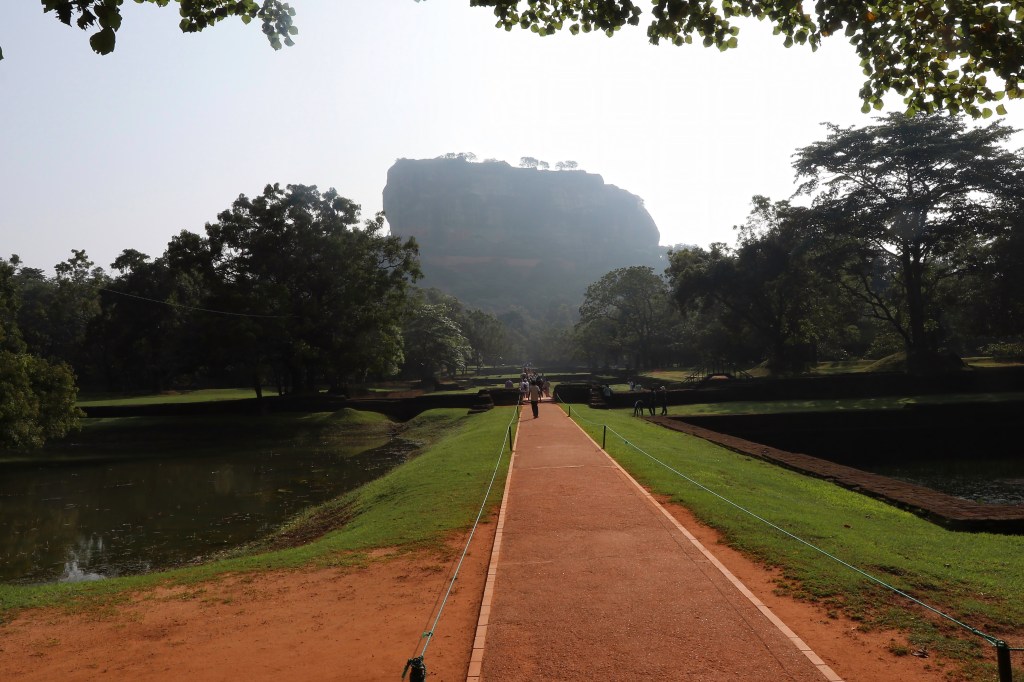
The approach is though a series of what were lush gardens with fountains that were fed from a reservoir. You then start the climb up for 200m in height. The beginning is relaxing and gentle. You eventually start the real climb having entered the complex through a narrow arch with guardposts in natural indentations in the rocks.
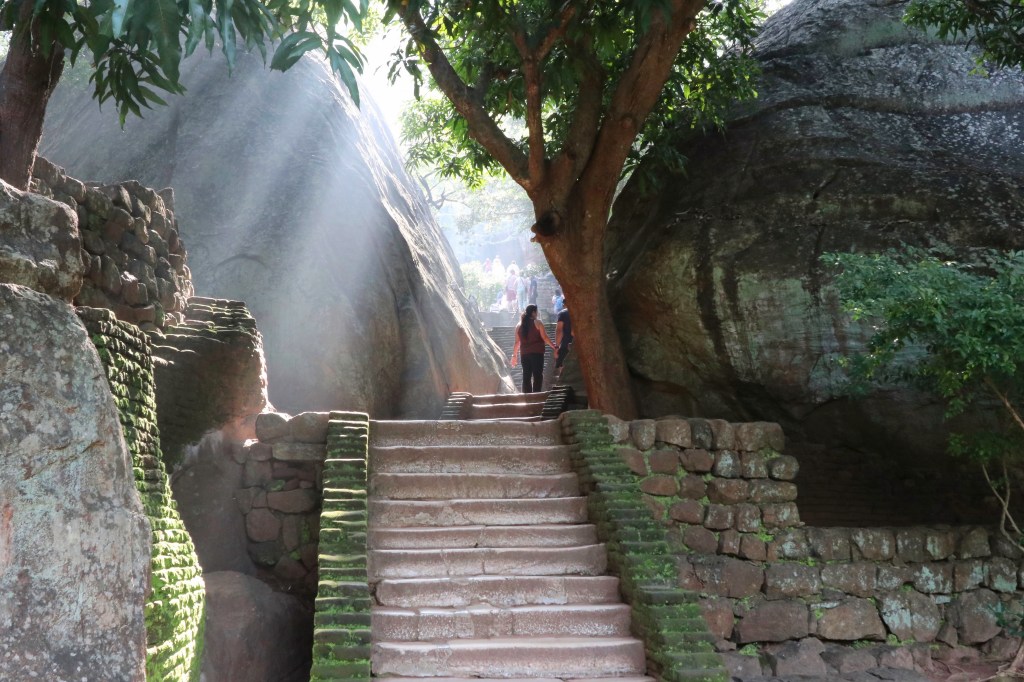
There is then set of step climbs up the edge of the rock. You are quite exposed and it does feel a little precarious and would certainly not meet UK H&S standards! It can also be slow with both the volume of people and some with physical difficulties.
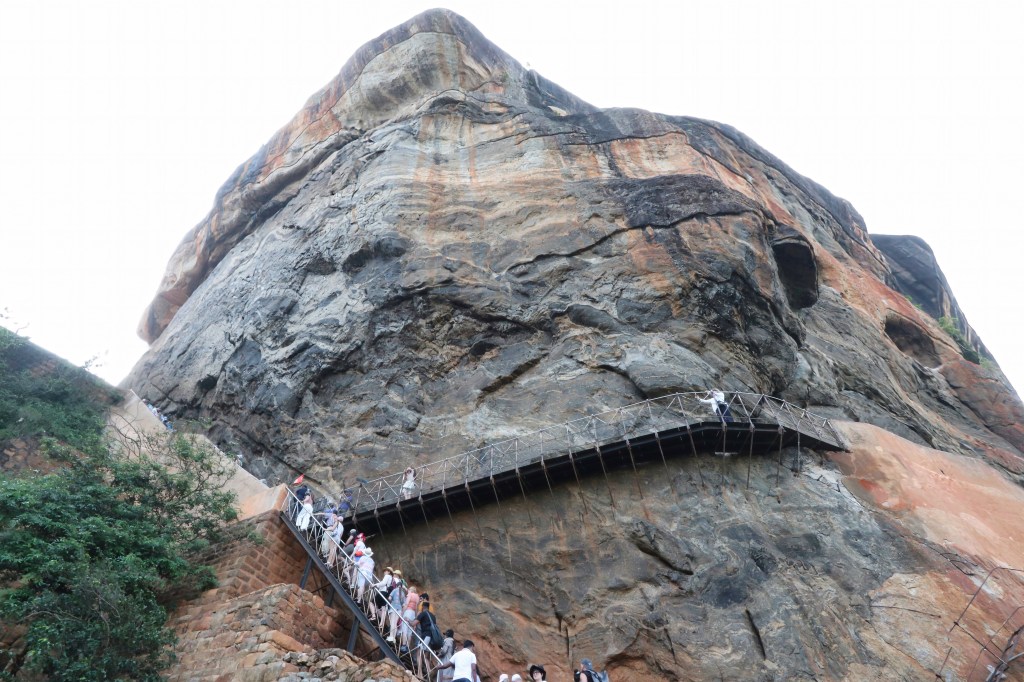
Once at the top the view are spectacular. Ruins from the buildings, swimming pools and reservoirs for the dry season are still very evident. It is an awe inspiring place.
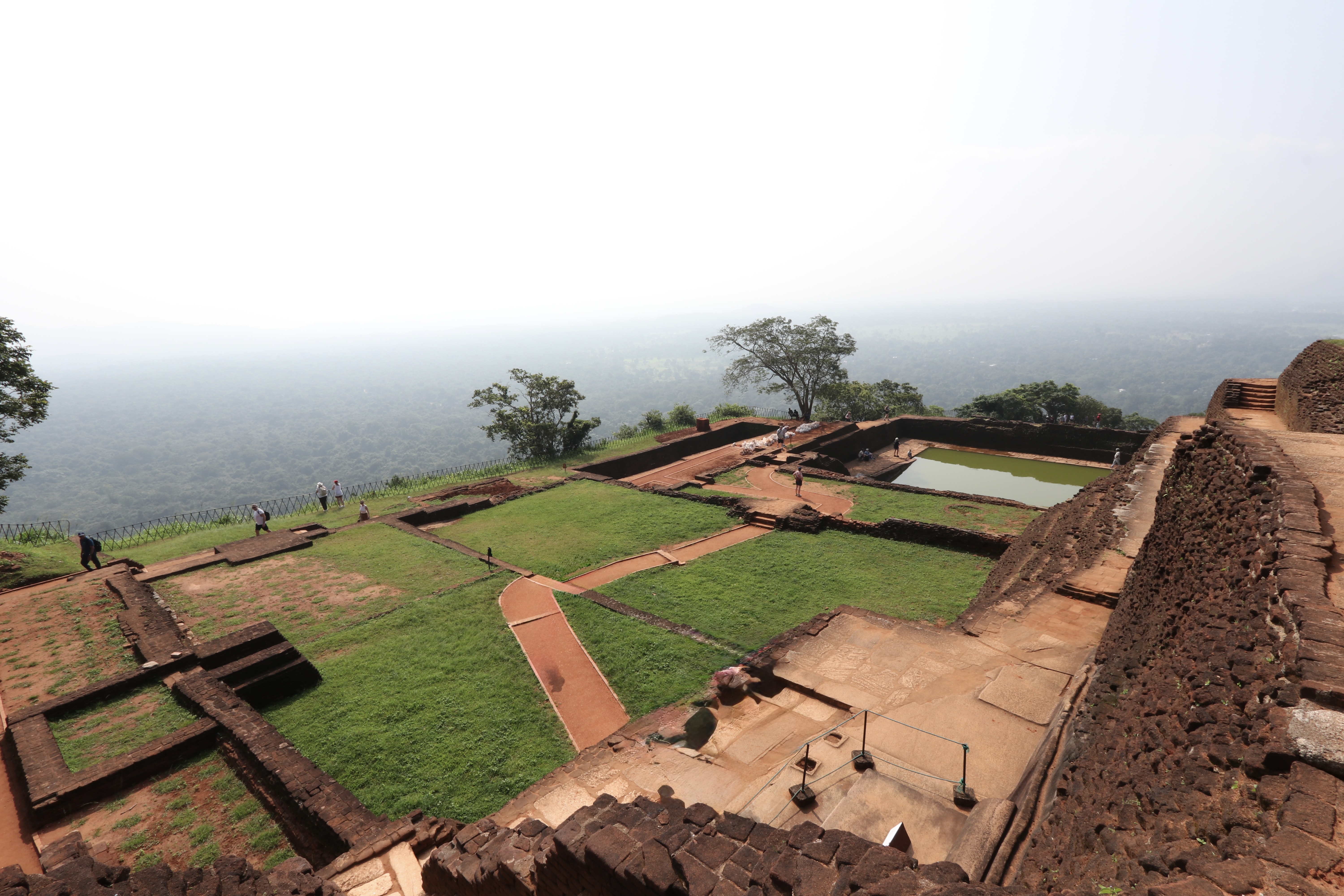
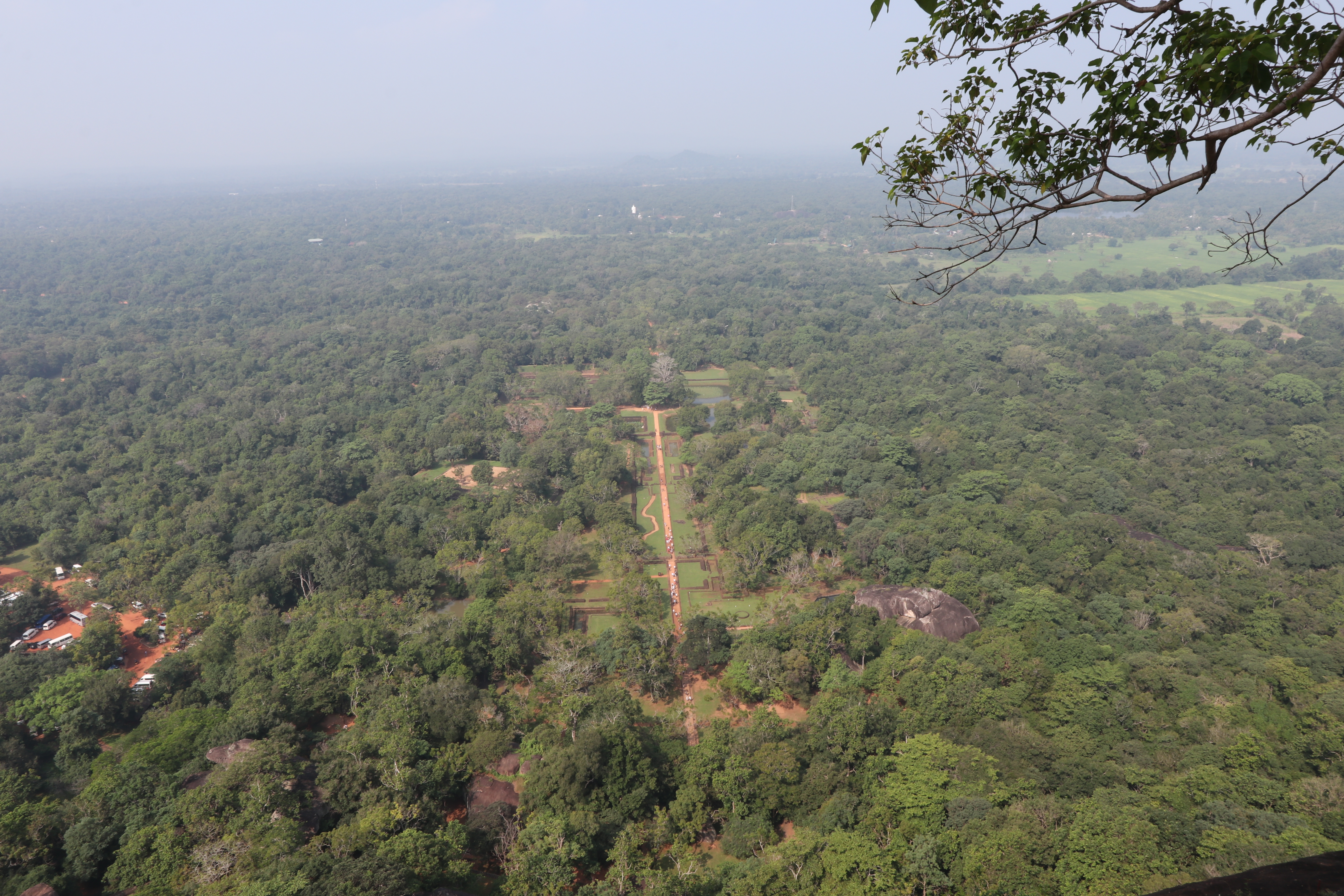
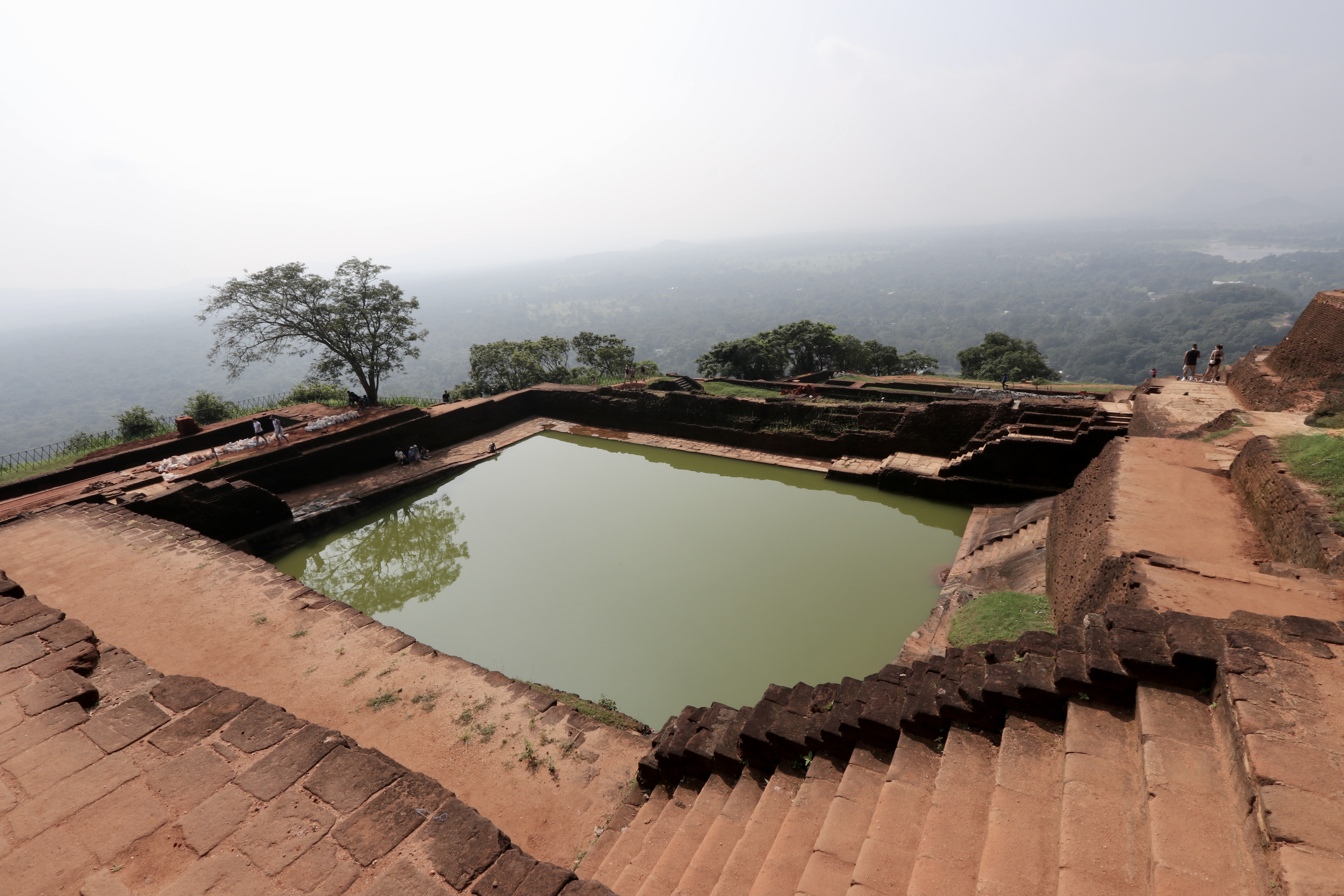
The climb down felt just as precarious. The exit was via the mirror wall and paintings. The King was reputed to have had a concubine of 500 and each had their portrait painted – only 18 remain but the details is remarkable. the mirror wall was built, plastered and then a shine put on it with honey. When the sun shone in the right direction, the portraits were reflected onto the wall.
Visit to Local Village and Local Lunch
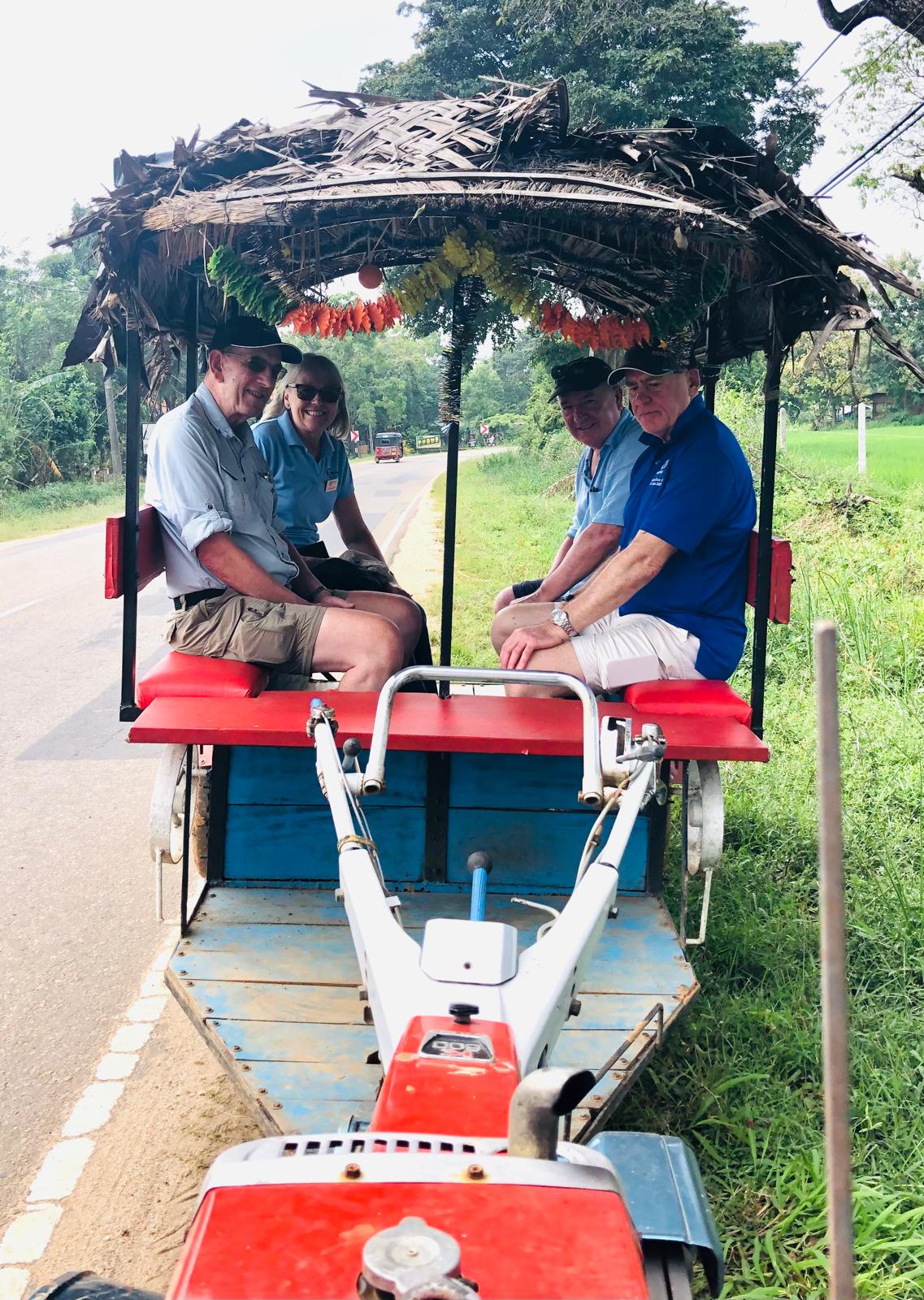
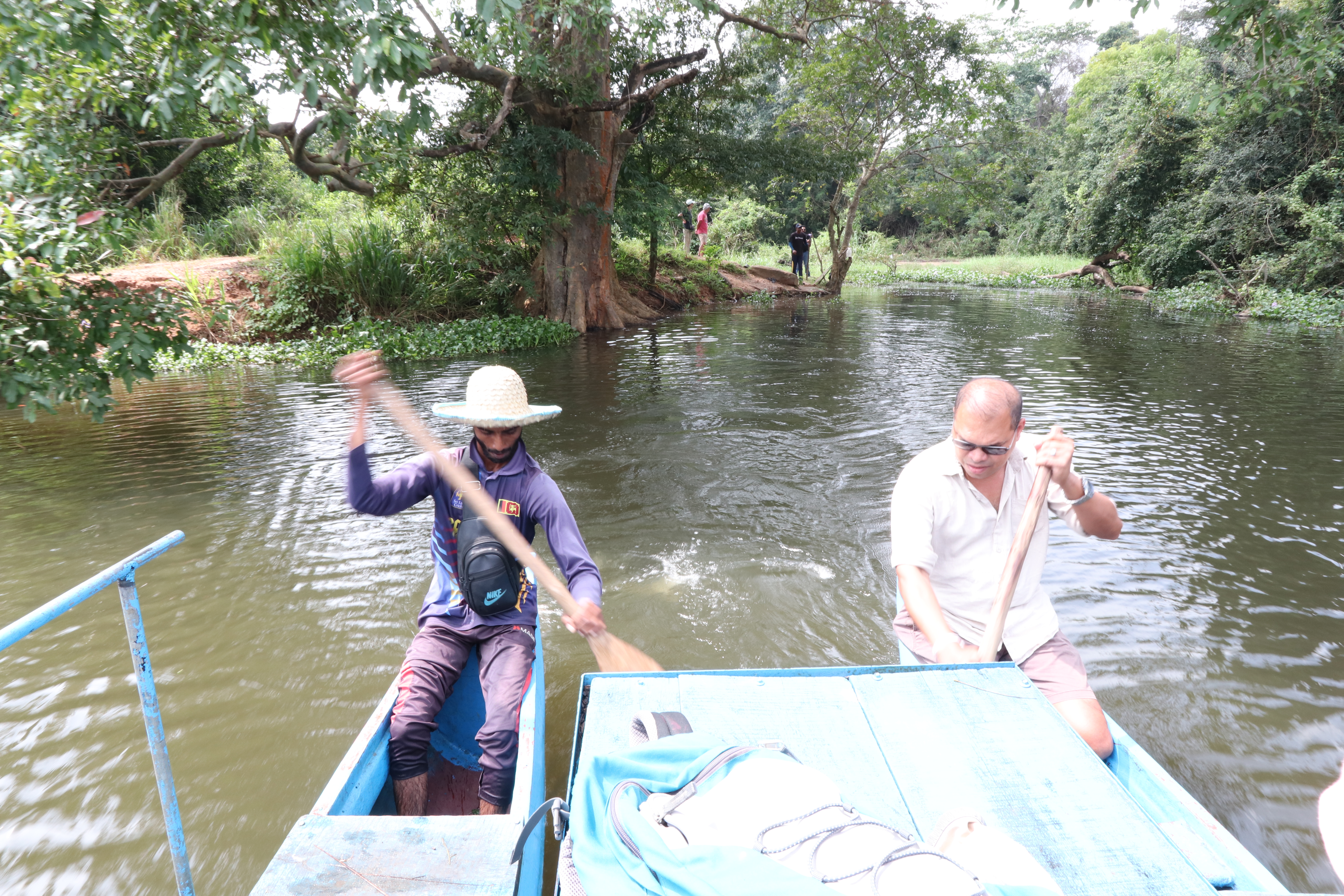
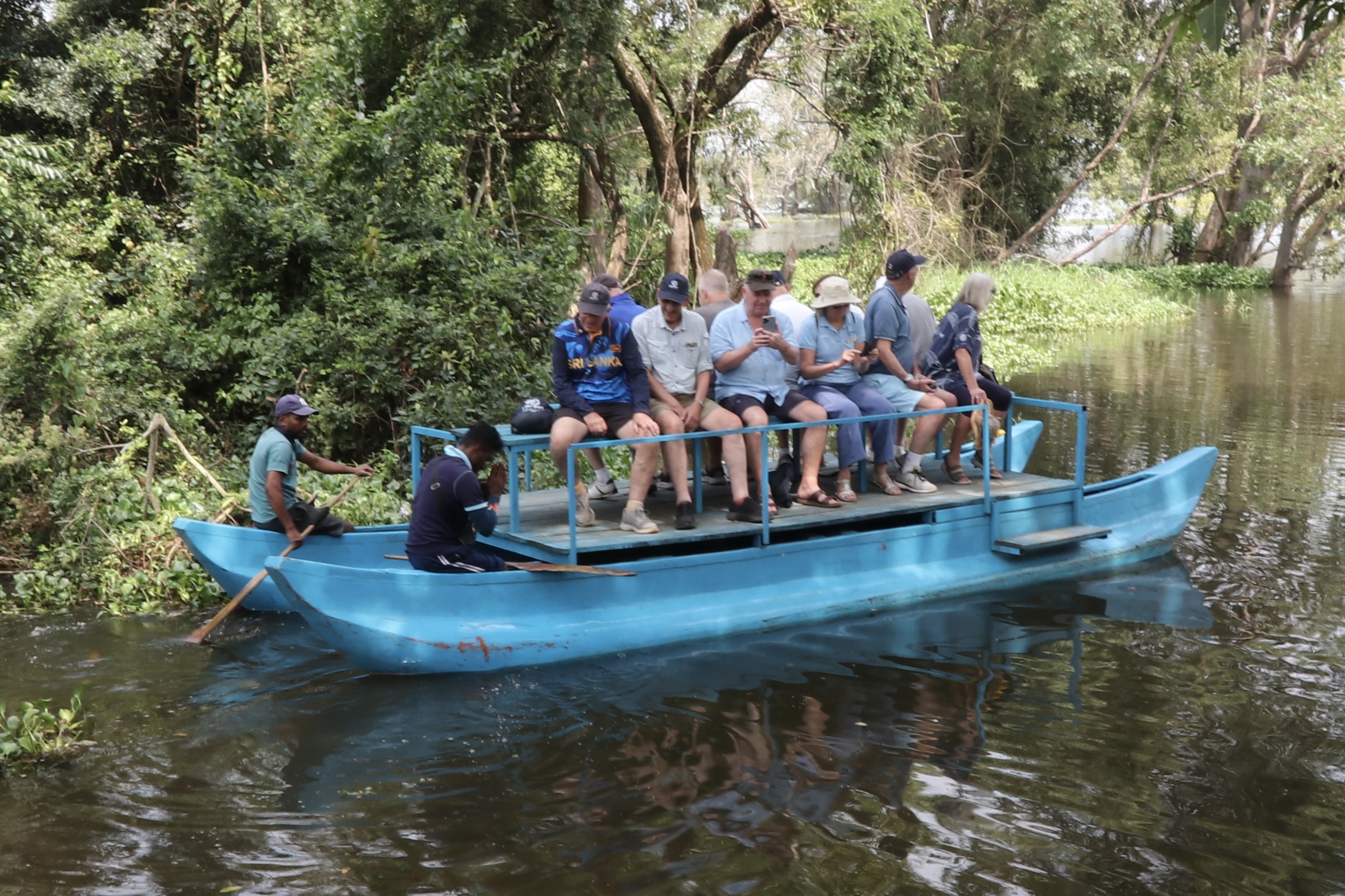
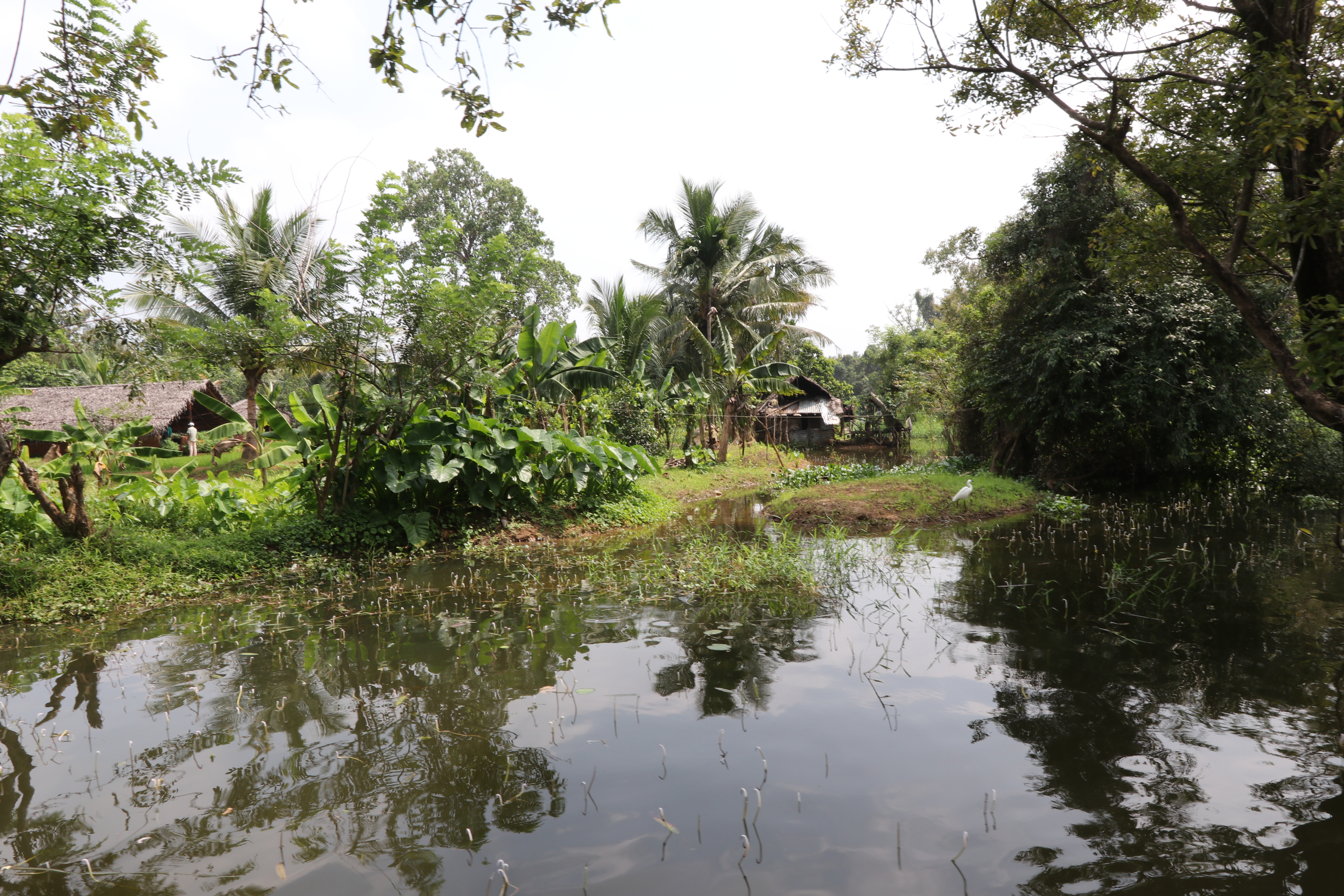
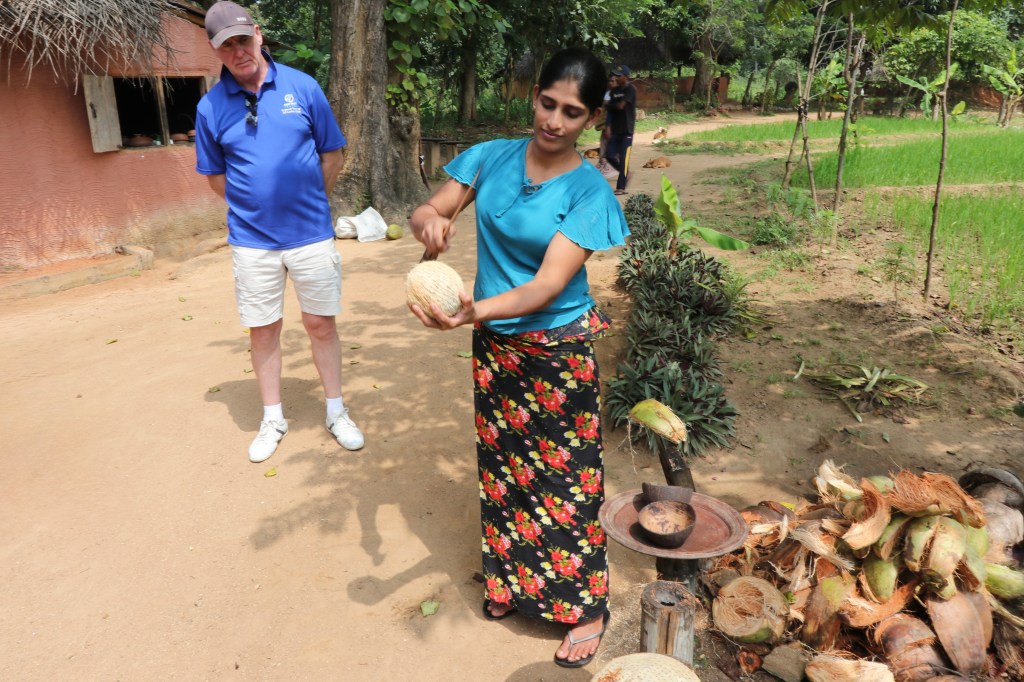
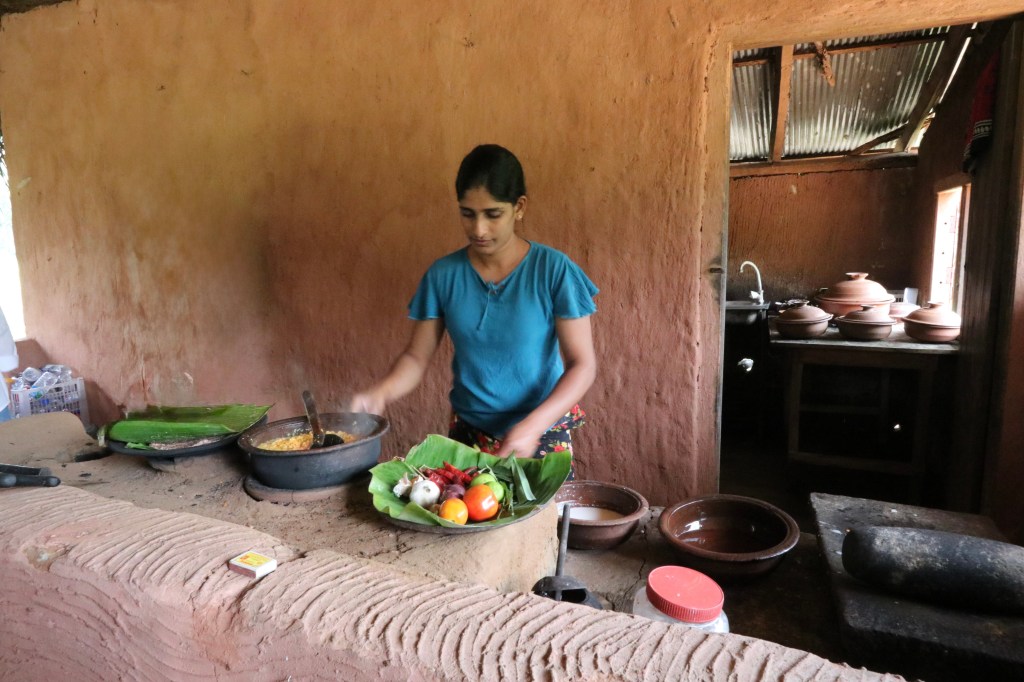
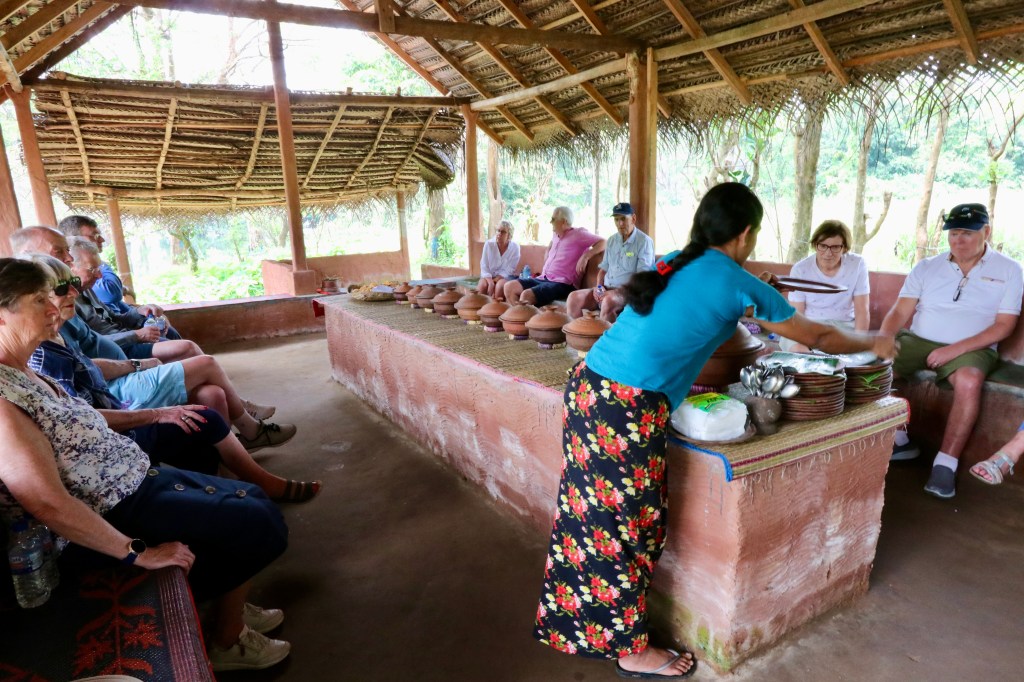
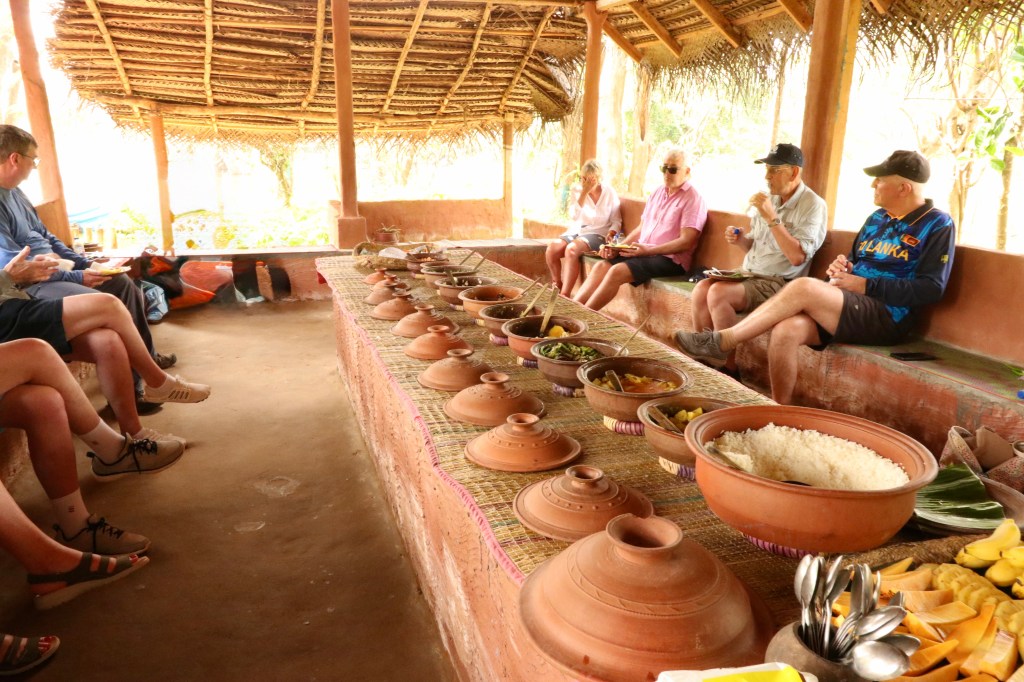
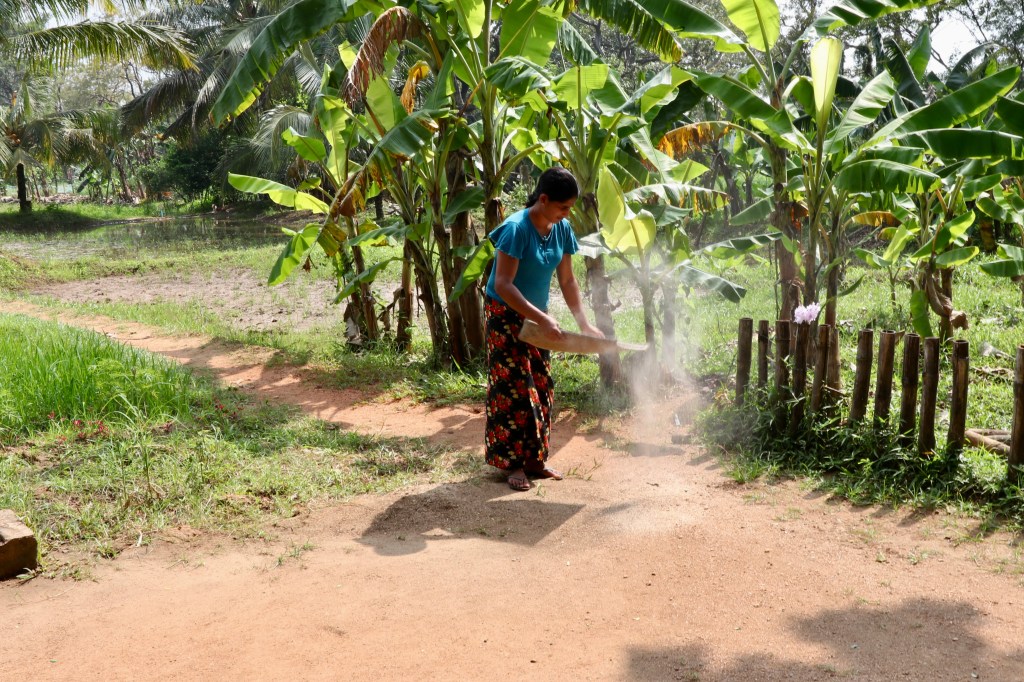
This was advertised as a visit to a working village but Gillian called it a Business Park! We were taken by a tractor pulling a wagon with seats to a ‘canoe’ and taken across the water to the village. We then had a cookery demonstration in a village house. At the end we wandered around the ‘village’ and discovered all of the houses were used for tourist cookery demonstrations. This did not detract from the event which was superb. The woman took us through all the stages of preparing food from coconut rice, dal, vegetable curries and breads. Traditional wood fire and clay pots were used as well as rudimentary but sharp tools. The food itself was wonderful including the dried fish which Gillian loved. As every eating fruit in the country in which it was grown made you aware of how poor the quality is by the time it reaches UK.
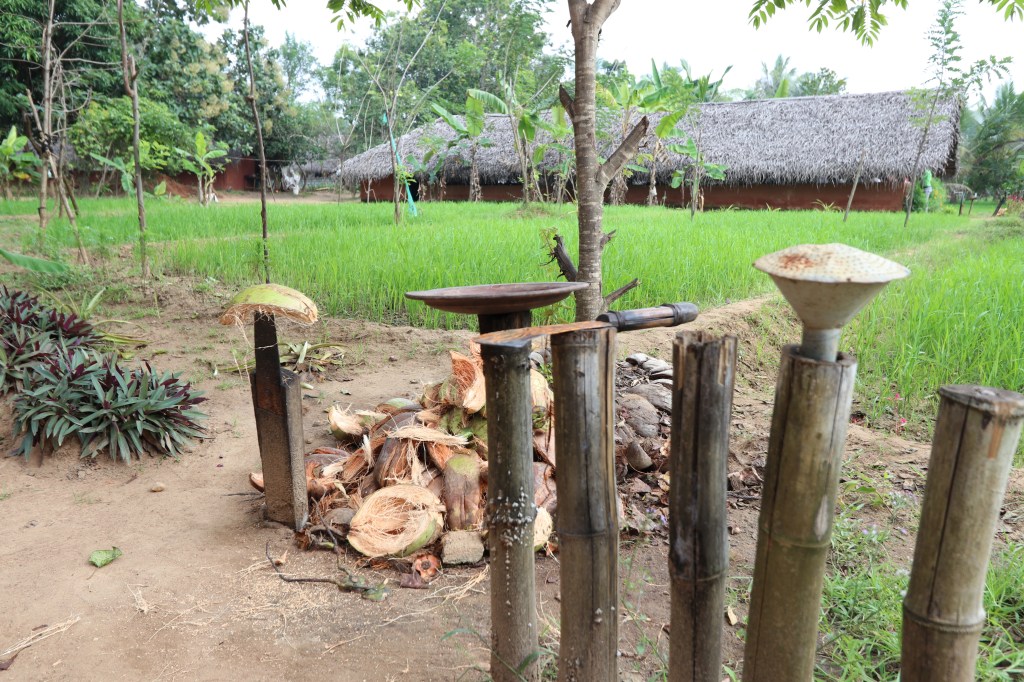
Safari
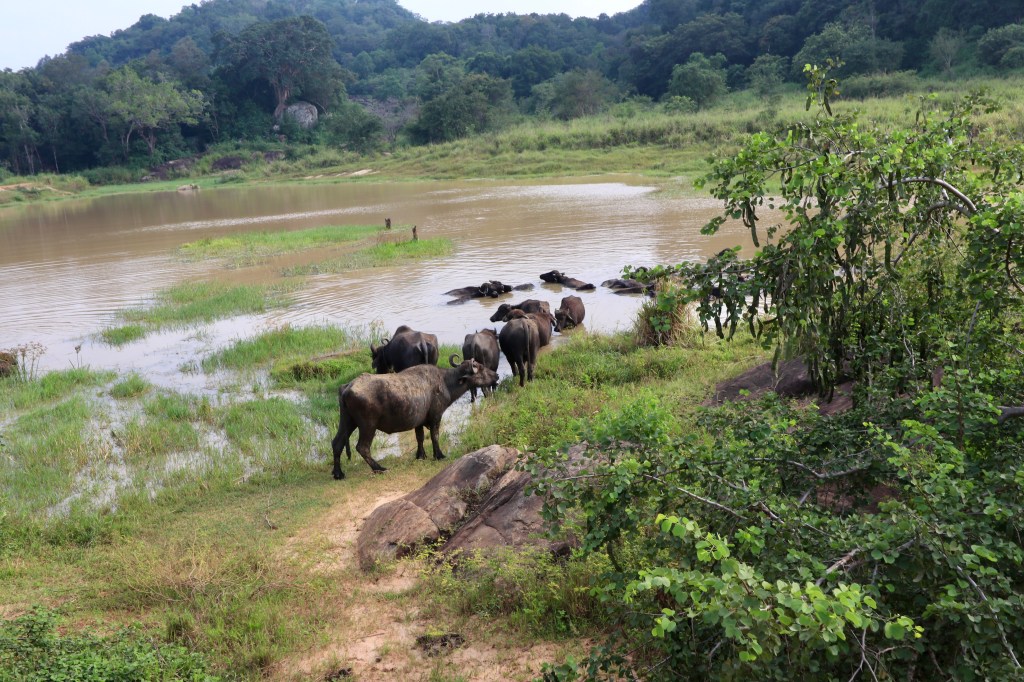
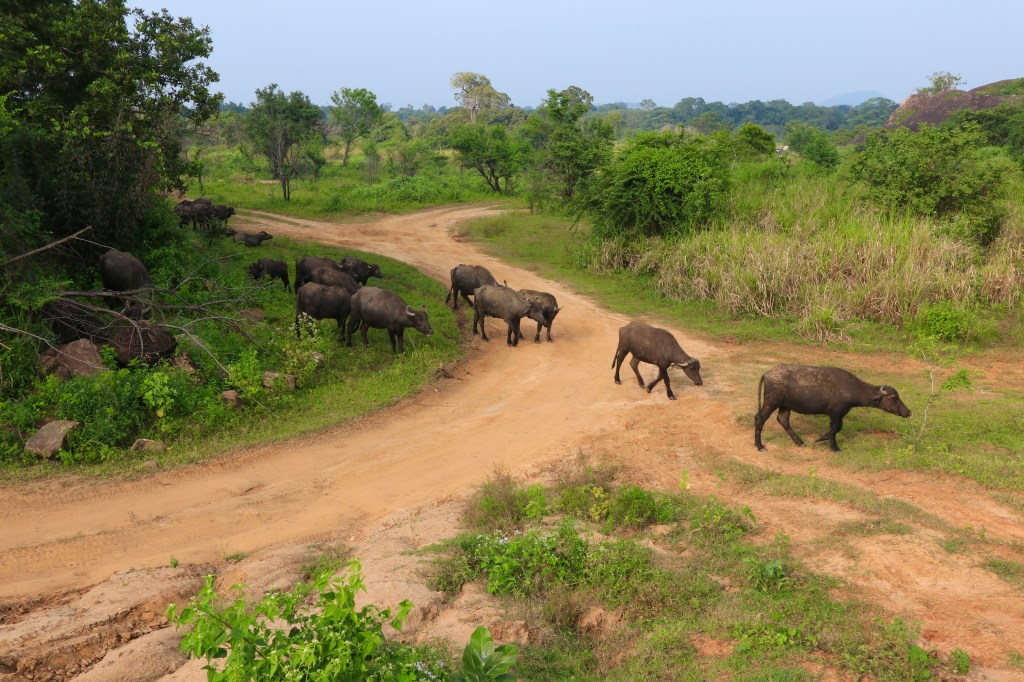
The final part of the day was a safari by land cruiser through a national park. This was supposed to be the highlight of the day but it turned out to be something quite different.
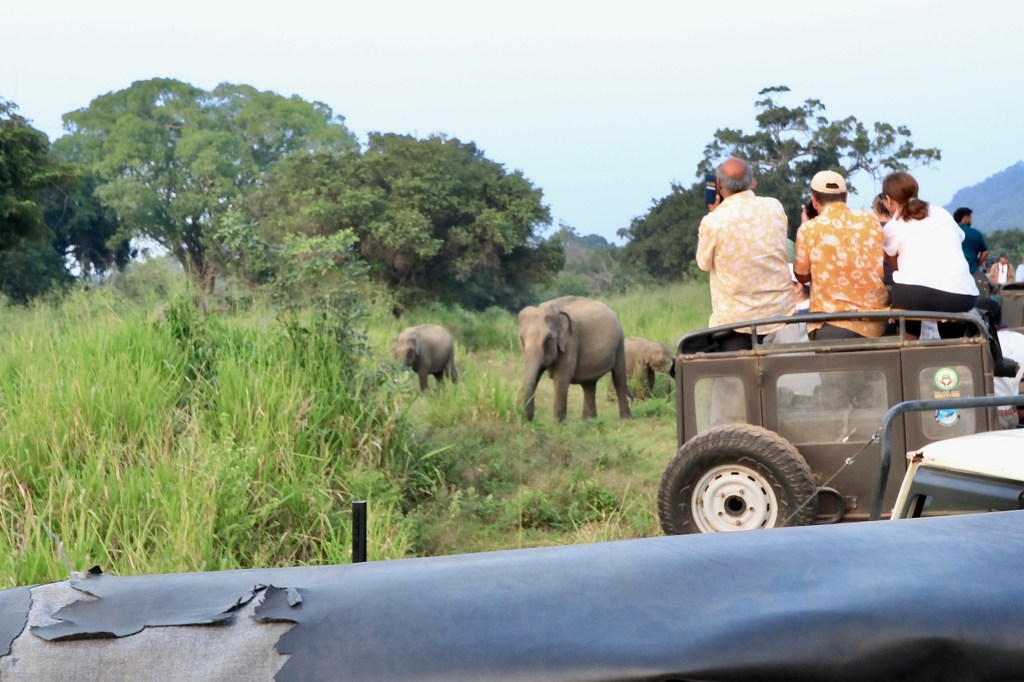
The picture does not convey the reality of around 15 vehicles descending on a sighting of elephants, each jostling for the best position for their clients. There was no etiquette as each vehicle was a private enterprise and wanted to get the best for their clients to get the best tip. This did not show respectful tourism at its best. Ironically the best photos of elephants was from the road!
19th January – Travel to Nuwara Eliya
This was going to be a long day – two stints of around 3.5hrs-4hrs each. But there was excitement in heading up into the Western Highlands and tea plantations that are between 6,000-6,700ft.
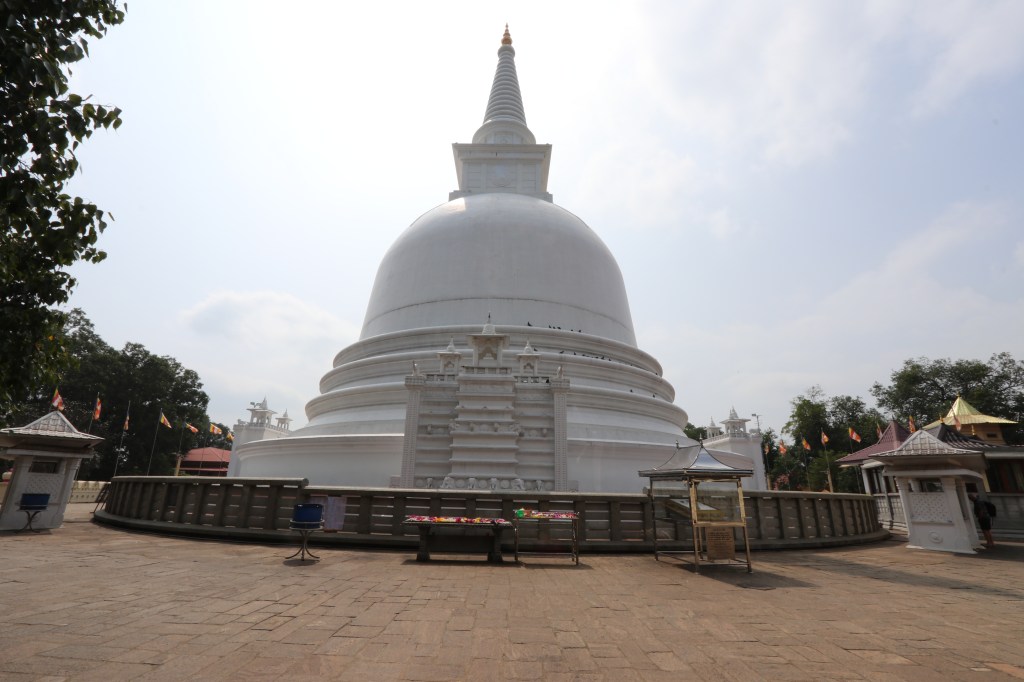
We stopped at 4 hours at Mahiyanganay Ramamaha Viharaya – an important Buddhist temple. Historical sources record that the Buddha visited the Mahiyangana area in the ninth month after he attained enlightenment, which was his first visit to the country. It has also gained importance in Buddhism as the Buddha gave a small number of his hairs which are enshrined in a small stupa, this was enlarged when the Buddha’s shoulder bone was included with the hair.
Lining one of the courtyards were indigenous people selling honey and bead necklaces. It was clear that they were very poor even by Sri Lanka standards. Gillian bought a small bead necklace – partly as a reason to give them money – but it turned out to be very pretty.
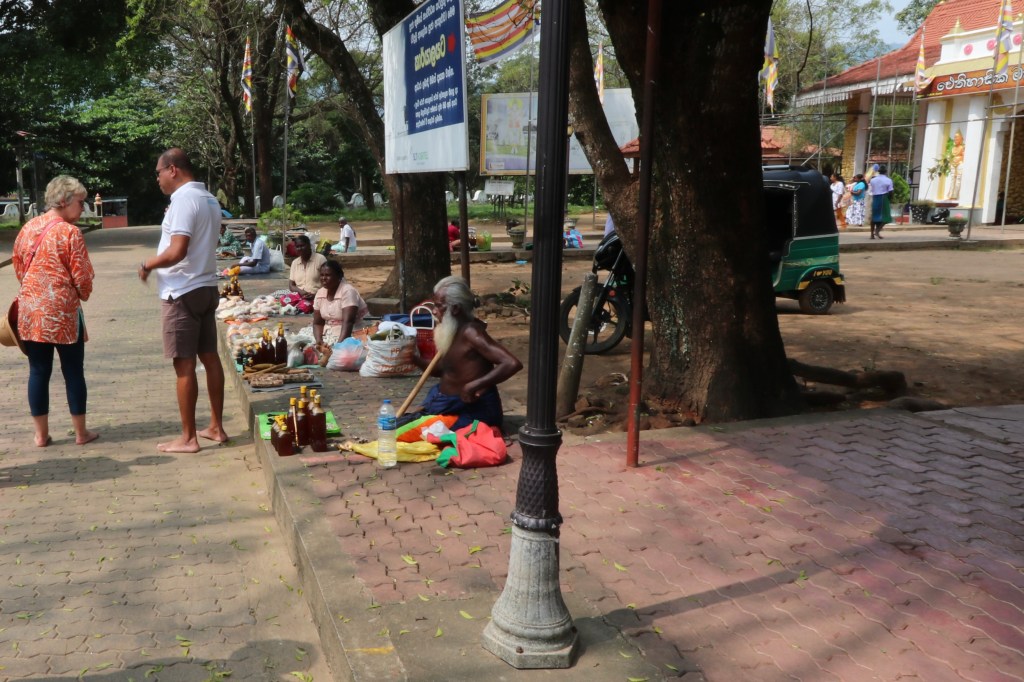
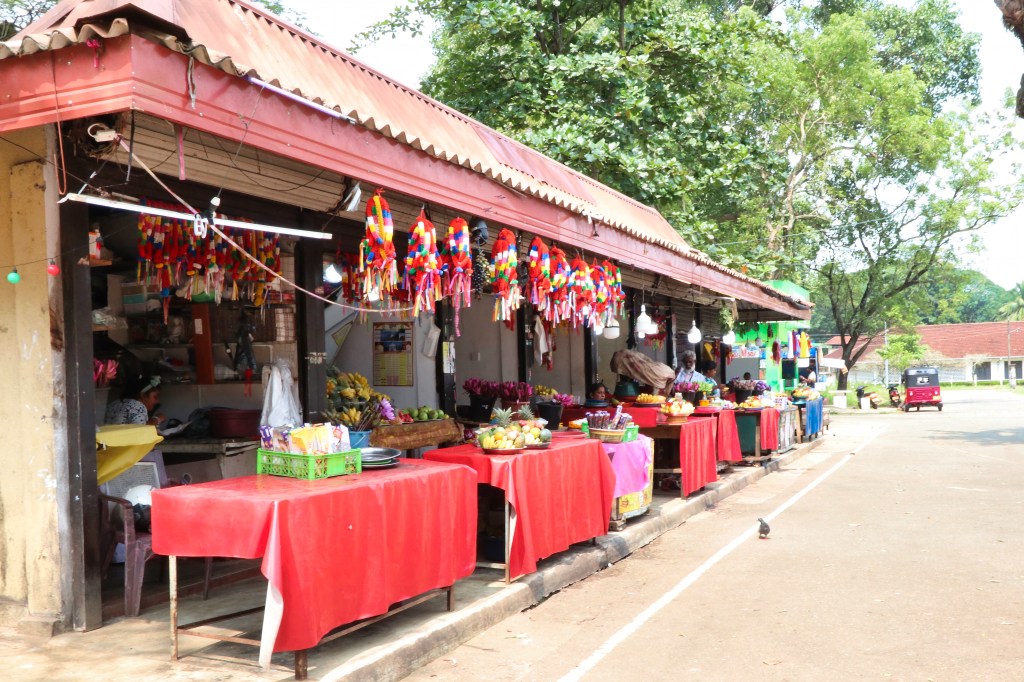
We had arrived as the worshippers were lining up to make offerings. Outside the temple were multiple stalls selling ‘ready packaged’ offerings to be made.
A short but interesting stop.
We then continued our journey and were now travelling more and more uphill on twisting mountain roads. On one side steep valleys and on the other jungle and woods of pine planted by the British. evidence of the cyclone that came though the region in December were evident. The landslips probably aggravated by the amount of deforestisation that had taken place. At last we arrived in what was called Little England – Nuwara Eliya. Sitting at 6,000ft the air was notably different and as the evening drew in, very noticeably cooler to such an extent that a jumper was required.
The town is full of restaurants, cafes and hotels plus surrounded by tea plantations which is also a major employer even if a poor payer!
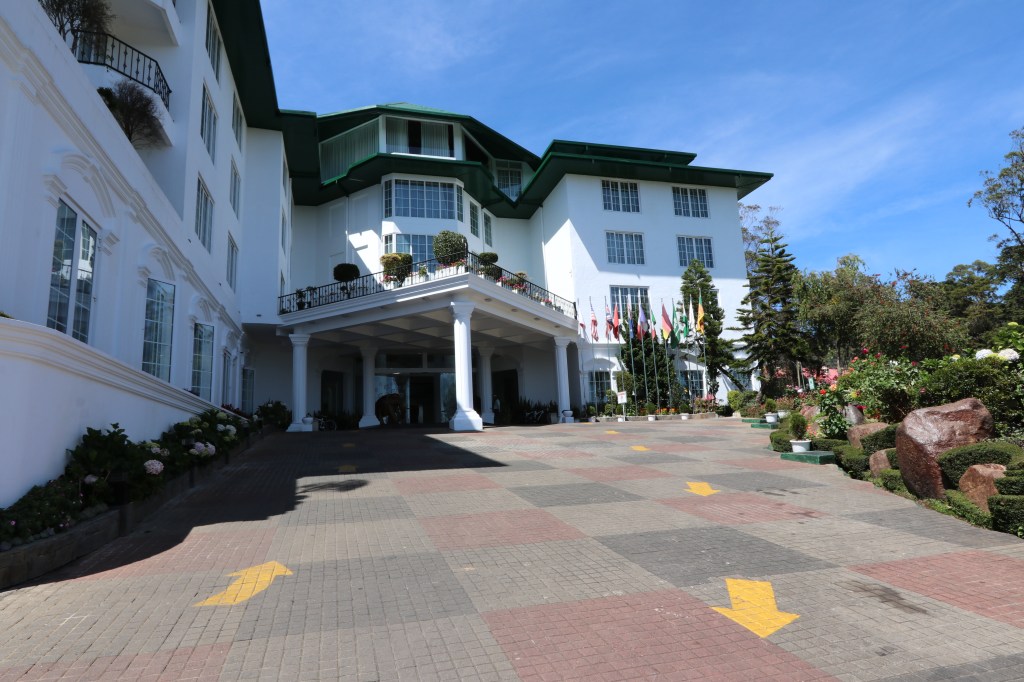
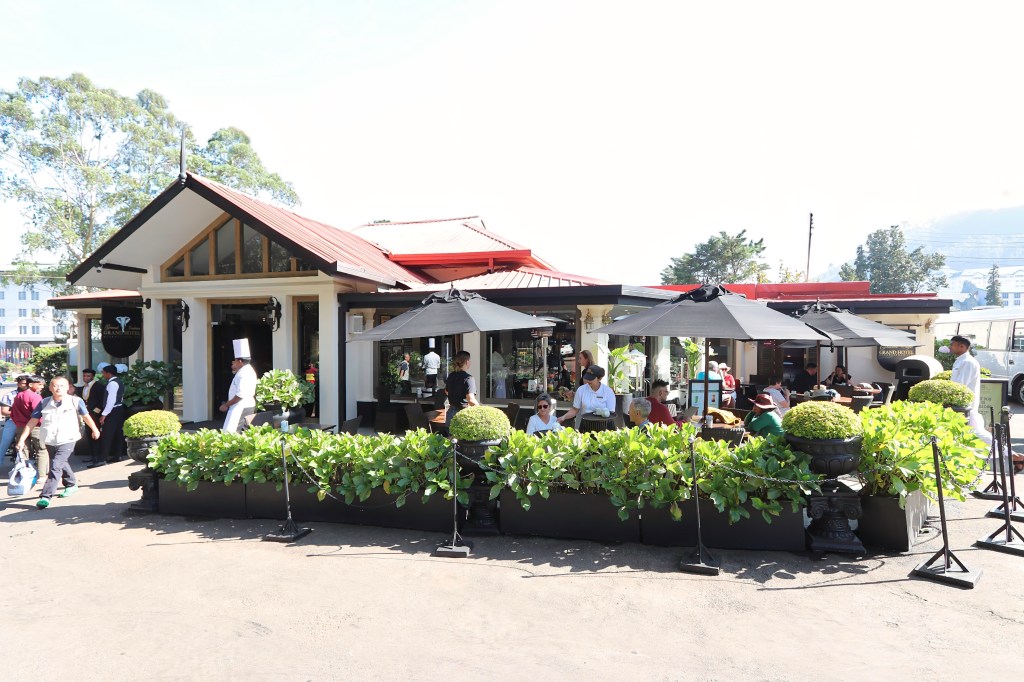
Late afternoon we walked to the Grant Hotel – the place to stay. It has the look and feel of a very colonial style place with all the waiters in uniform of different cuts to indicate their seniority. We had a couple of Sri Lankan G&T in one of the many bars/rooms. They were quite strong and for Sri Lanka expensive – £10 per double.
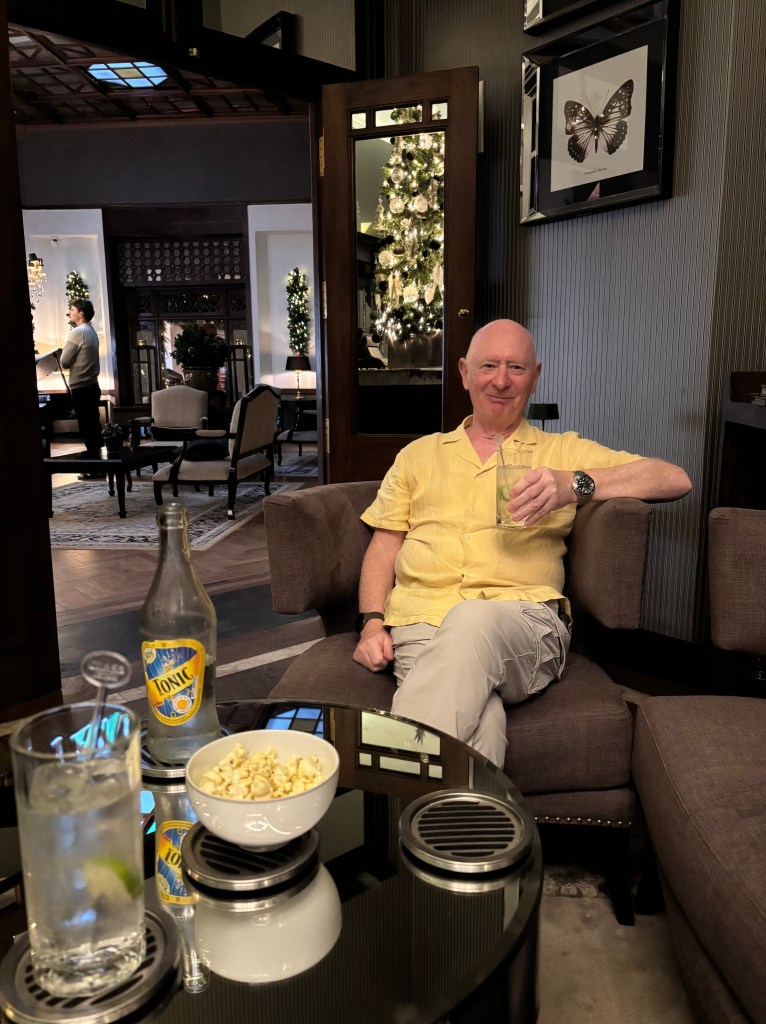
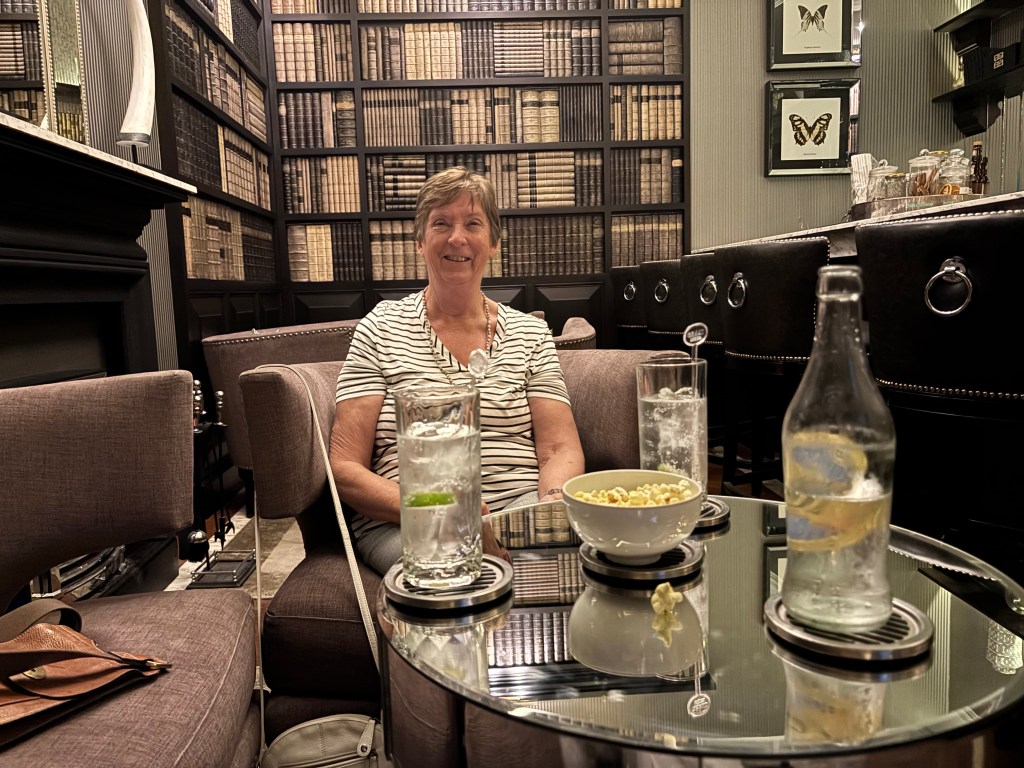
In the evening we went to the Grand Indian at the Grand Hotel – although not far away we took a tuk tuk there and back – the back is a later story. The service and meal was fantastic. We both had mutton, rice and roti bread. On the way back we asked the young driver if he was available to take us on a tour the following afternoon. He was eager to do so – so much so that between him picking us up at 1400 and dropping us off at 2300 that evening we had 15 WhatsApp messages from him!
20th January – Visit Tea Plantation and Eagle’s View Point
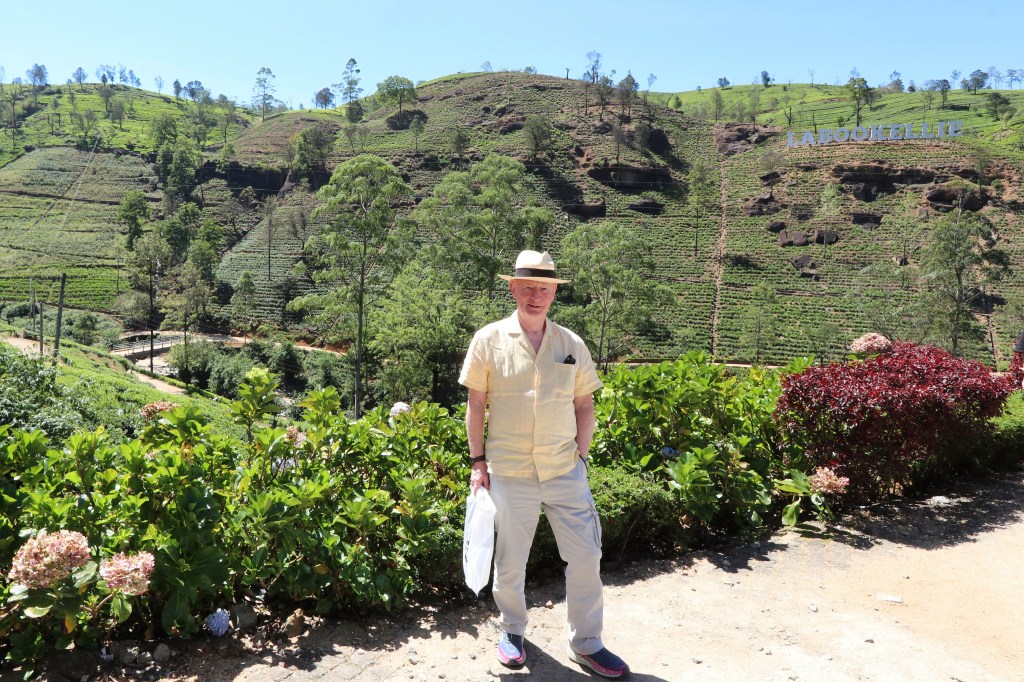
Tea Plantation Labookellie
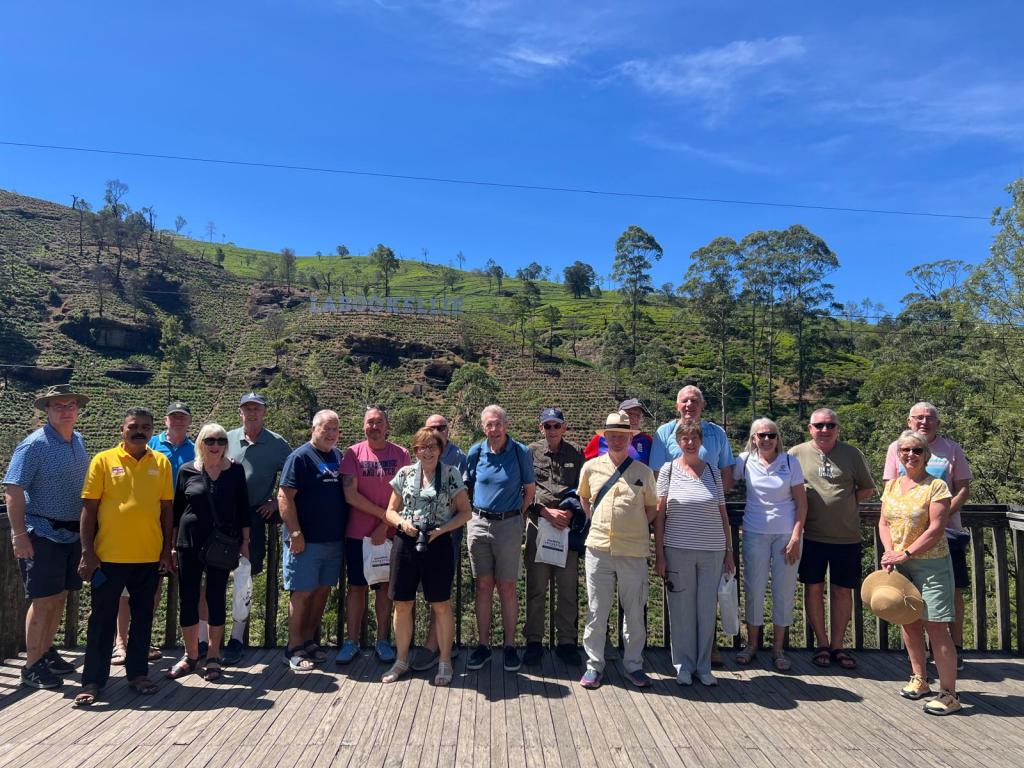
This is one of the highest and oldest tea plantations – 1870. It was started by Captain William Mackwood and was kept in the family till 1956. The tea plantations went through a number of changes of ownership as a result of independence. They were initially privatised and then leased back into private hands. Most are now owned by conglomerates, who themselves have been swallowed up by even larger conglomerates. This plantation is owned by Damro the largest furniture and washing machine manufacturer in Sri Lanka. it bought into plantation management in 2017 when it acquired the then owner of Labookellie. The state currently employs around 500 people including pickers. The pickers are mainly Tamils from S India who were brought in by the British as they were easier to manage and control than the local workers. Of course they are paid a pittance. They are provided with health care, housing and education but the whole area as you drive through the towns feels very poor.
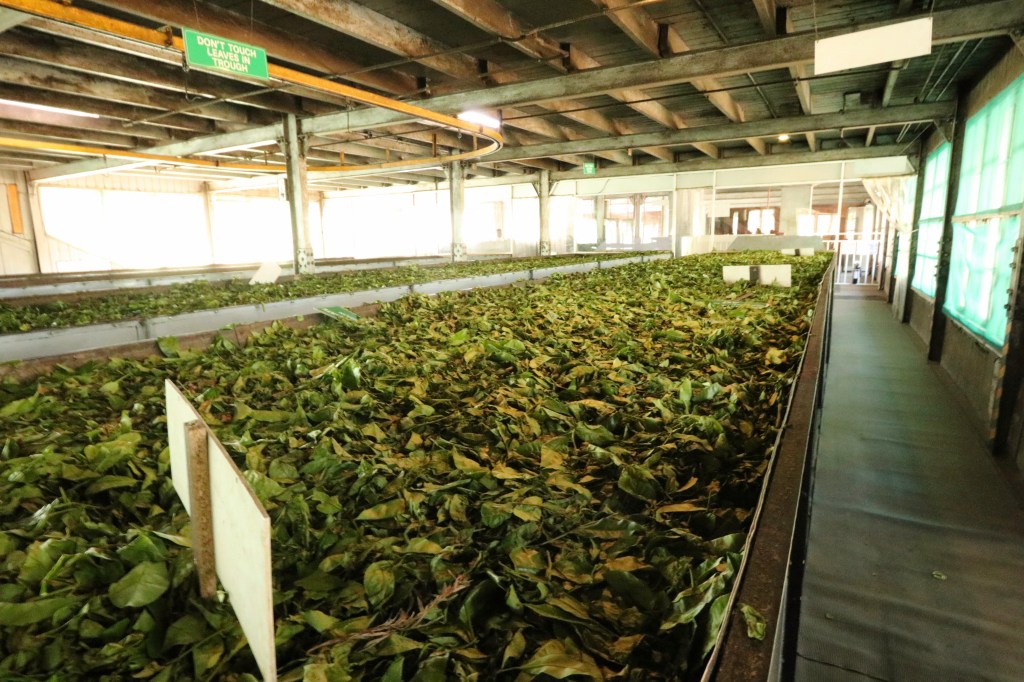
We had a tour of the factory to watch the various processes; drying, crushing, sorting and grading, then a further drying process before packing. All the teas are then auctioned off in Colombo where the likes of Lipton tea and others buy various grades to mix.
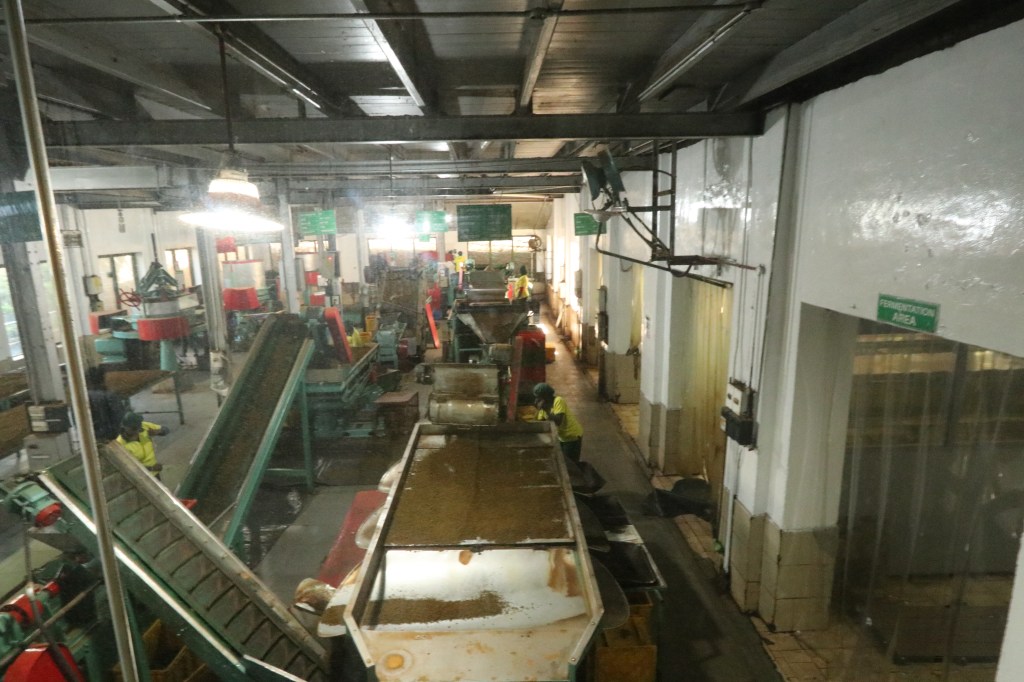
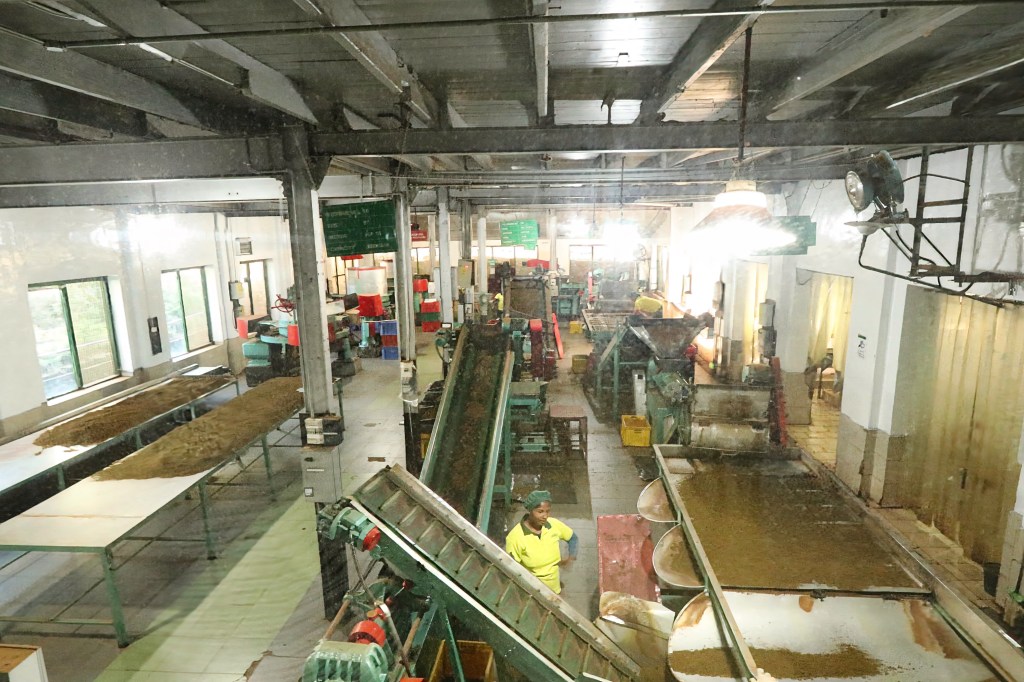
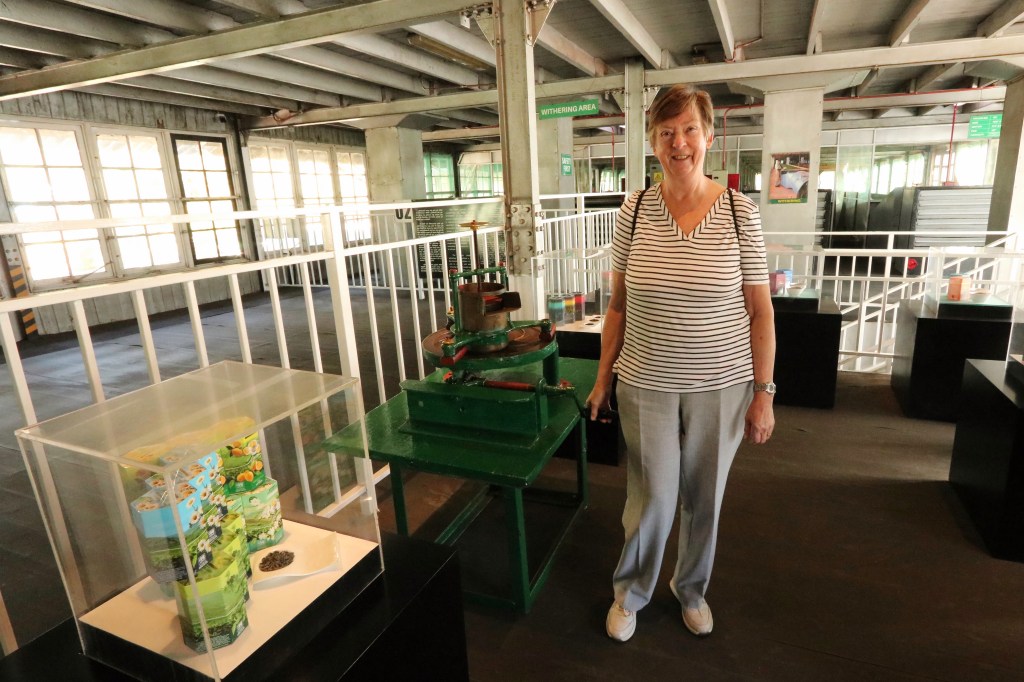
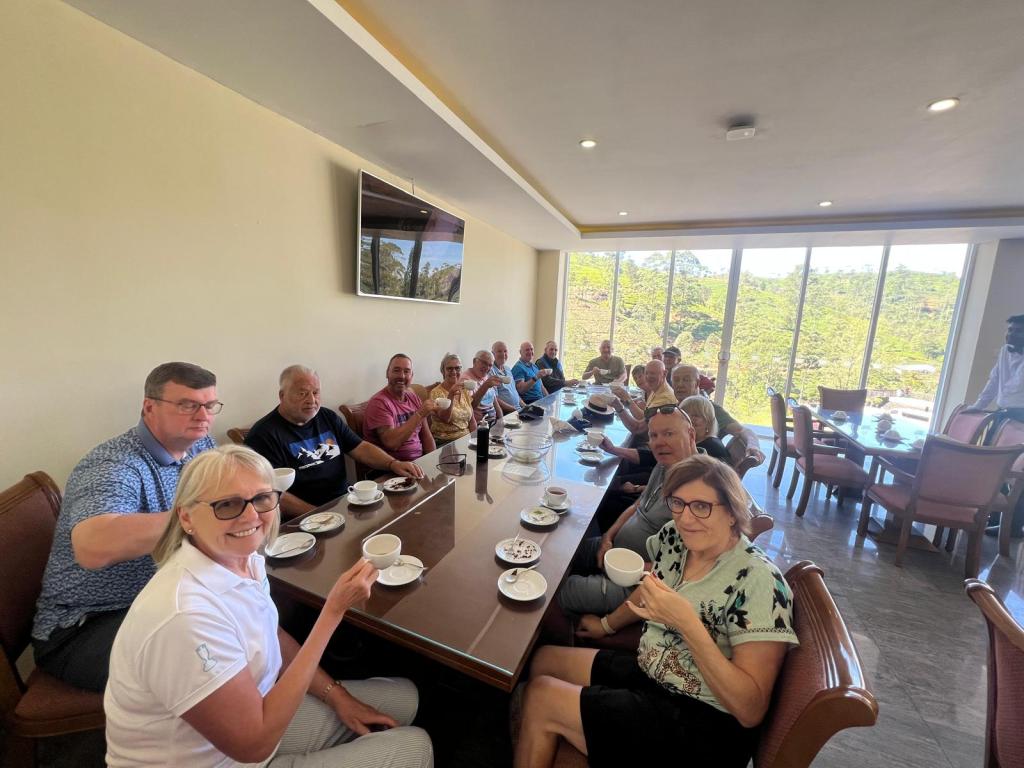
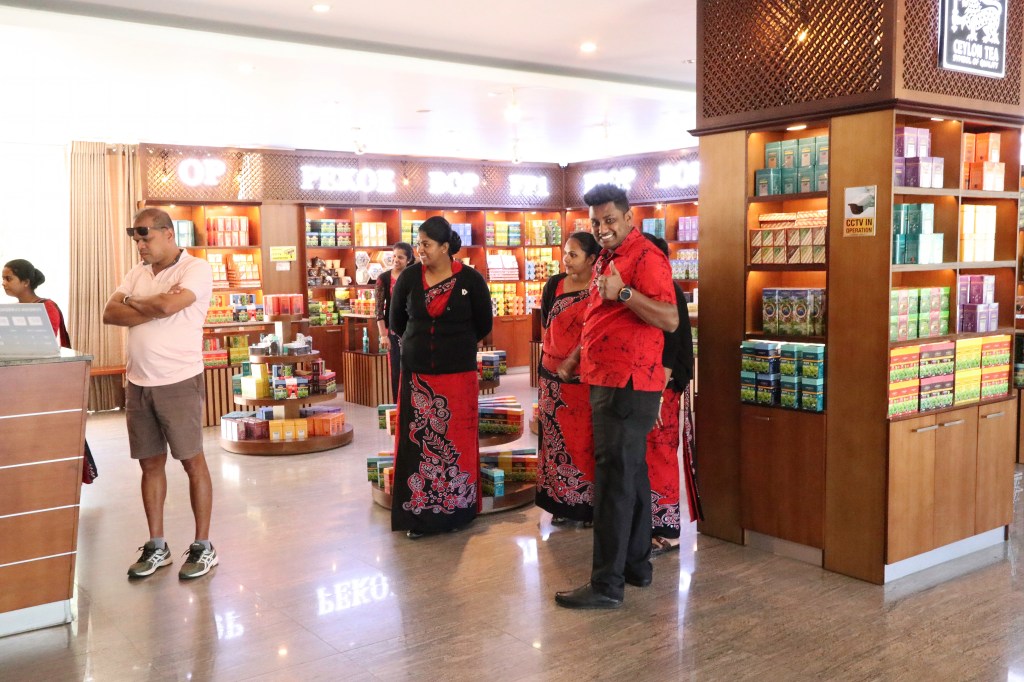
Following the tea tour there was the tasting of various teas; white/silver tip, green and black. With the latter coming in various strengths. Inevitably we bought tea to bring back with us. Probably 3 years supply! The unique selling point in the shop was that this tea was a single estate tea and not mixed with any other.
Tuk Tuk Tour
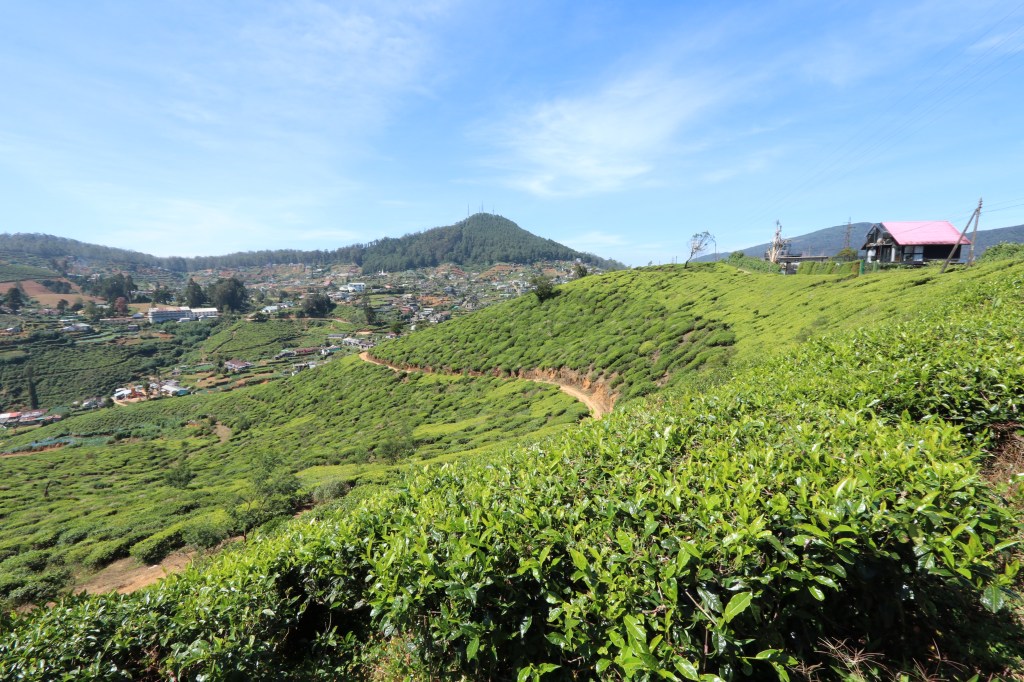
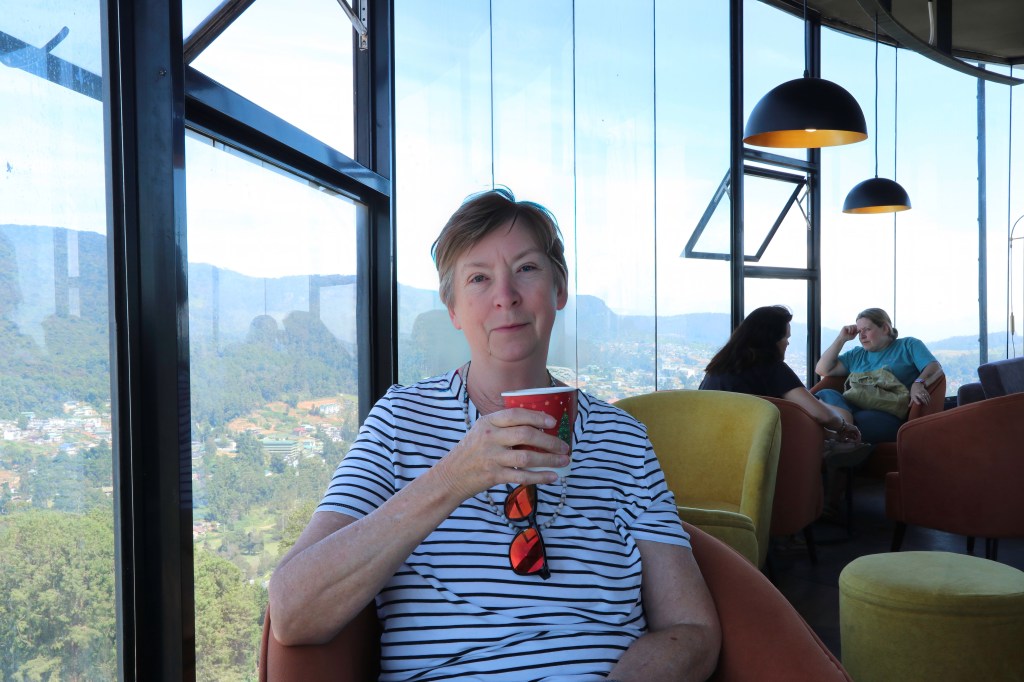
We were picked up at 1300 and spent two hours with our young tuk tuk driver who seemed very keen to show off to the other tuk tuk drivers that he had paying customers who were foreign. We first headed up to the Eagle’s View Point at 6,700ft. A bit of a hairy drive up …… and down! But the views from the top were worth the trip. We climbed up to a viewing platform which had an excellent coffee shop as well as a vista across the valley and the many tea plantations.
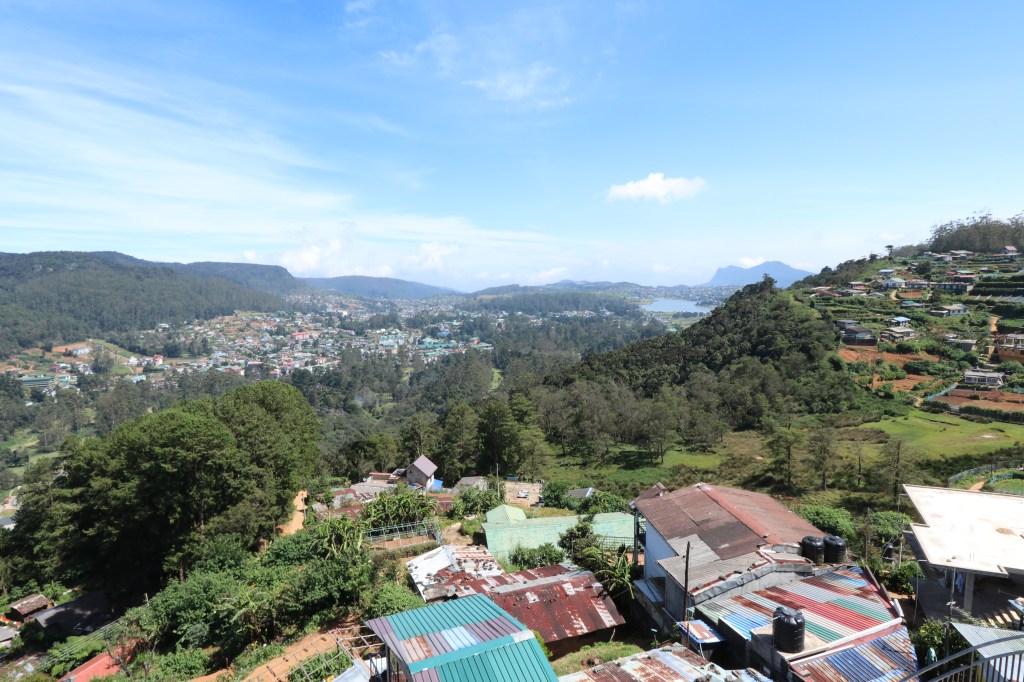
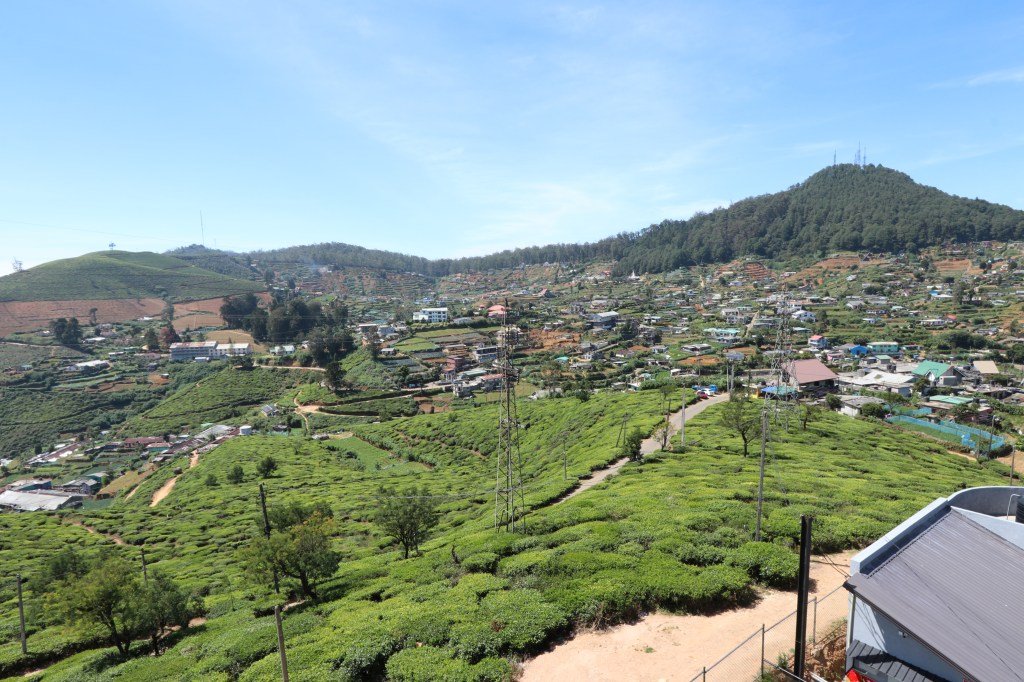
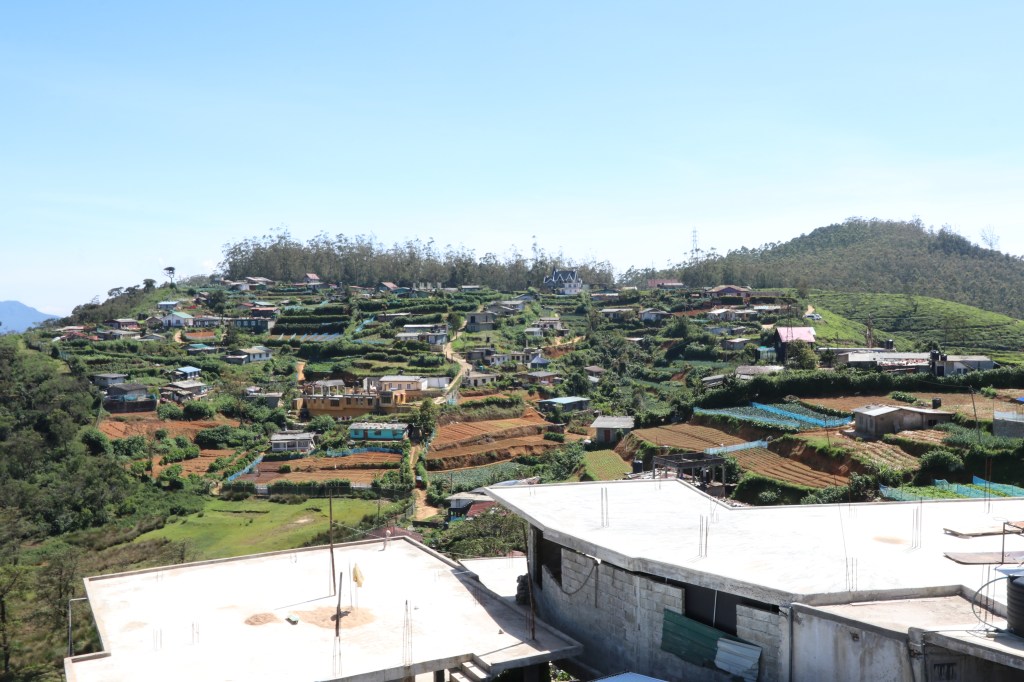
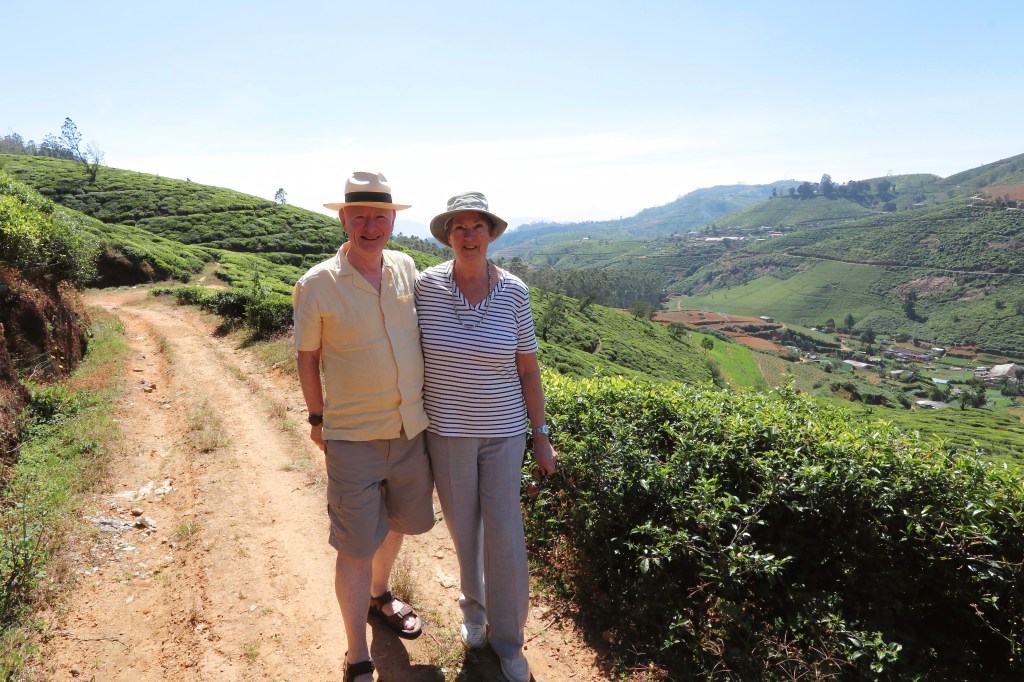
The area is renowned for growing vegetables and fruit, including strawberries, potatoes and cabbages. The tuk-tuk’s family came from a village nearby and we strolled between lines of tea bushes before returning to the valley.
We then visited the lake where the super rich of Sri Lanka land in their sea plane to occupy their weekend or summer house! Quite a noisy place with lots of vendors trying to sell us trips on various types of boats. As we neared one end of the lake there was an urgent need to find a toilet – which we did – very Indian/Sri Lankan style. Fortunately Gillian carries plenty of packets of tissues wherever she goes!
Finally we had tea and a sandwich at the Grand Cafe before returning to the hotel.
That evening we returned to the Grand Indian which was not quite as grand as the night before. They were very busy and whilst the food was good the service was not quite as good as the previous evening. We were asked if we would share a table with a couple – June and Simon. They were both from London. Simon surprisingly had taken up boxing aged 60 to keep himself fit and was going to have his first fight until his opponent pulled out at the last minute. he now teaches and mentors young boxers from his local club.
A tuk-tuk back and to bed for an early start the next day.
21st January – Nuwara Eliya to Colombo
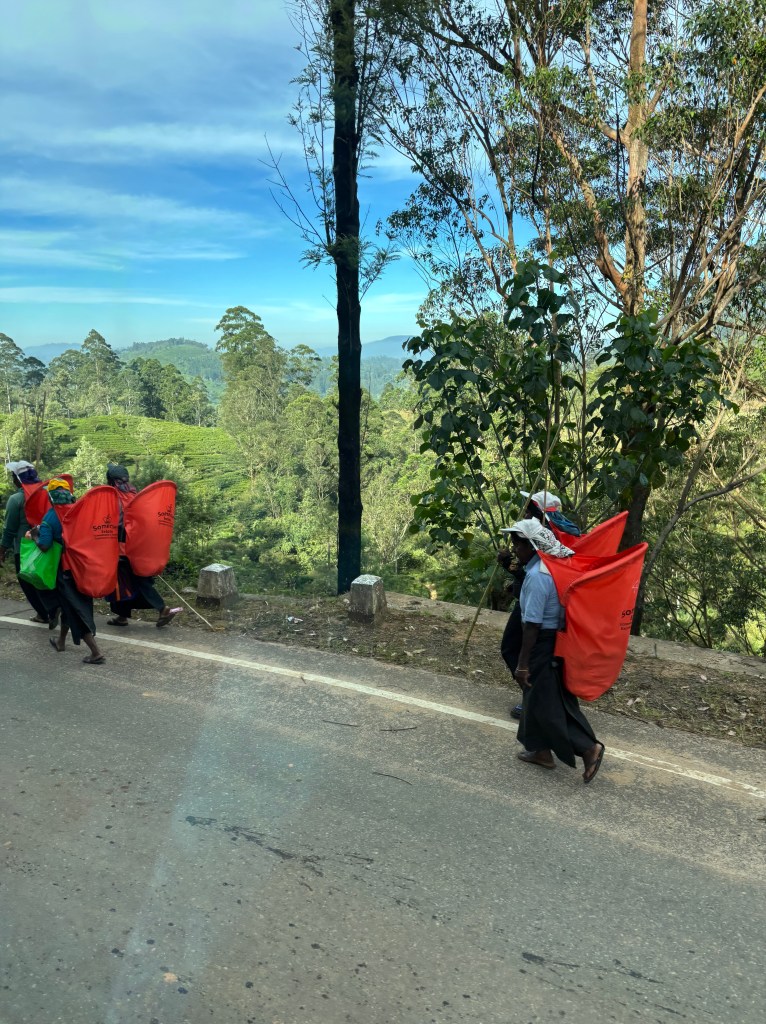
We were warned that the trip ‘down the hill’ to Colombo would be long – around 7 hours. The distances in Sri Lanka are not long but the roads are twisty and narrow. The guide – at last – was being honest with the journey times. The first half consisted of us working our way down through multiple tea plantations. Again the extent of the deforestastion was obvious. It is a difficult balance, people need to earn money and tea plantations provided employment – but if this is at the risk of the sustainability of the landscape this does question whether the right balance has been struck. As we had set off early in the morning we passed tea pickers on their way back from work. I think all were female and were Tamil in origin.
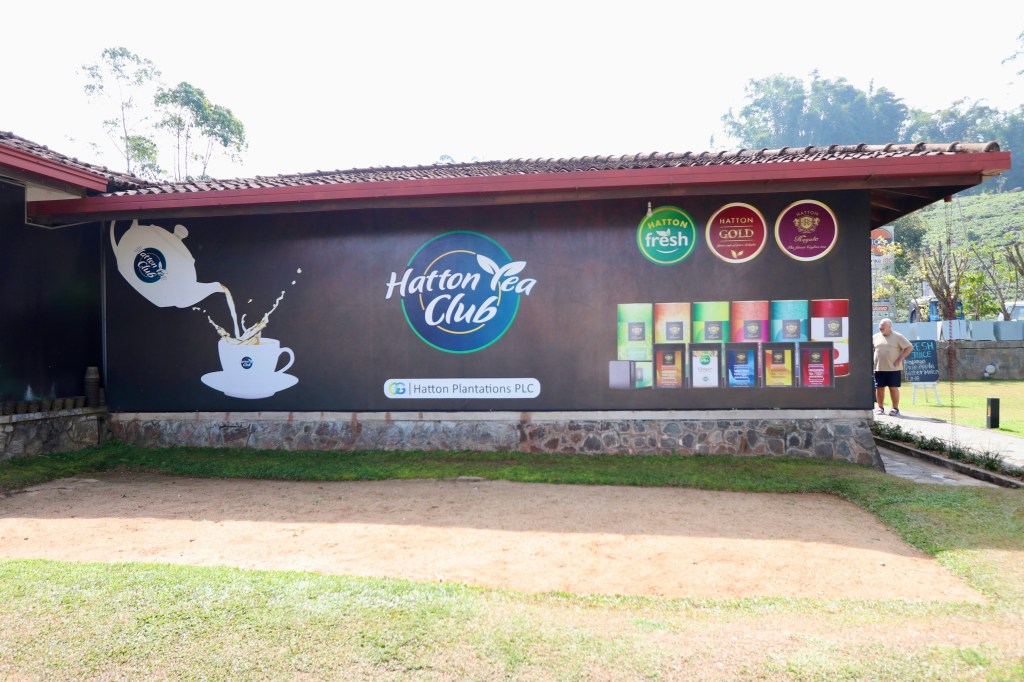
We had a stop at a couple of waterfalls as well as a teashop at another tea plantation. I increased my years supply of tea from 3 years to 4 years!
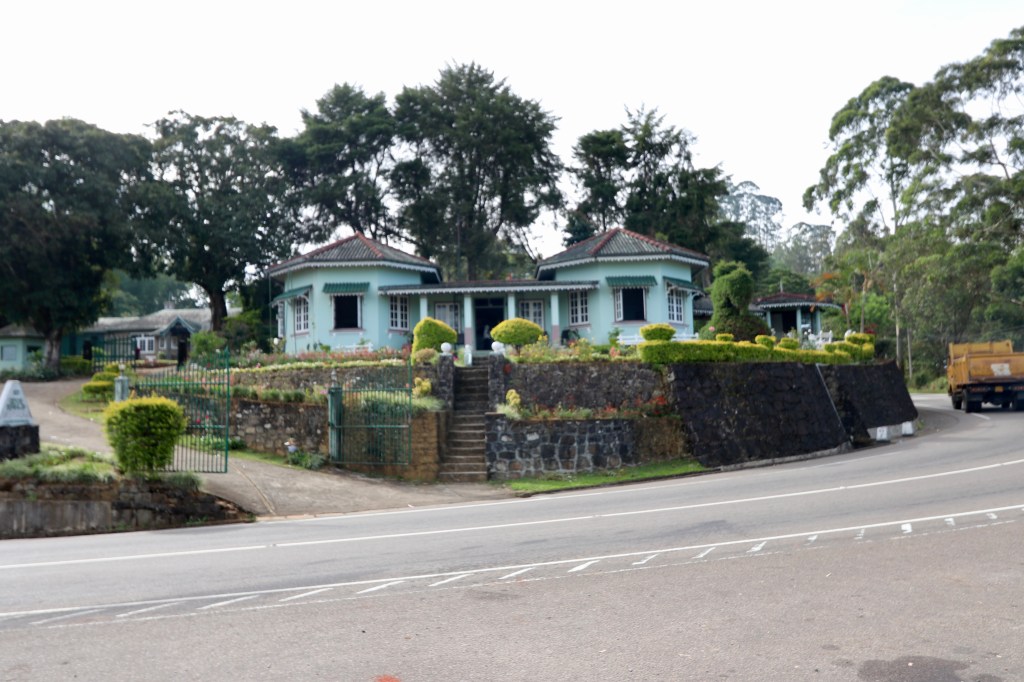
There was also an old colonial house that had been turned into a museum but had excellent loo facilities – every important on long coach journeys.
That evening we arrived in Colombo at the Sophia Colombo City Hotel. It was not in a great location but the hotel itself was pleasant and did an excellent evening buffet.
22nd January – 1st ODI – Colombo
The match took place at the R Premadassa International Cricket Stadium.
Score Sri Lanka 271/6. England 252 all out.
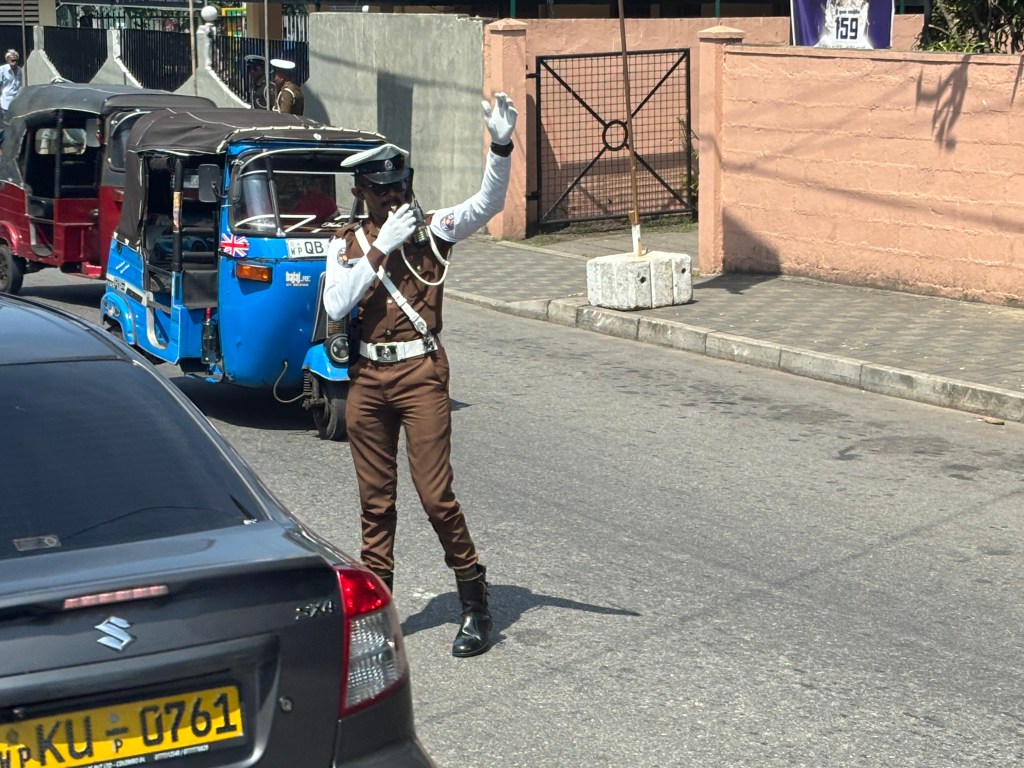
We arrived early and into first day chaos. Although 10/10 for the Sri Lanka traffic police who controlled everyone with great confidence and skill! Don’t cross the policeman with. whistle!
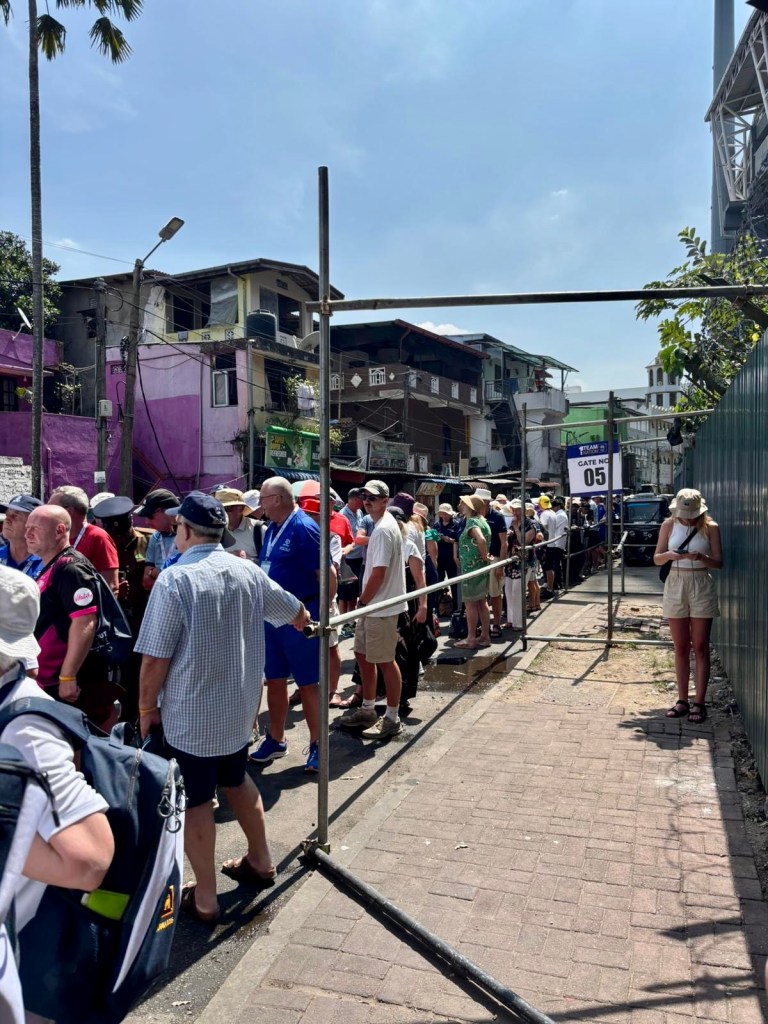
The game started at 1430 local time to accommodate TV – all matches being day/night. After queuing for some time we eventually got into the stadium where great seats had been reserved for the group in the stand that was more or less behind one of the wickets. With the match ticket you got 3 vouchers each for free drinks. It was clear that Sri Lankans like hot dogs – virtually every food stall served them. We went for the deep fried chicken burger. Surprisingly this was lovely. It was not reconstituted chicken – but actual chicken and was a great fillip at change over of innings – around 6pm. Crowd was mainly UK but a reasonable number of locals. It was a working Thursday and hence the low local turn out.
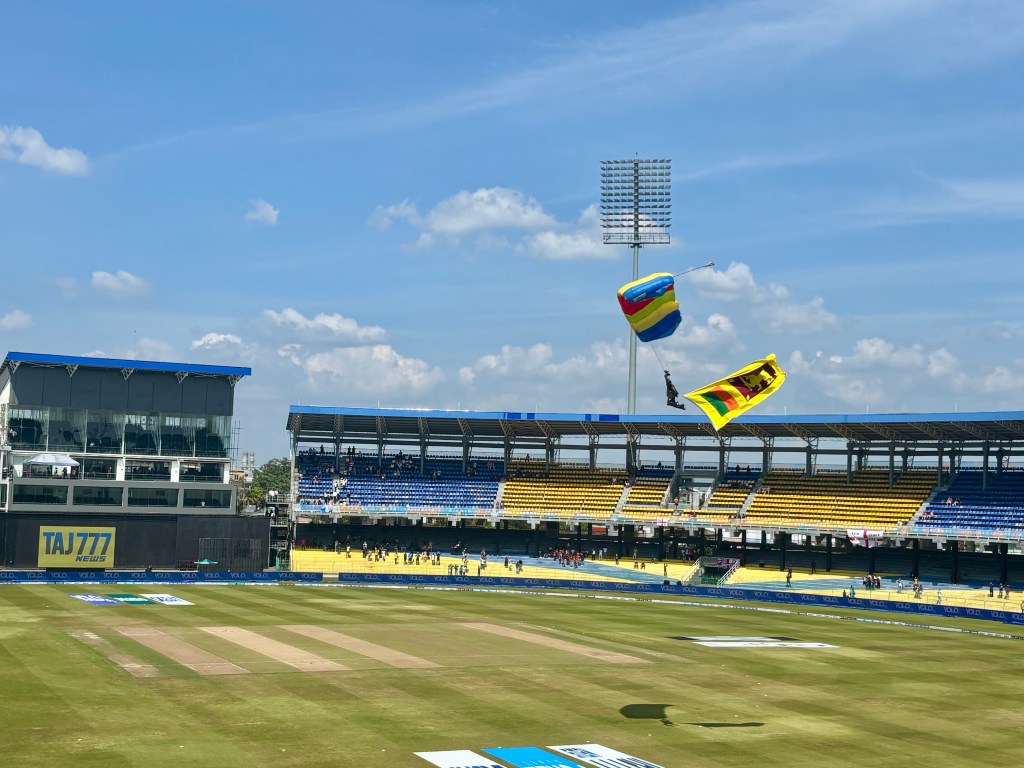
The match started with the Sri Lanka Army Freefall Team parachuting in with the series cup. One did not make it and landed – discretely – on one of the stands roofs. I had not realised that the SL national anthem was so long – we got the one verse of God Save the King – followed by a very extended SL national anthem!
From a cricketing perspective the pitch was a spinners pitch and there was an advantage to whoever won the toss – England lost. We bowled reasonably well but fielding was sluggish and we gave away 3-4 boundaries more than we should. Jamie Overton bowled the last over and went for 23 runs. When it came to our innings we lost an early wicket – Zac Crawley – but were in a good position at 129 for /1 in the 27th over. It then turned into a route and by the 40th over we were 168/6. This left a high run rate to catch up to SL total of 271. The highlight was Jamie Overton trying to make good his poor final over in the SL innings with 34 off 17 balls. But the gap in the final voer was too great. Although the winning margin of 19 runs seems large – it was close and if it had not been form the boundaries we gave away plus Jamie’s last over – it could have gone our way.
At the end of the game we made our way back to the busses – again it was a little chaotic and not everyone was quite sure where to go. But we eventually got to the right place and bus before making a very slow journey back to the hotel. We were pretty done in and went to bed.
23rd January – Mystical Tour of Colombo
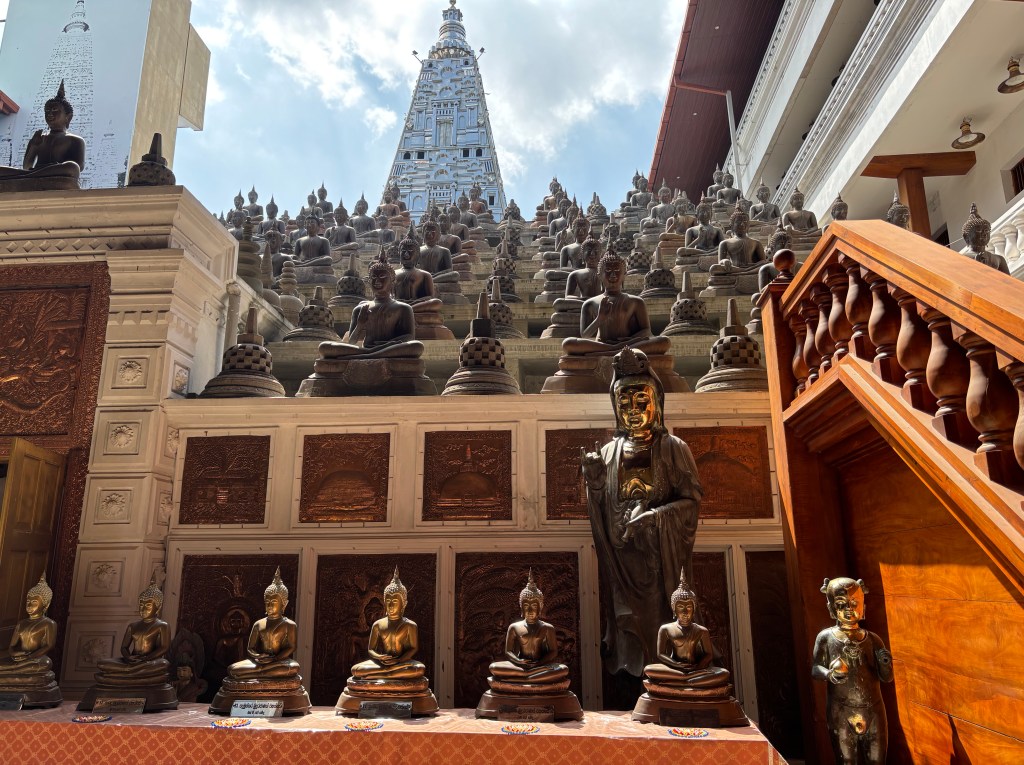
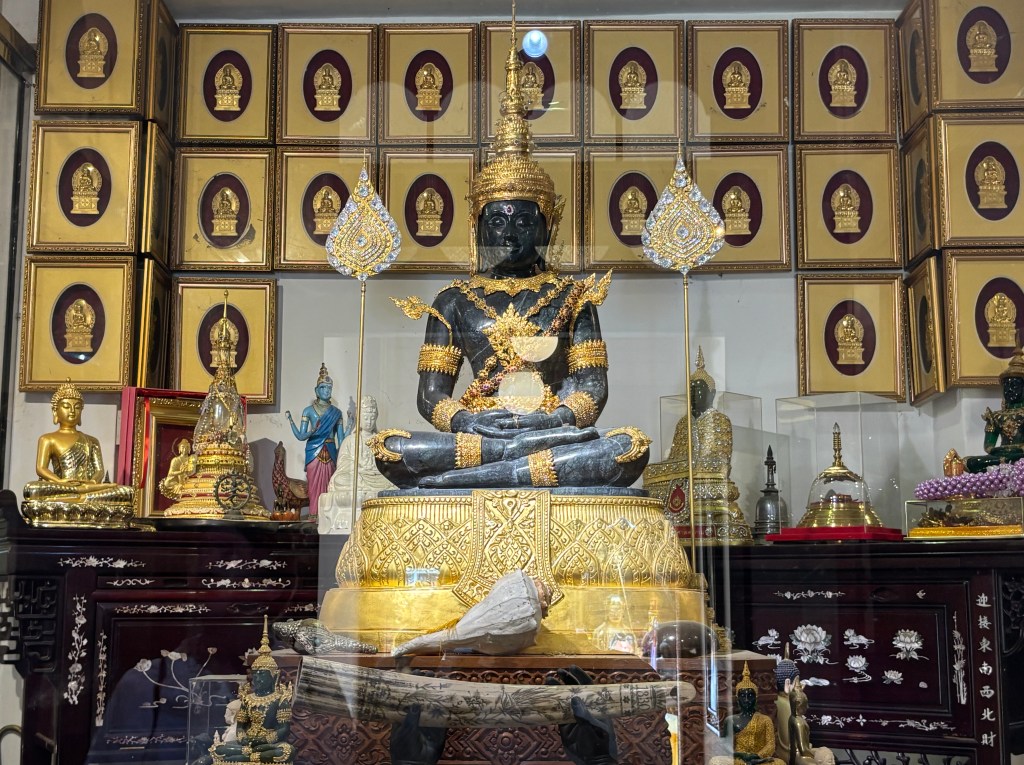
This turned out to be an unexpected and expensive day! We had booked a tour with Deegoda on the With Locals platform. We have found this to be a reliable source of guides when we visit overseas locations – a little expensive but generally you get a great guide who speaks good English and is happy to tailor the trip around what you want to do. Deegoda was not able to pick us up till the afternoon so for the morning we were going to avhe a quite time in the areas of the Dutch Hospital Shopping Centre. We took a tuck tuk from the hotel – the driver usually does city guides but we resisted the offer on the basis we would be doing one with Not Out on the Sunday. There was not much to see at the Dutch Hospital and as we wondered aimlessly around the block we were approached by someone who worked at the Hilton Hotel and recognised the Not Out bag Gillian was carrying. Before we knew quite what had happened we were in a tuk tuc with him racing across Colombo to visit a temple – Gangaramaya Temple. The temples serves as a place of Buddhist worship and a learning centre. The temple is involved in Buddhist welfare work including old peoples’ homes, a vocational school and an orphanage. It was built in the 19th C so not as old as many. But it is a seat of Buddhist learning.
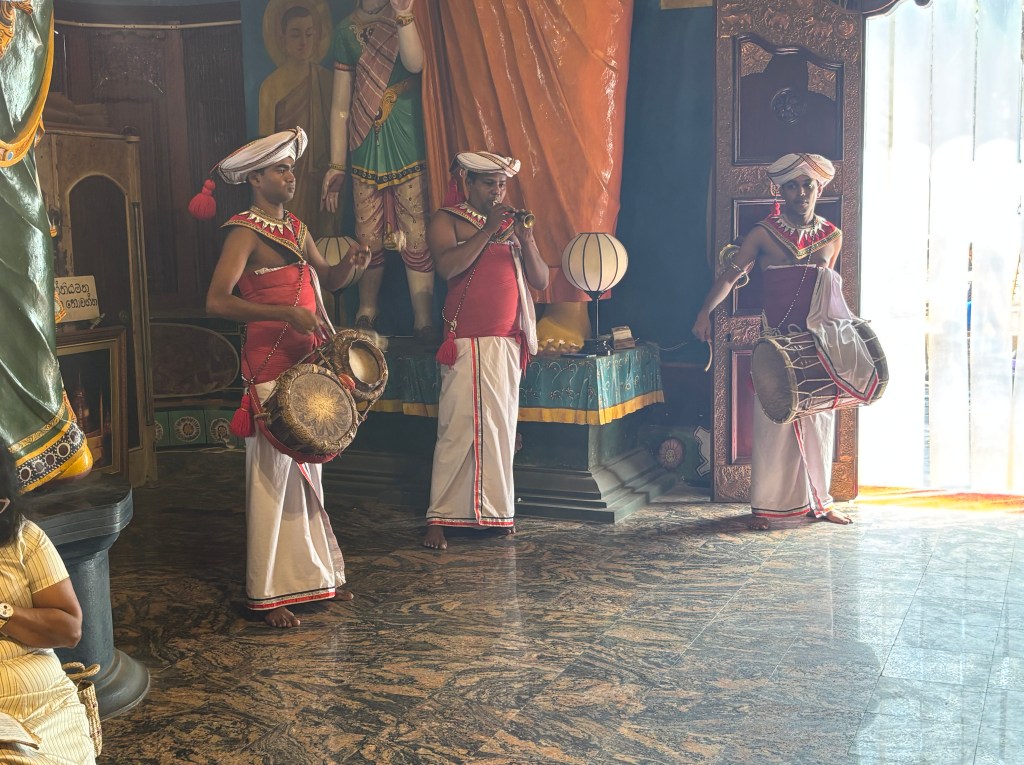
it is quite a large site with a number of different buildings. We were blessed by the Buddhist Monk and watch one of the arms giving ceremonies. it did seem not just tolerant of visitors but very welcoming. The Buddhist monk who blessed us was from Birmingham and he had with him a young boy monk who was probably around 12 years old. the music played was quite evocative.
Deegoda and Tour of Food Markets
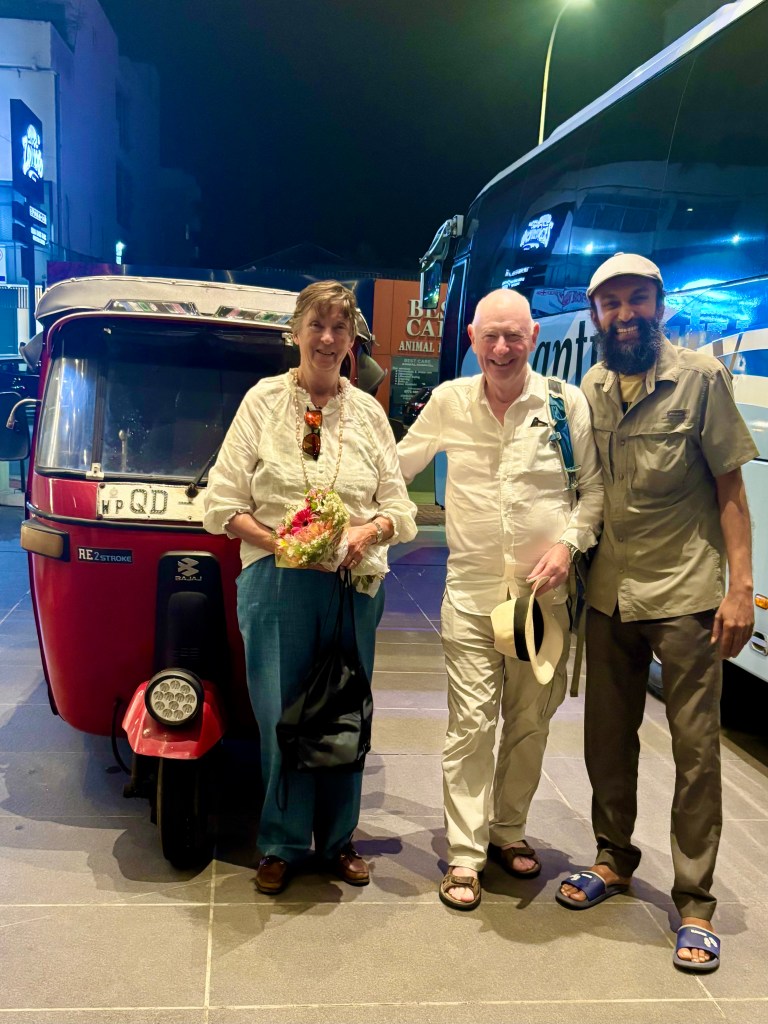
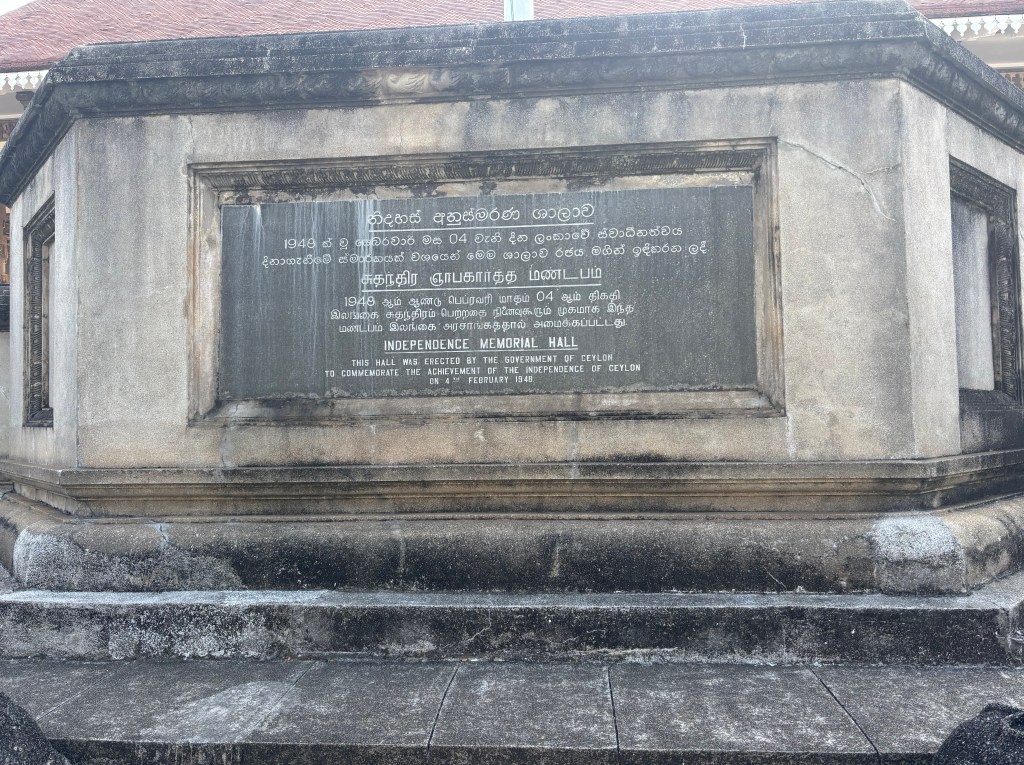
In the afternoon we were picked up by Deegoda for a tour of Colombo with an emphasis visiting the Pettah food market. he met us with a bunch of flowers for Gillian and a necklace for each of us. After flying round Colombo for about an hour looking at different sites including a stop at Independence Square where Deegoda opened up a little on the politics of Sri Lanka.
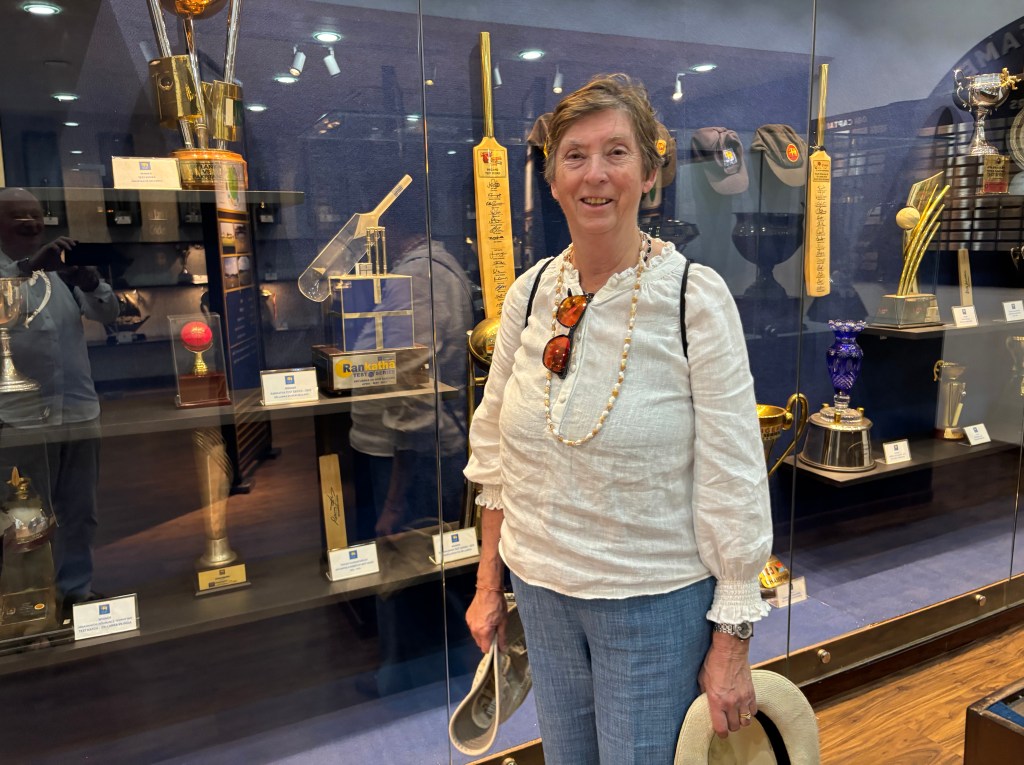
One of the places visited was the Cricket Museum. It was closed but opened up for us. It was not a large but it was an impressive display of national pride in their cricket tem which did gain test status till 1981 but did play in the 1975 Cricket World Cup. They have done better at White Ball competitions than red ball. But they have had (and still have) some great players.
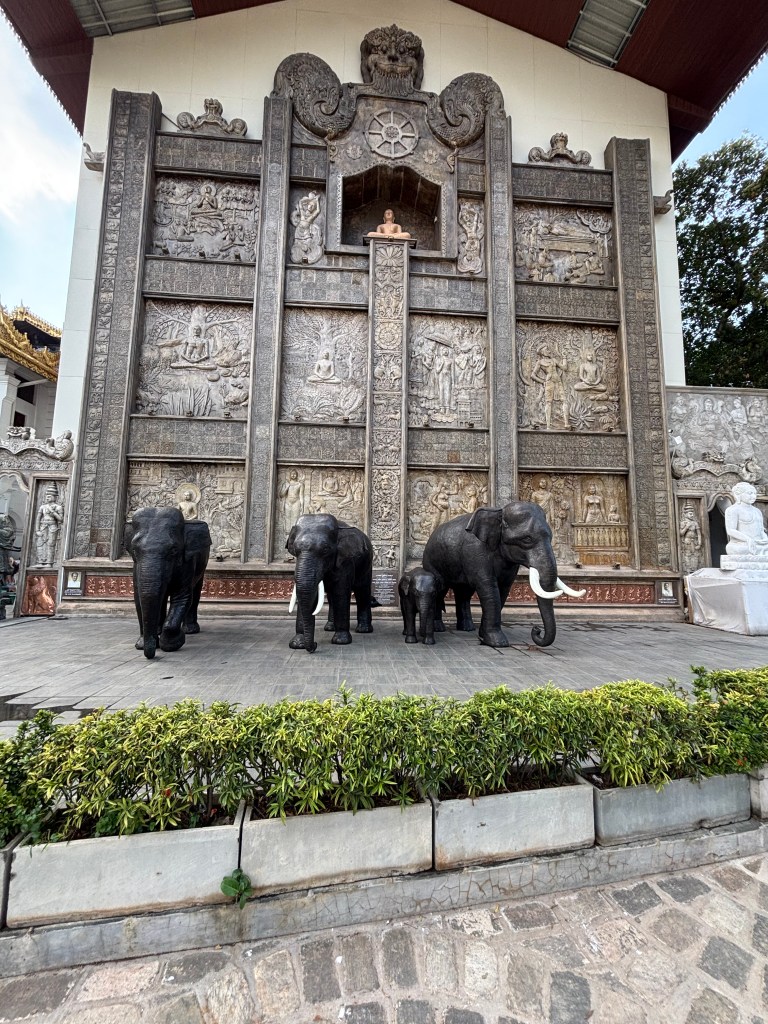
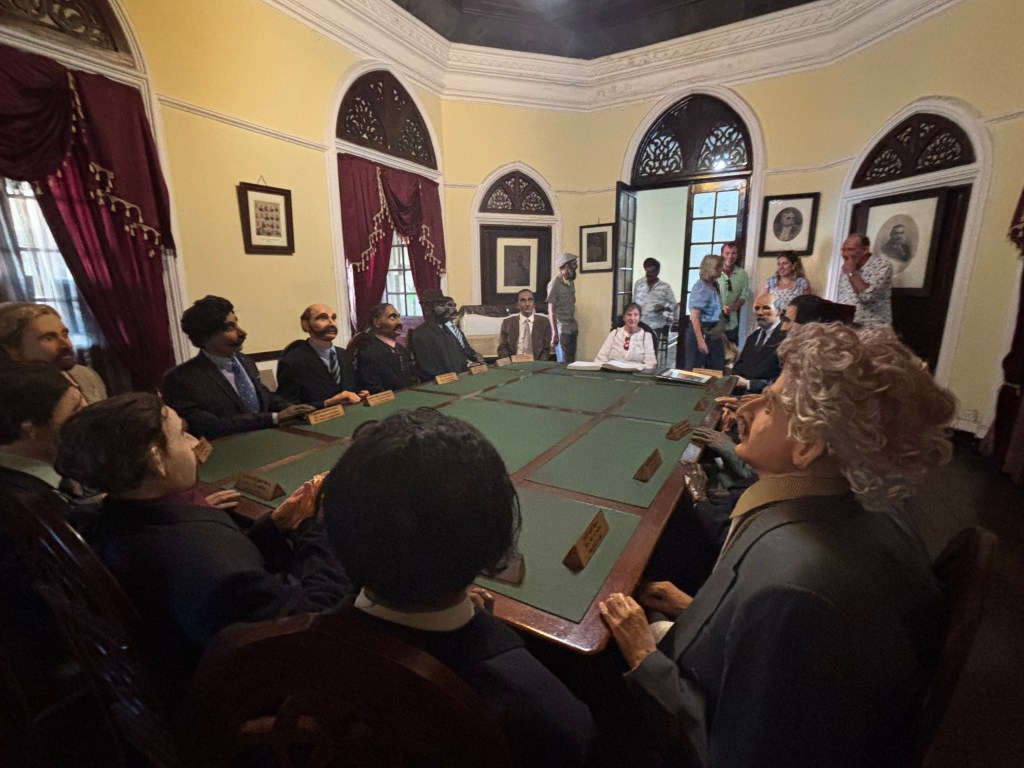
Our final destination before the market was the Old Town Hall. This was built in around 1870 and acted as the Municipal HQs until the 1920s. Despite being a museum there is no public entry point – you just walk in and there are a couple of people who seem to run the place. One of the rooms you enter is set up for a meeting and at first it takes you by surprise as you are met by a table with a number of people sitting around in the midst of a meeting. It takes you a couple of seconds to realise that the people are wax dummies. There does not seem to be any historical context to the people around the room – nor is it a replica of some important meeting!
From here we walked to the Pettah Market – one of the main local food markets in Colombo.
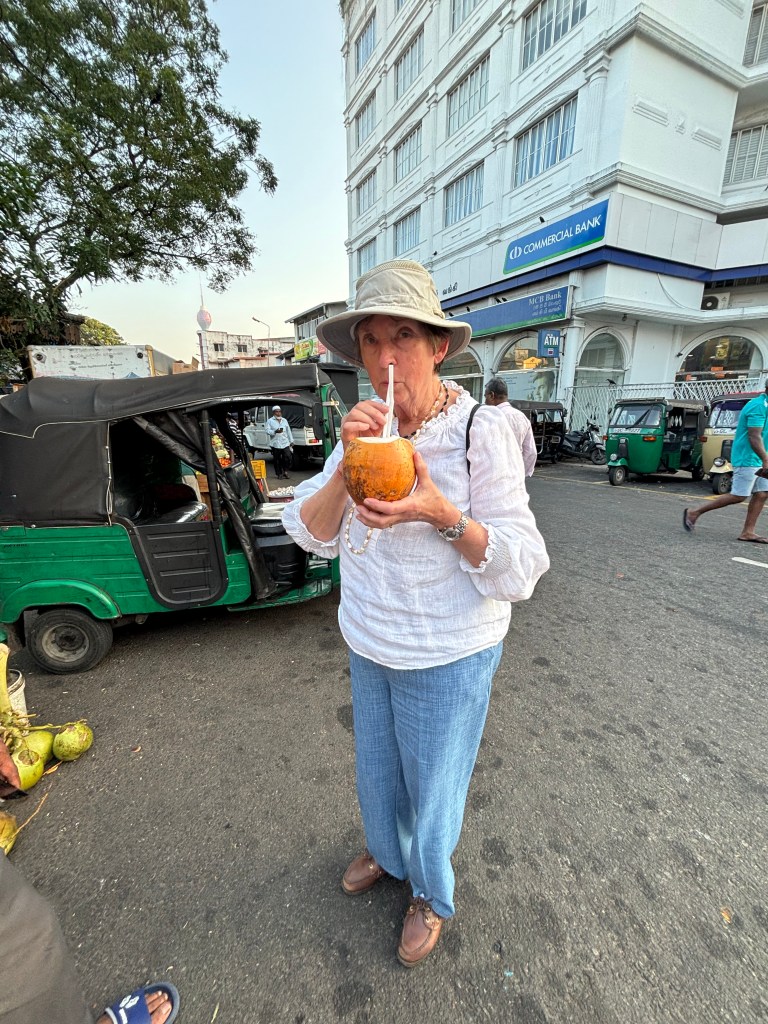
The guide was well known – I suspect for giving generous tips to stallholders as a thank you. We tasted many different fruits, understood a lot more about their diet and easting culture. The spice and dried fish stalls were particularly fascinating.
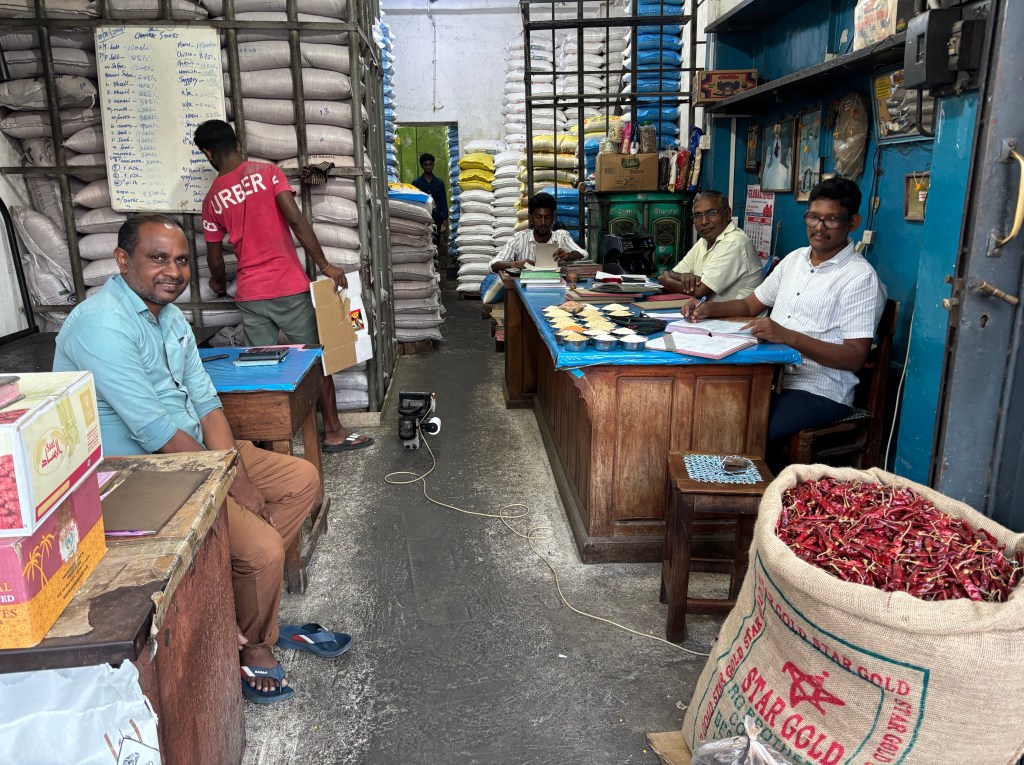
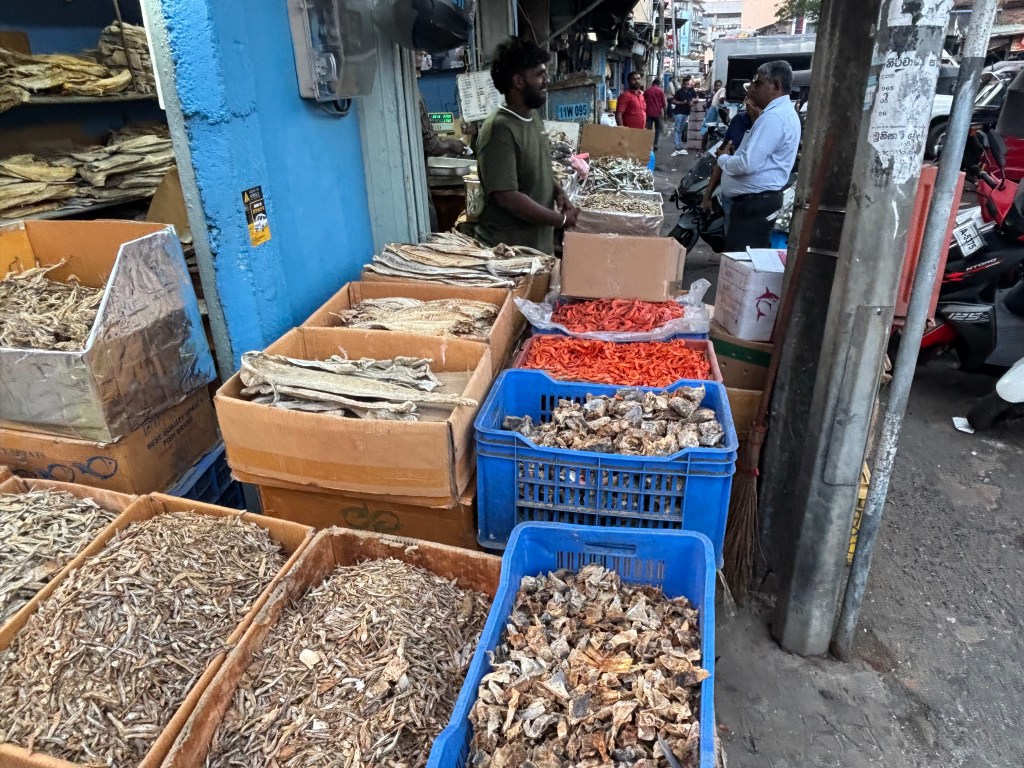
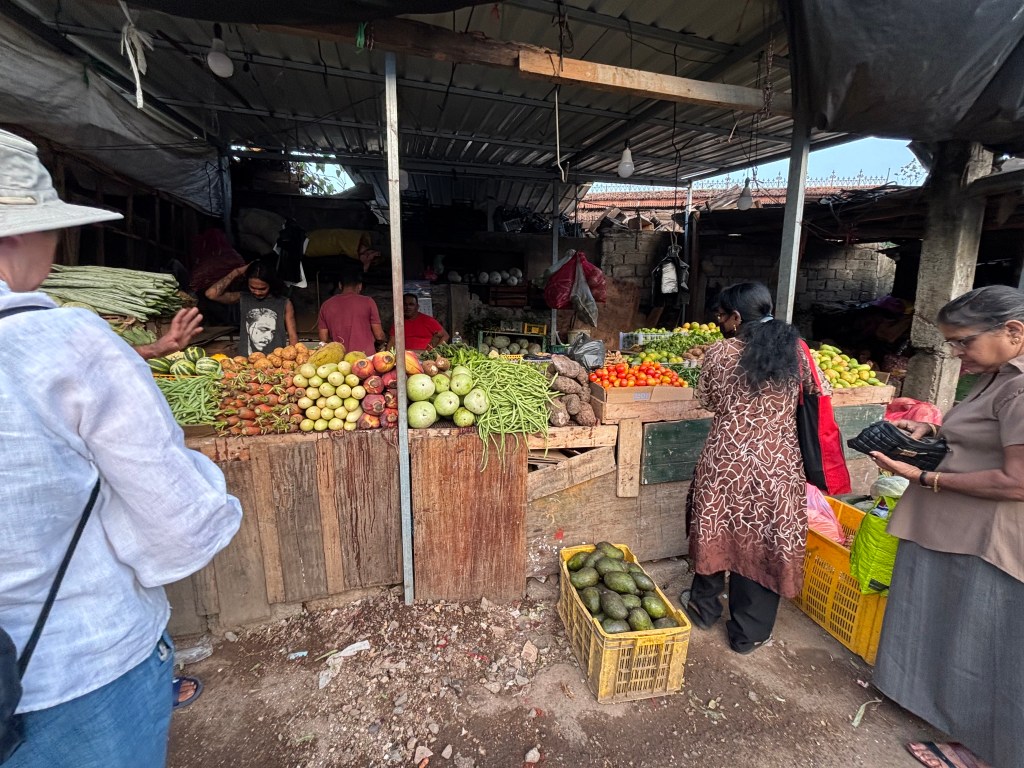
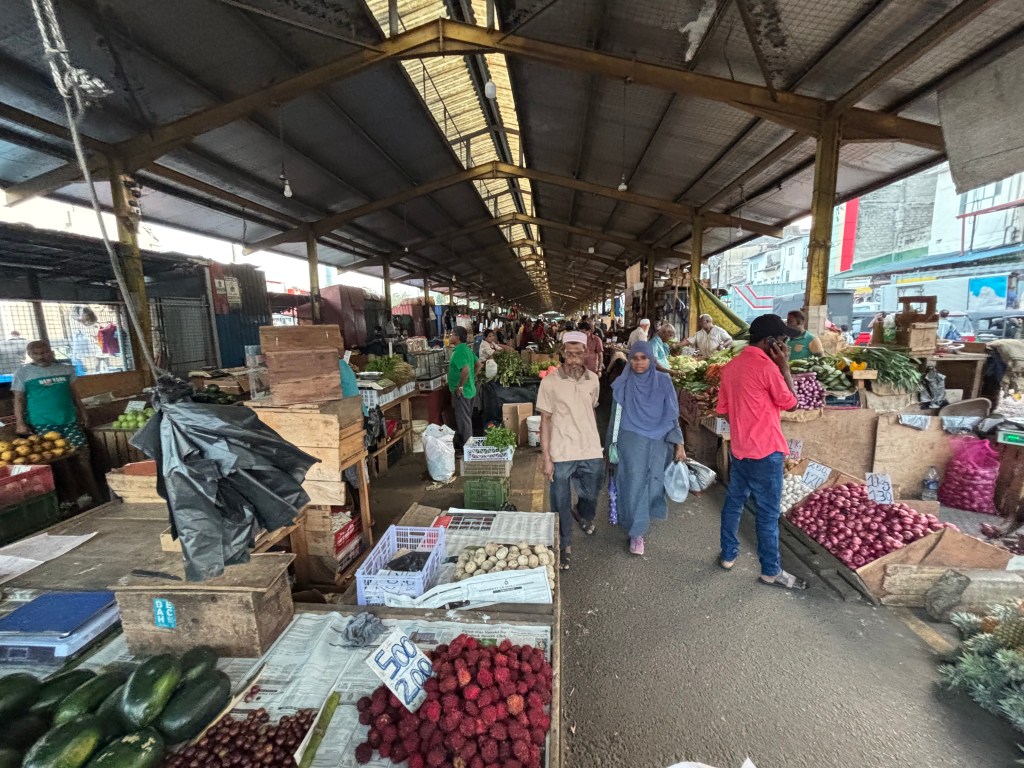
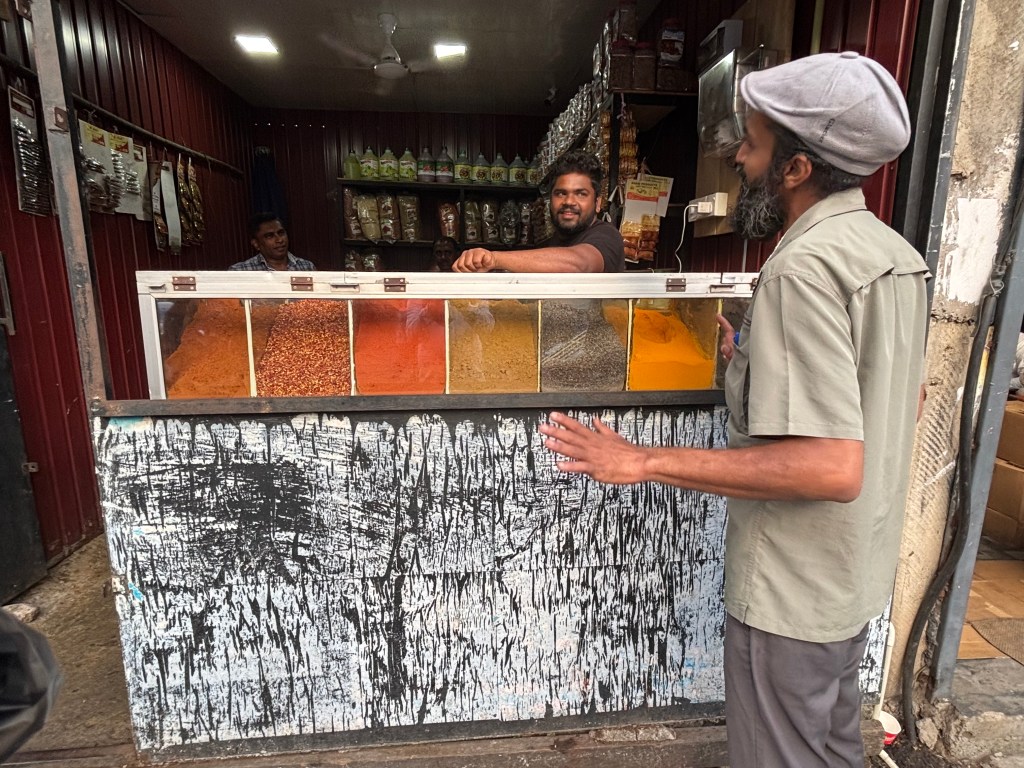
After the market we went to a local restaurant/cafe after having bought ‘crisps’ from a local vendor. These were deep fried bread fruit with chilli leaves. Despite some reservations at buying from a street vendor, Deegoda assured us they were safe. They tasted most definitely better than Walker crisps. The restaurant was quite basic and very local. We were served rice, some chicken plus various sauces. Dessert was Watalappam made with coconut milk, eggs and jaggery. Very sweet.
The return home was a drive along the coast line – which as a bit long as we had left the hotel at 3pm and it was now 8pm. The drive had been so long that Deegoda had to stop twice to refill with petrol!.
Back at the hotel we had a shower and an early night.
24th January – 2nd ODI
Score SL 219 England 223/5. One match apiece.
The morning was spent at leisure in the hotel after a hectic day before. We read and I caught up with the blog before we made our way by coach to the stadium. Another warm day as we took our seats in the stand. Being a Saturday there was a large turnout of locals together with a local band who managed to play for the entire match – 1430hrs though to 2200hrs – impressive stamina as well as music.
A strange match. England bowled over 40 overs of spin out of 50. They used 8 bowlers with the main ones being Liam Dawson, Will Jacks and Adil Rashid. Batting, Zac Crawley was injured and Rehan Ahmed was promoted to opening batsman. England bowled out Sri Lanka for 219 which was a low score. Joe Root, Jamie Overton and Adil Rashid each took 2 wickets. Joe Root’s second wicket was in the final over. When England came to bat, we lost our first wicket in the 6th over 20/1 (Adil Rashid) but then had a great partnership between Joe Root and Ben Duckett – 88/2 in the 16th over. The next stand took us to 97/3 in the 19th over. Then Joe Root and Harry Brook brought England to a winning position and by the 40th over England were 178/8 with Joe Root getting 75. it was mainly done in singles with a reluctance to take on spin with expansive shots. Joss Butler gave a sporty display with 33 for 21 balls. We crossed the line with a 4 from Will Jacks in the 46th over.
Levelling the series at 1-1 was good news as it makes the last match much more meaningful.
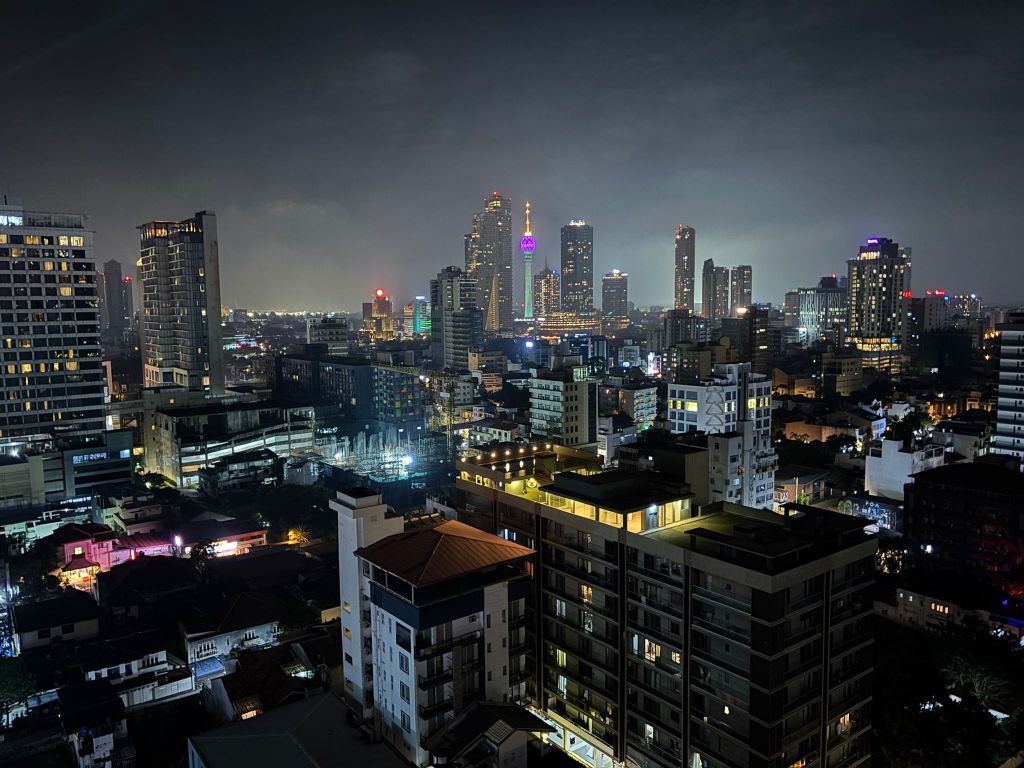
Having returned to the hotel, we both decided to have a late meal on the roof top of the hotel and shared a mixed grill. A nice end to the day.
25th January – Rest Day at Hotel
Today was spent catching up on admin and the blog. A very lazy day.
26th January – Road Trip to Galle
We departed at 0800 along with a multitude of other cricket tour coaches for a day trip to Galle – about 3 hours away.
Turtle Nursery
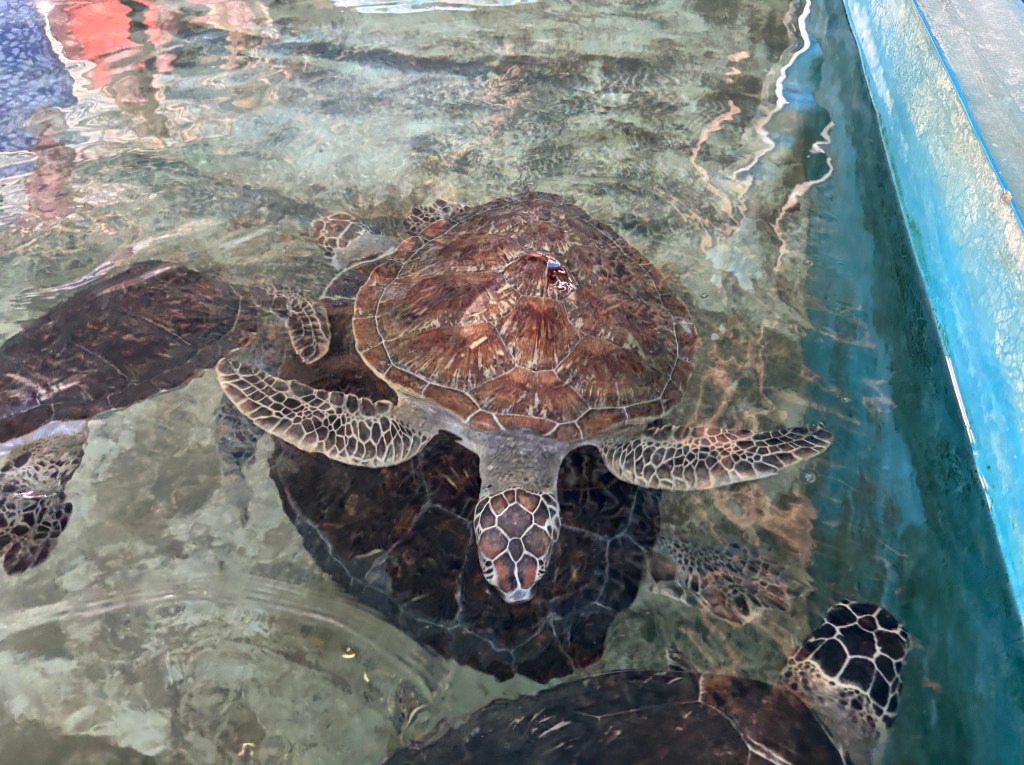
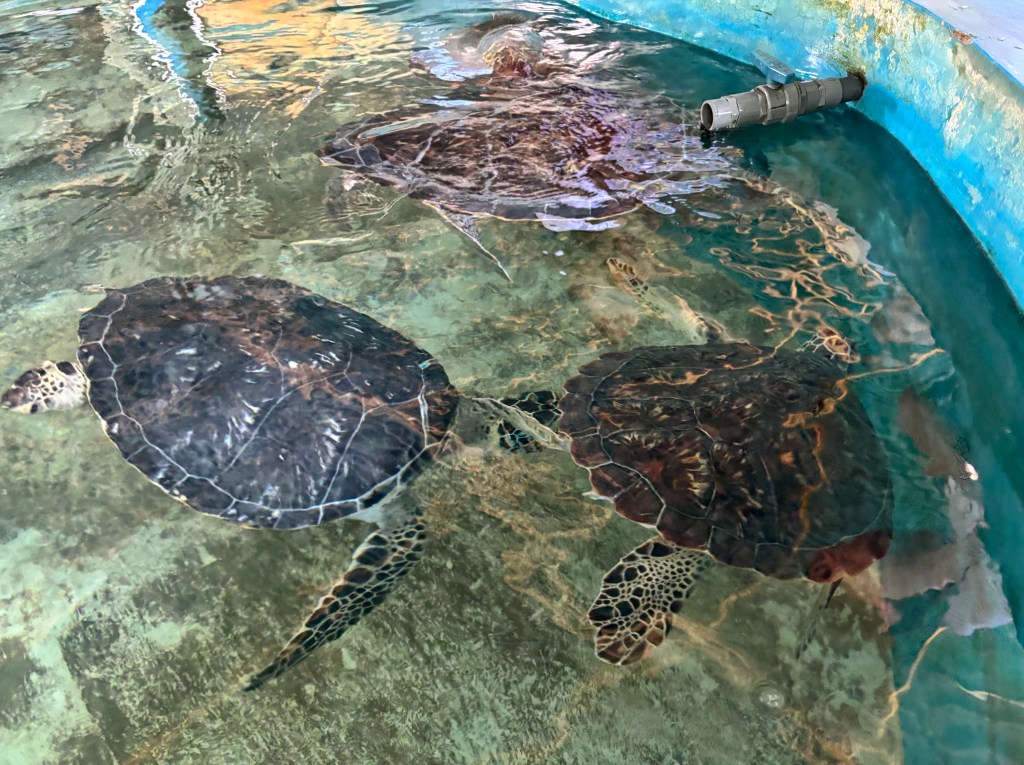
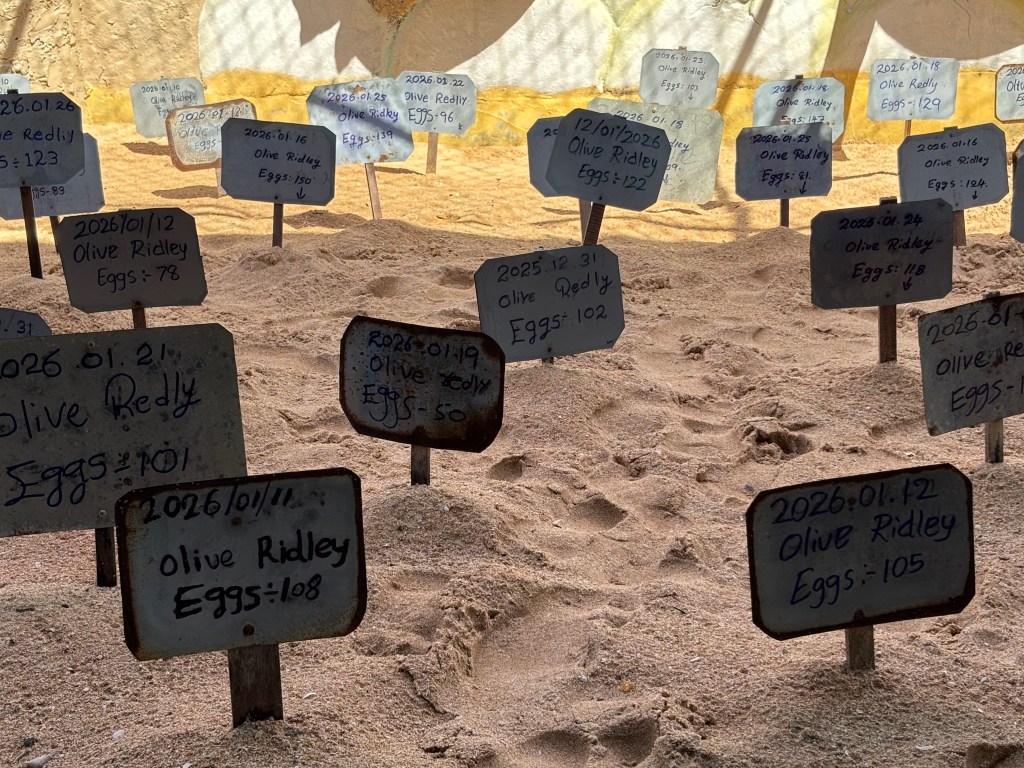
We had a short stop at a charity that rescued turtles. Their main work was harvesting the eggs and hatching them at the nursery to increase the success/survival rates. They lay around 100-150 eggs buried in the sand after first digging false nests to try and fool predators. The survival rate is very low -2% due to birds, and other land preditors including dogs and monitor lizards. Locals also dig up to sell as turtle eggs in some cultures is viewed as a delicacy. The nursery offers to buy the eggs from the locals rather than them selling them on to middle men. They are then buried in sand at the nursery and released into the sea around 3 days old. Survival rates are still not great – around 20%-30%. But a critical period has passed as the shell whilst not fully formed stops fluid leaking from the equivalent of their belly button which attracts predators in the water. The nursery also takes in injured turtles generally as a result of fishing nets, plastic and injuries from boats.
Madugangar River and Mangroves
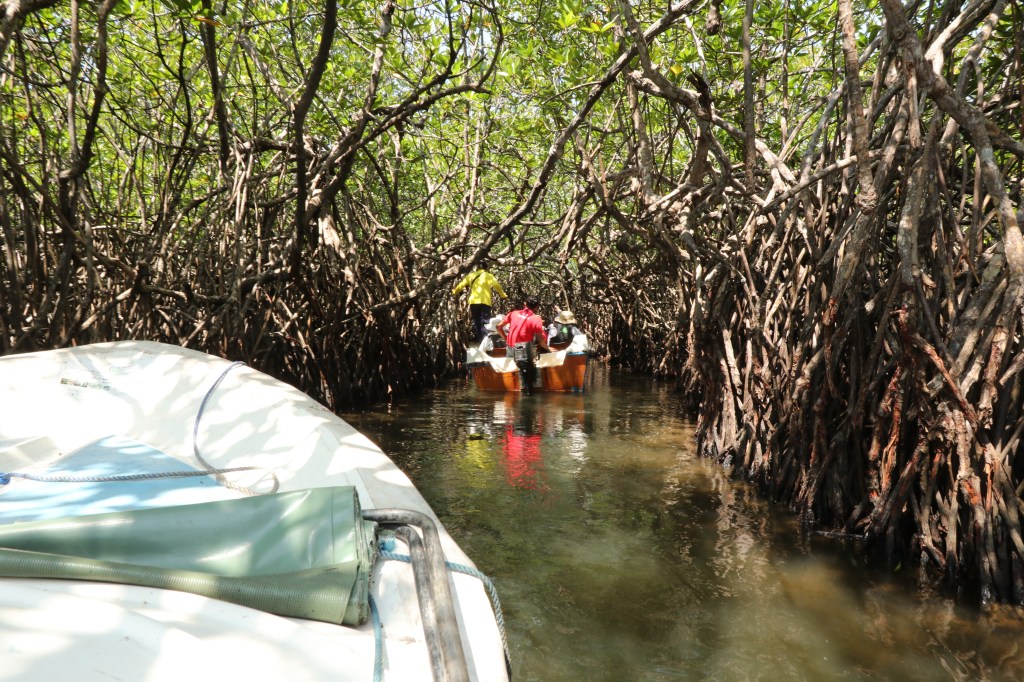
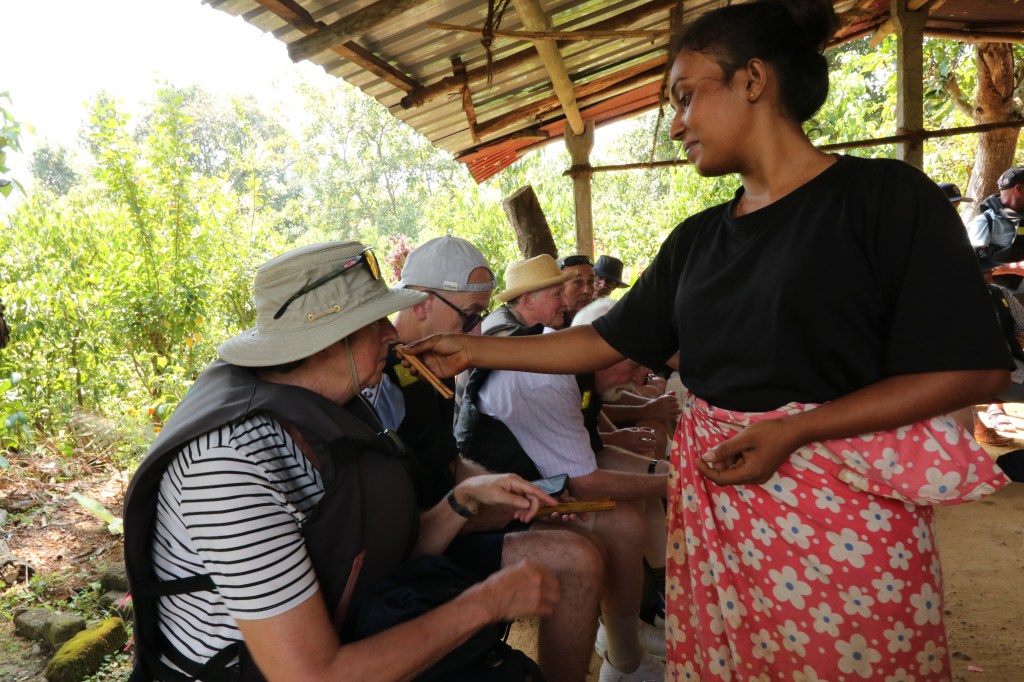
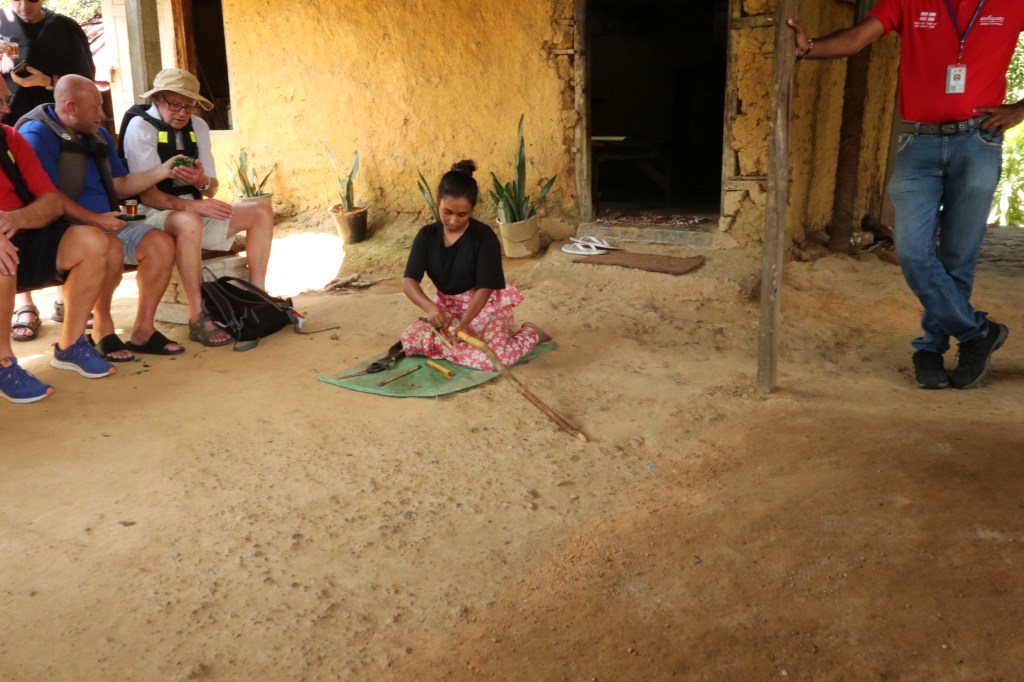
Next stop was a river trip on the Mandugangar River. It is more like a lagoon and a mixture of fresh and salt water. A large expanse with around 16 islands. As with other tourist spots we had been to it was swarming with people. Climbing in and out of the boats was a challenge on rickety piers. After exploring some of the river and a small mangrove we sped across the water to a cinnamon village. A good demonstration of stripping the inner bark and wrapping in the outer bark which is then dried in the shade. A drop of cinnamon oil was placed on our hands and the smell stayed with us for the rest of the day. I am not sure I would wear it as a perfume!
Galle
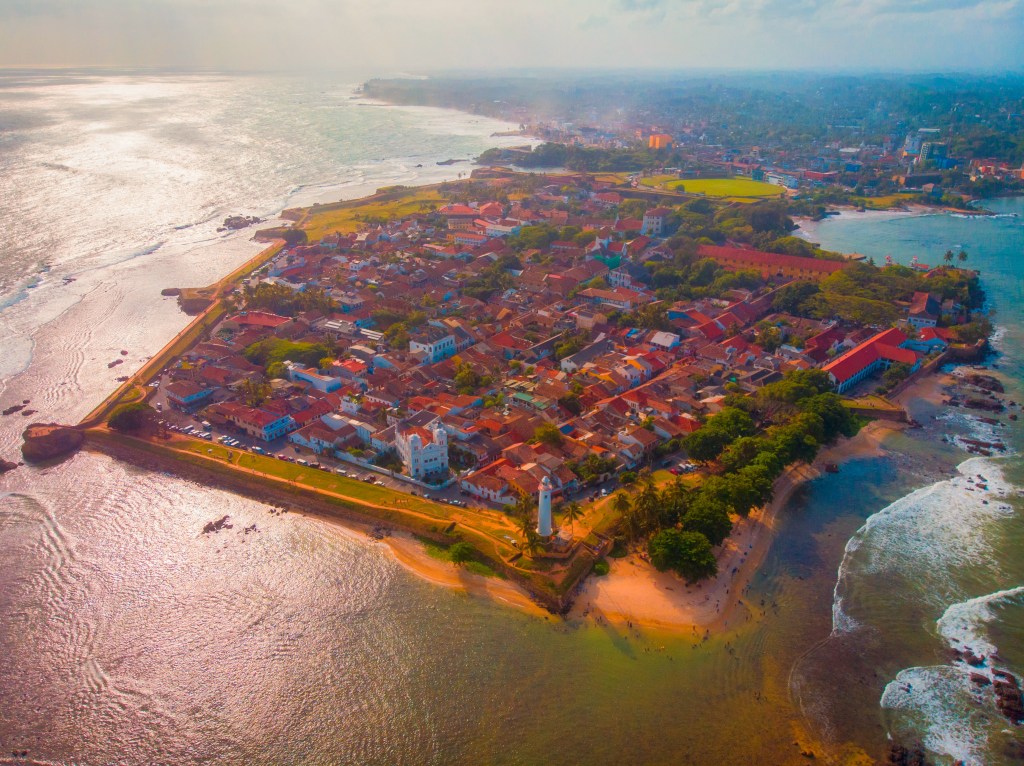
Our main destination was Galle. However with time running out we ended up with just 1.5hrs here and most of that was taken up with a walk to the fort and lunch. The trip into Galle was passed the beach where the tsunami hit on Boxing Day in 2005. Nobody knows the true death toll but the guide stated the official figure was 150,000 throughout Sri Lanka. Along the road there were empty and overgrown plots with just the concrete foundation left and nobody alive to come back. There were two waves, the first was not too devastating and after it arrived people went to help those in trouble, unknown to them was the second wave 20 minutes later with a peak height of 18m. This was black with the debris from the fault line that had been the cause of the tsunami. The resulting fatalities from this were huge. The Japanese had donated money for a tempe of remembrance and the Buddha outside was the same height as the wave – 18m.
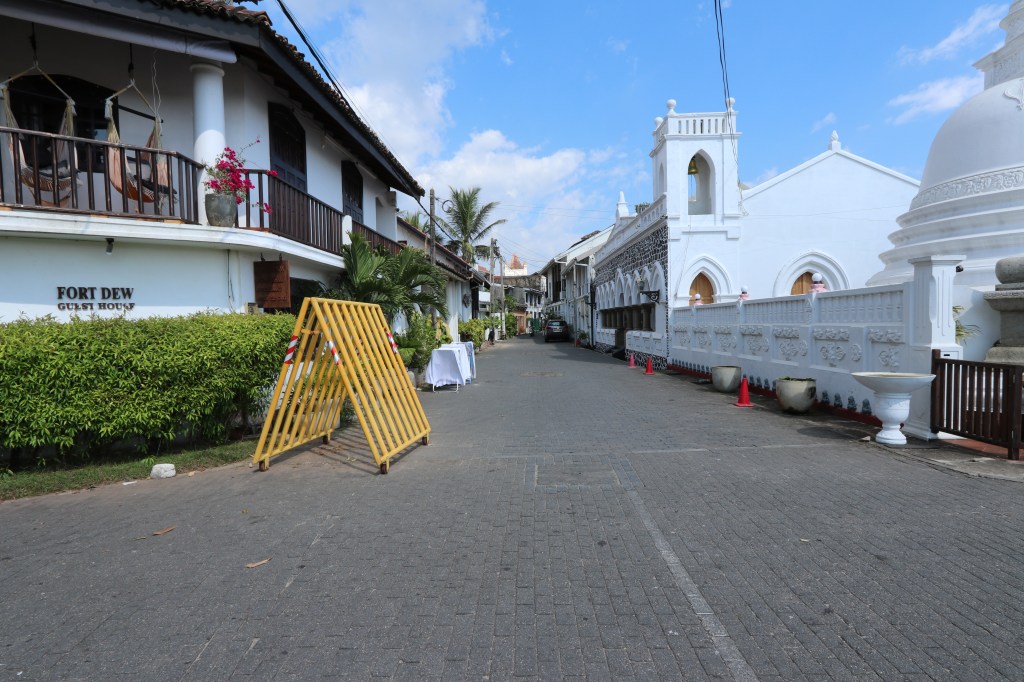
We eventually arrived at the Portuguese Fort (1558) which had subsequently become a Dutch Fort (1649) and finally a British Fort (1796). This protected and controlled the entrance to the harbour at Galle. An impressive and well preserved structure and a UNESCO World Heritage Site. As we had so little time we did not have the chance to explore what is in effect a city within a city as can be seen from the photograph above.
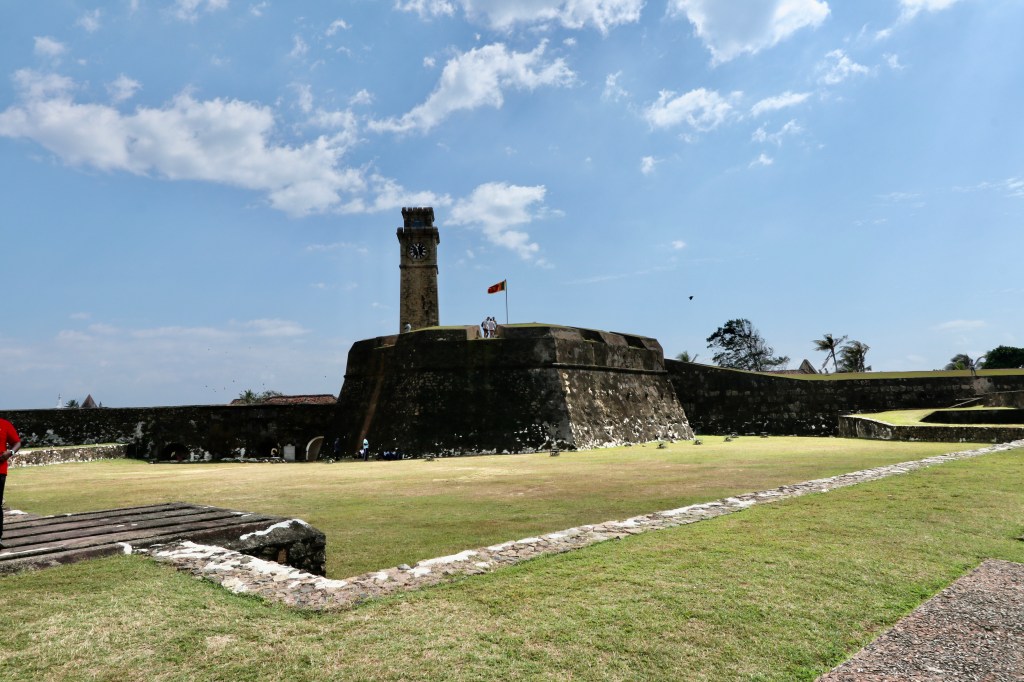
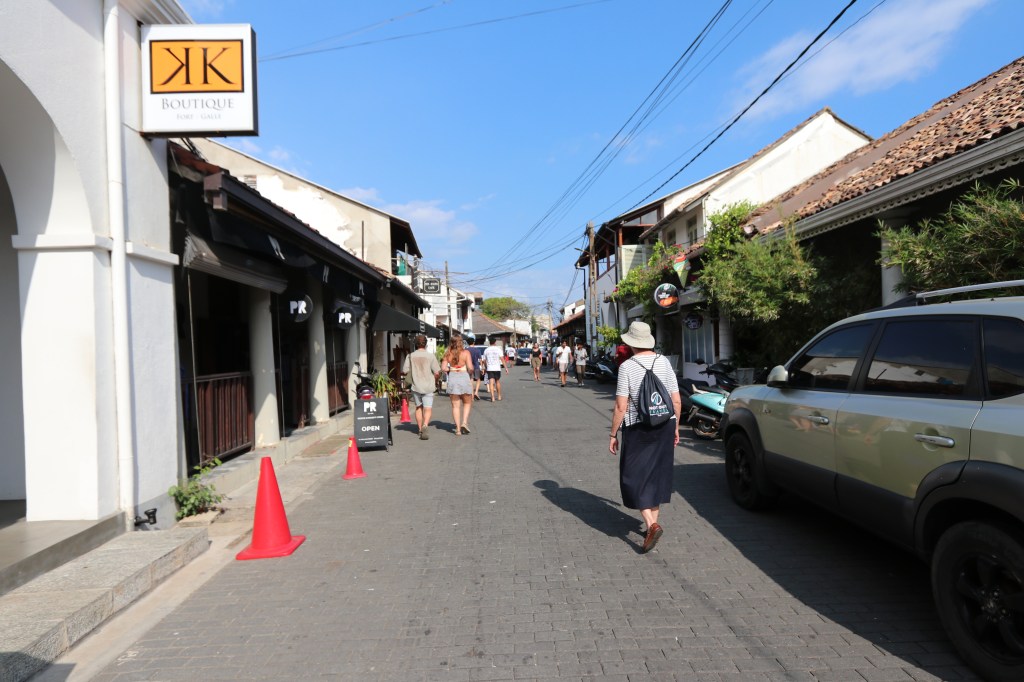
After a group photogragh by the clocktower we went off to find a late lunch which was hastily eaten in order to get back to the coach on time! I had a chilli omelette which was not too spicy and Gillian a Fish Curry with some very ‘heavy’ roti bread. We wandered back through some of the side streets and gained a fleeting impression of what must be a very nice city to visit and stay.
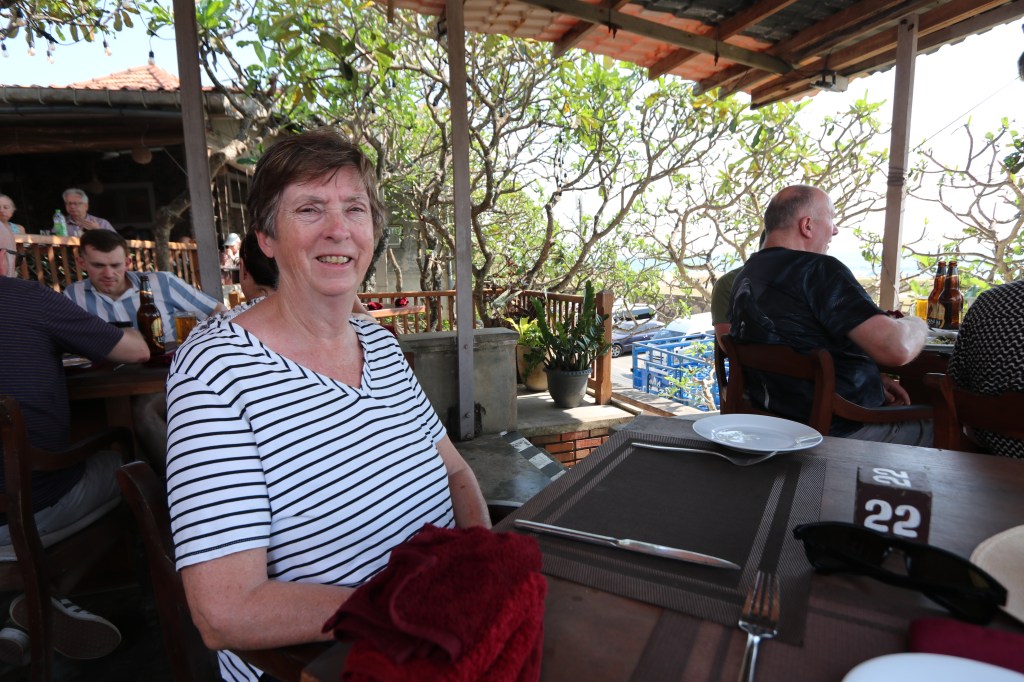
Upon return we had group drinks in the evening at one of the Kingsbury Hotel where those who paid a lot more than us for the tour were staying. Whilst you could buy some nibbles, the drinks were free and after a long day we made the most of it!
27th January – 3rd ODI
The morning was spent sorting out our packing and bags for departure the following morning. We left for the match – the decider with the series at 1 each – at 1230ish. The trip to the ground is around 30 minutes and as ever most of the junctions near the ground were controlled by the traffic police who continues to be impressive! UK police could learn a lot from them. The rules regarding roundabouts still seemed a bit arbitrary and leaned towards big has right of way! Horns are an essential aid to driving in Sri Lanka. Everywhere are tuk tuks which are nicknames mosquitoes.
We arrived at the ground well in time for the toss. The experts leaned towards leaned towards whoever wins the toss bats first and has a high probability of winning as those batting second have to contend with the dew and slower outfield. England had lost the last 2 tosses but won this one and chose to bat first. This turned out to be a great game and unlike the previous two ODIs was high scoring. England got off to a slow start and were only 40 after ten overs. The usual target is 50+. we had also lost a wicket with Ben Duckett out in the 6th over and Rehan Ahmed out in the 10th over – 40/2. It was a worrying start but then the game changed. Joe Root and Jacob Bethell has a great partnership – JB was out first on 65 from 72 balls in the 31st over. Joe Root stayed in and then partnered with Harry Brooks who had not had a great series either in Sri Lanka or Australia. But he was on form tonight hitting 136 off 66 balls. A very different century to Roots who was very planned and methodical whereas Harry Brooks hit 11 fours and 9 sixes. The temperature on the pitch was high and you could see that the length of time Joe Root had been in had taken its toll. But they both batted to the end with the last five overs going for 13, 16, 14, 18, 22 and 18. The final score was 357 which in ODI cricket is a big score!
Sri Lanka came in with a fierce determination to make a fast start, and they did. After 10 overs they were 104 v Englands 40. But they had lost 3 wickets Mishara 22 off 17 balls, Mendis 20 off 9 balls and Nishanka 50 off 25 balls. But once the power play was over and England were able to protect the boundaries the run rate steadily began to fall. There was an amazing stand by Rathnayake – 121 off 115 balls and his was the last wicket to fall in the 46th over, having reached a total of 304.
This was England’s first ODI series win overseas since 2023 and the first series loss at home by Sri Lanka for 5 years.
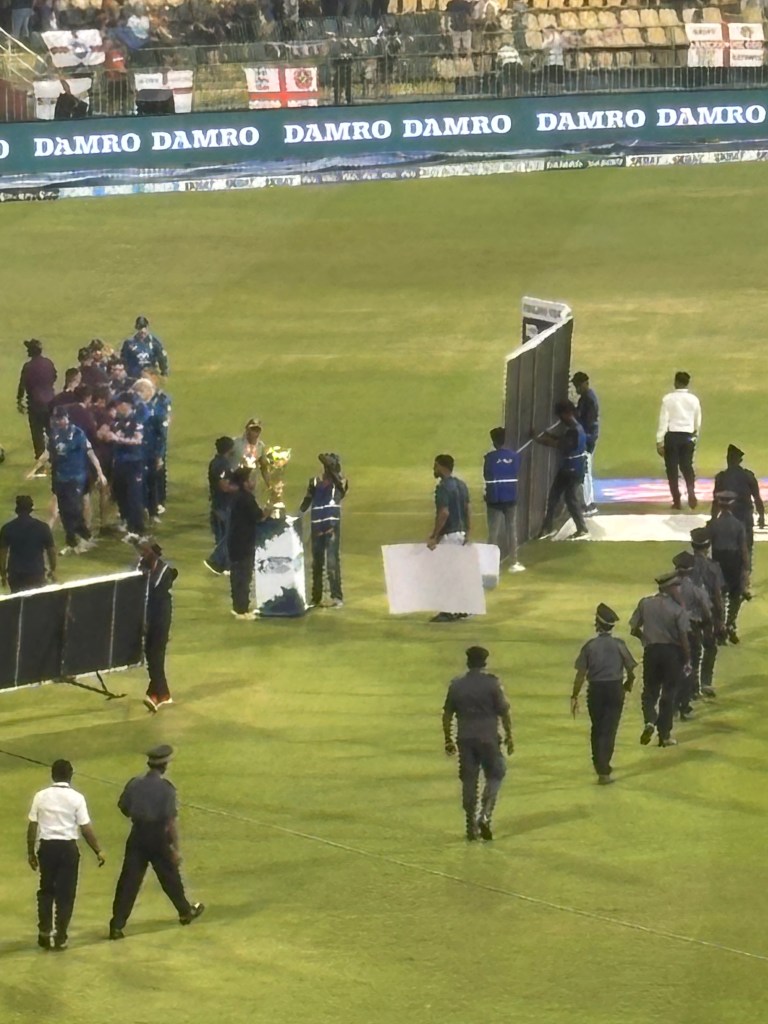
We returned to the hotel late – around 11pm. At first we were not going to have a drink upstairs but I had to go up to sort out the bill and Gillian ended up in the bar as her room key did not work. In the end it was a good decision and we both relaxed with a couple of beers and wines with Maggie the tour leader.
28th January Colombo to Kandy
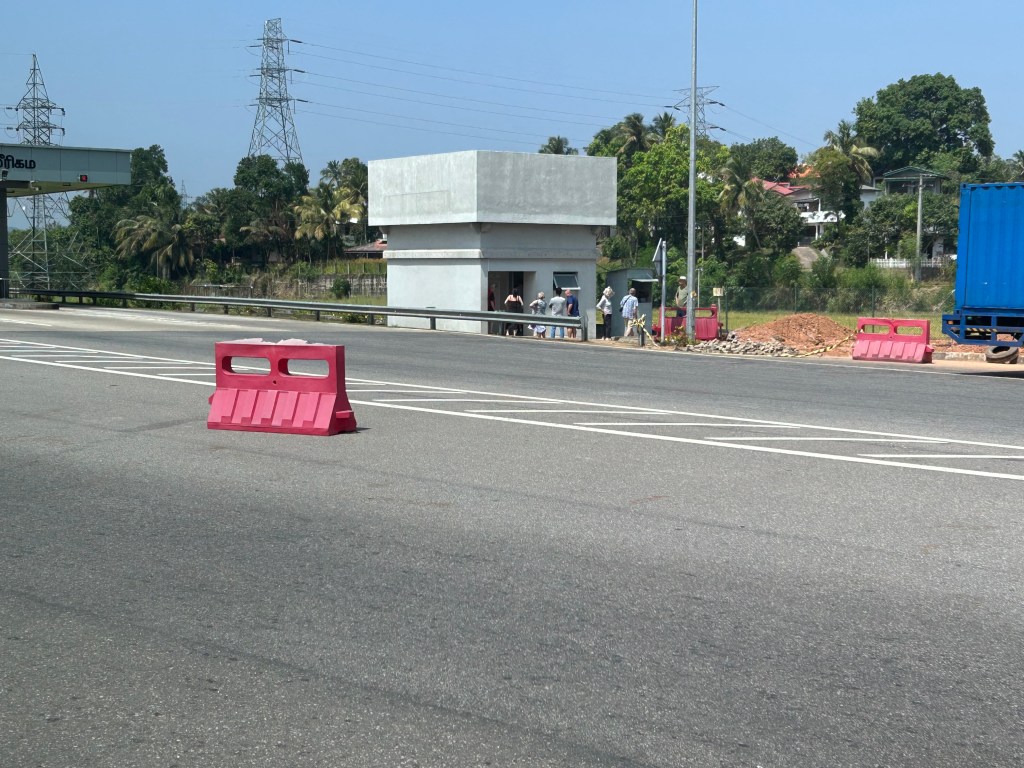
Not too early a start. We left at 1030 for a 5 hour drive. We were now used to these long journeys. Gillian dozed and I listen to audiop books. We did have a toilet stop in a rather strange place – just before a toll booth on the motorway but the toilet was on the otherside of the motorway. Seemed common practice to cross all the lanes!
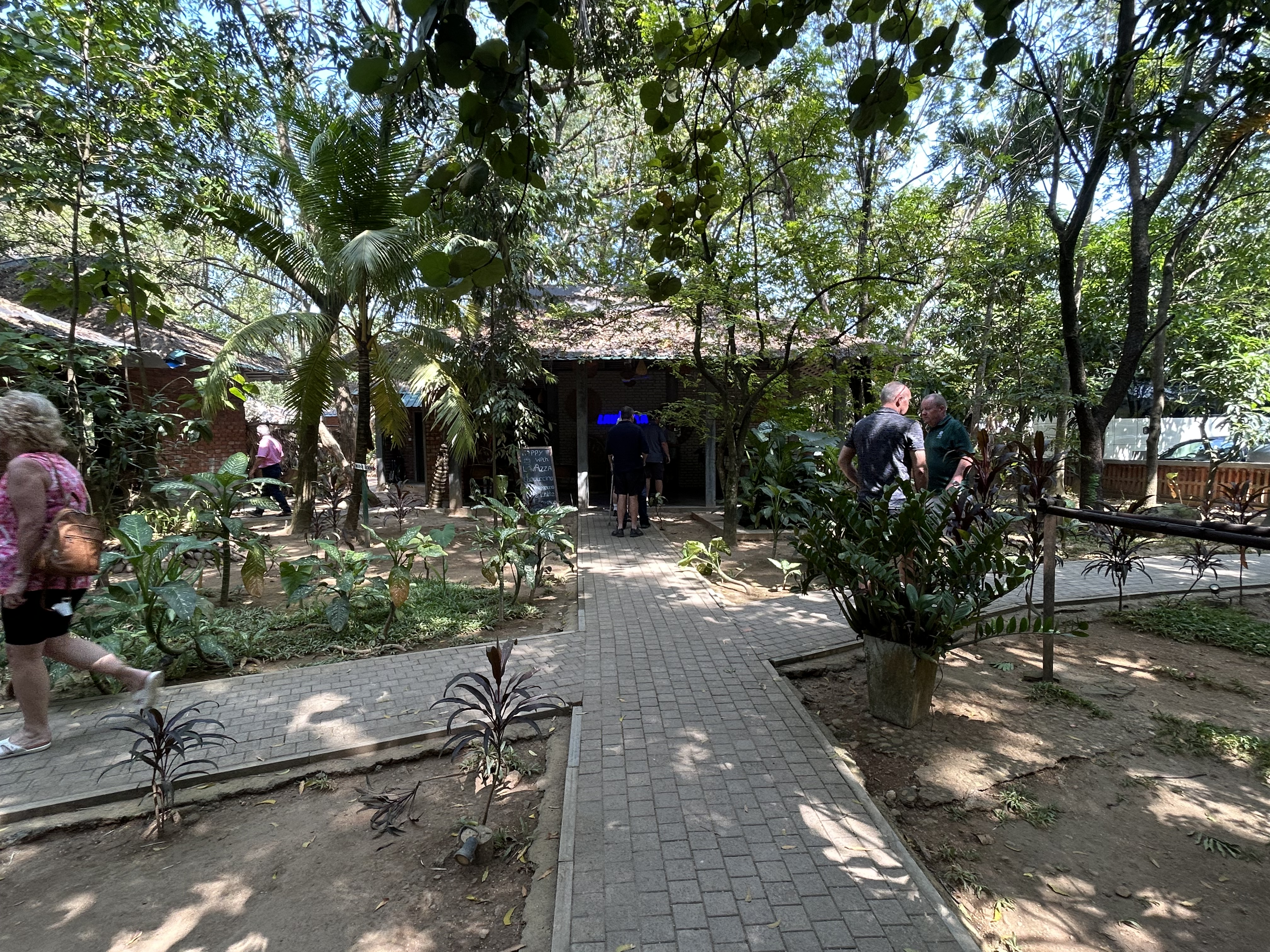
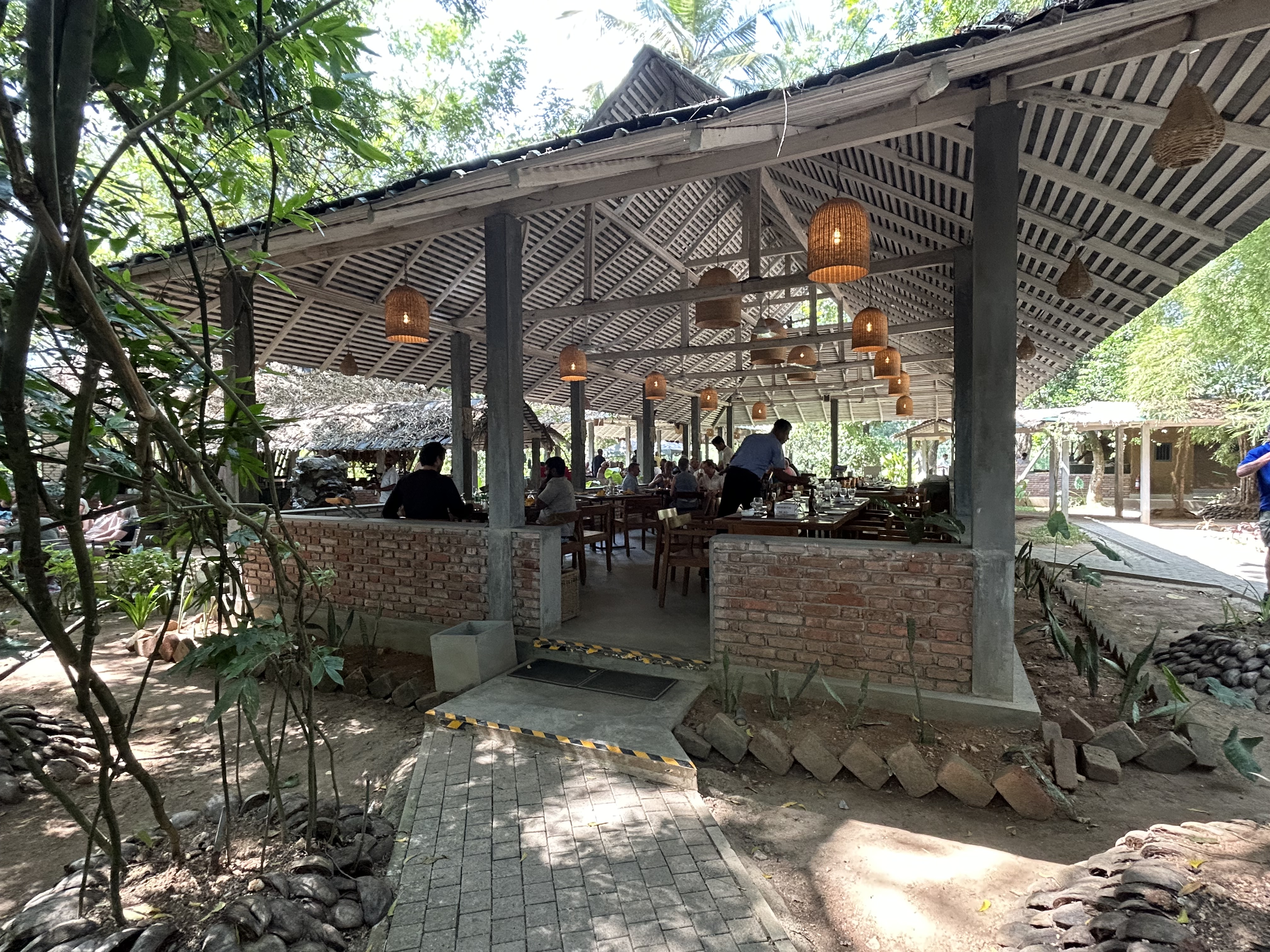
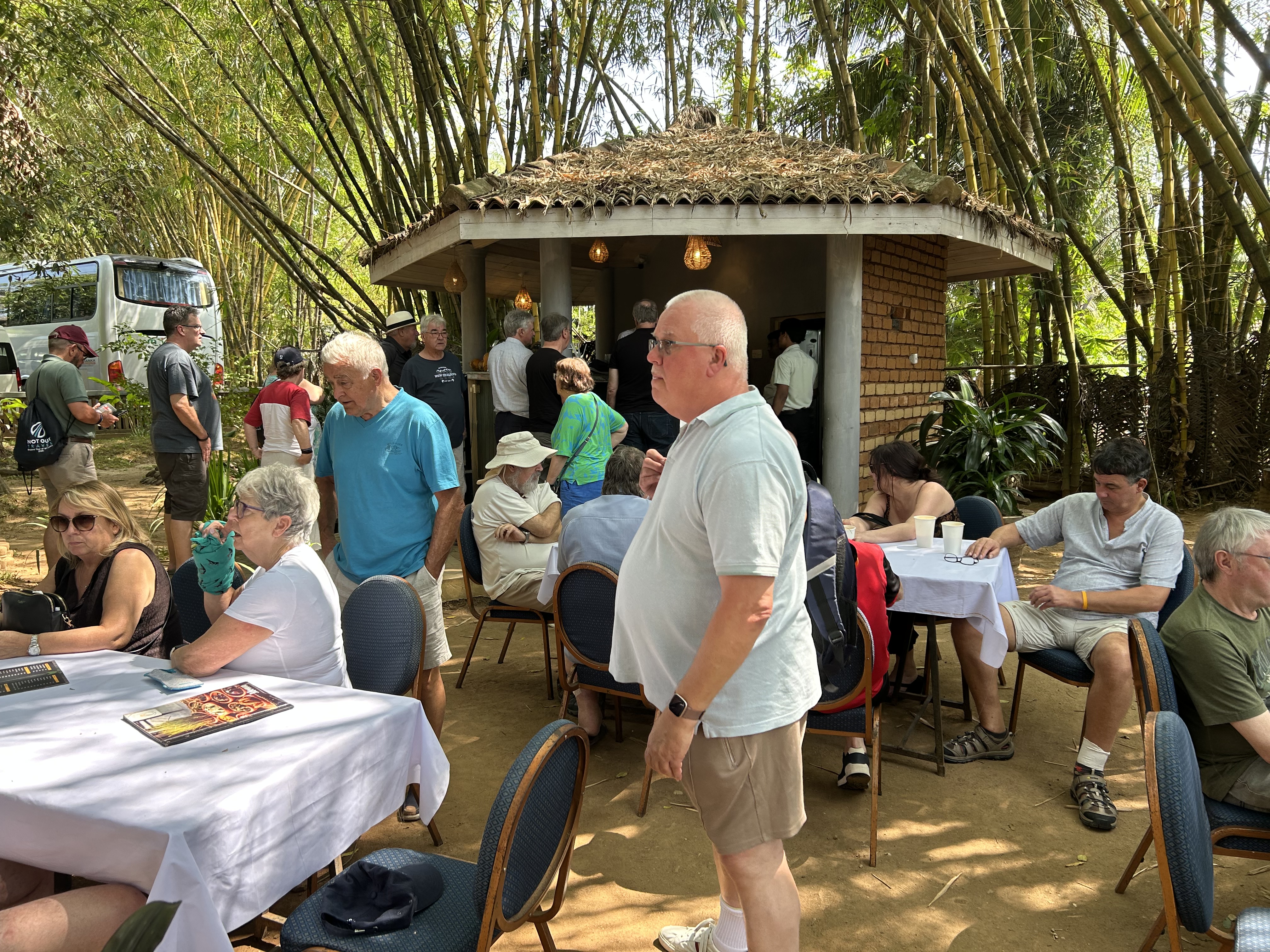
The trip up to Kandy was interesting. The landscape changed and became much more agrarian. Palm Olive trees, Coconut Trees and fields that looked like short stemmed wheat but difficult to tell. Again you could see the extent of the deforestisation to create land for cultivation. We stopped at a lovely place for lunch – no idea where it was! But a shaded area where you could buy a buffet lunch, or sandwiches or just coffee. Paper cups of mixed fruit juice were laid out on tables.
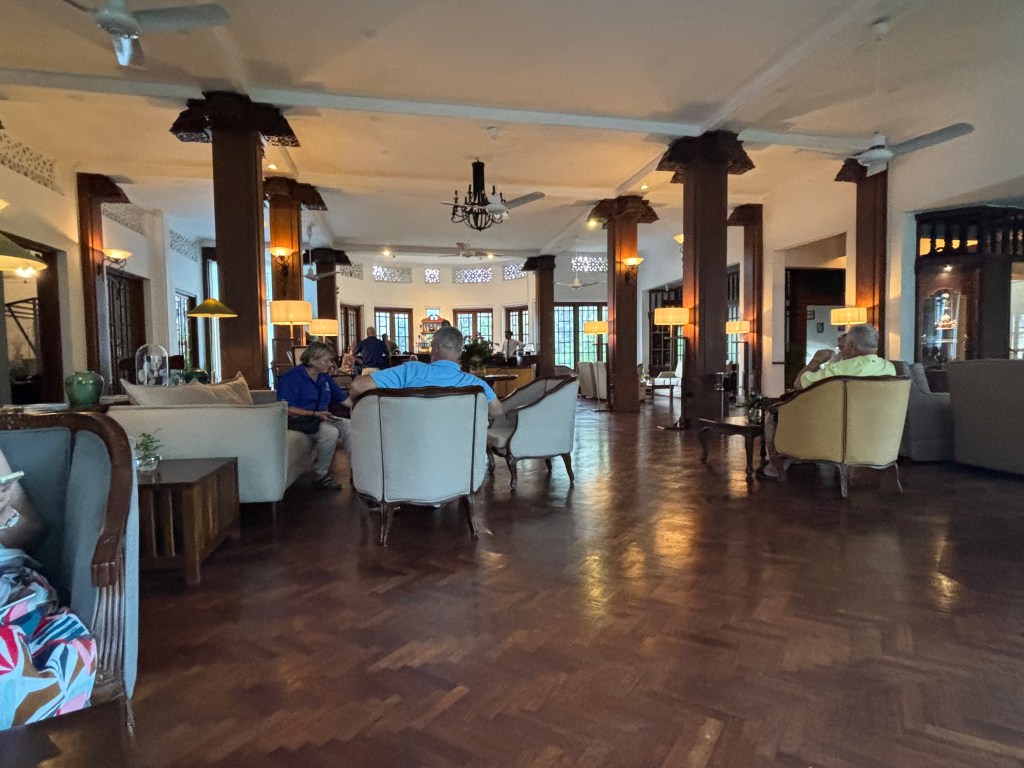
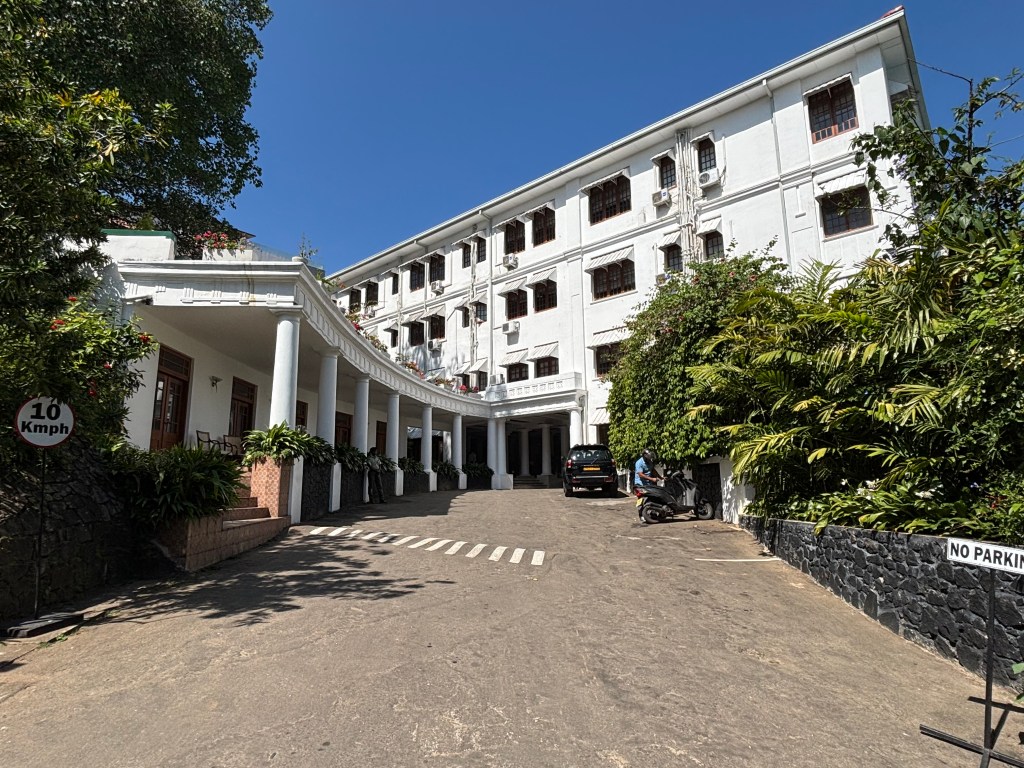
We arrived at the Suisse Hotel in Kandy around 1530. A very colonial building that stands above the lake in Kandy. Huge rooms with high ceilings. The bar area was was open and again with high ceilings and traditional colonial furniture and service. All the staff wore uniform. We quickly changed and found two seats to have a couple of Gin and Tonics.
We stayed at the hotel for a buffet dinner which we took outside the main dining on the grass. The edge of the area was ringed with paraffin lamps to keep the mosquitoes at bay. We had a lovely evening with Tony and Lynne not getting up from the table till around 1030. The hotel had a very welcoming and homely air. It did feel very much like an old officers mess such as Brunei.
29th January – Day at Rest
The Suisse Hotel has quite a history. Originally established in the 17th century, the building that is now Hotel Suisse was once the residence of the Chief Minister of the Royal Granary, a dignitary of the Kingdom of Kandy. Following the Great Rebellion of 1817-18, the British acquired the property and transformed it into “Haramby House.” This marked the beginning of its colonial chapter, serving as a residence for British officers and establishing its reputation among the colonial elite. George Wall, a pioneering figure in Ceylon’s plantation industry, made the property his residence around 1846. As the first Chairman of the Planters’ Association of Ceylon, his presence added another layer to the building’s significance in Sri Lanka’s colonial history. The property’s transformation into Hotel Suisse began when Madame Jeanne Louisa Burdayron, an enterprising Swiss lady, acquired the building. She established it as a guest house, introducing European hospitality standards while maintaining the property’s colonial charm. Hotel Suisse played a crucial role during World War II when Lord Louis Mountbatten, Supreme Allied Commander, chose it as the headquarters for the South East Asia Command. This period marked the hotel’s place in world history. Once it was returned to a hote, it has hosted the cast and crew of Steven Spielberg’s “Indiana Jones and the Temple of Doom” during filming, adding a touch of Hollywood glamour to its already illustrious history. In 1983, Hotel Suisse hosted the cast and crew of “Indiana Jones and the Temple of Doom,” including director Steven Spielberg and stars Harrison Ford and Kate Capshaw. This unexpected chapter in the hotel’s history demonstrates its continuing ability to attract prestigious guests and its role in contemporary culture. The filming period added a touch of Hollywood glamour to the hotel’s traditional colonial atmosphere, creating unique stories that continue to intrigue guests today.
After breakfast Gillian went to the pool and grabbed a couple of sunbeds where she initially relaxed by herself. I decided to take a turn around the lake and some of the town. The lake is a 2 mile circuit. It was originally paddy fields but the last King of Kandy turned it into a lake and built a bathing house for his queen. It was also to enhance the beauty of the Temple of the Tooth – more to follow on this in a later part of the blog. Kandy was the last independent kingdom in Sri Lanka and was only handed over to the British around 1815 as the local population had got fed up the the corruption and nepotism of the existing King. It is not clear if they lived to regret this decision!
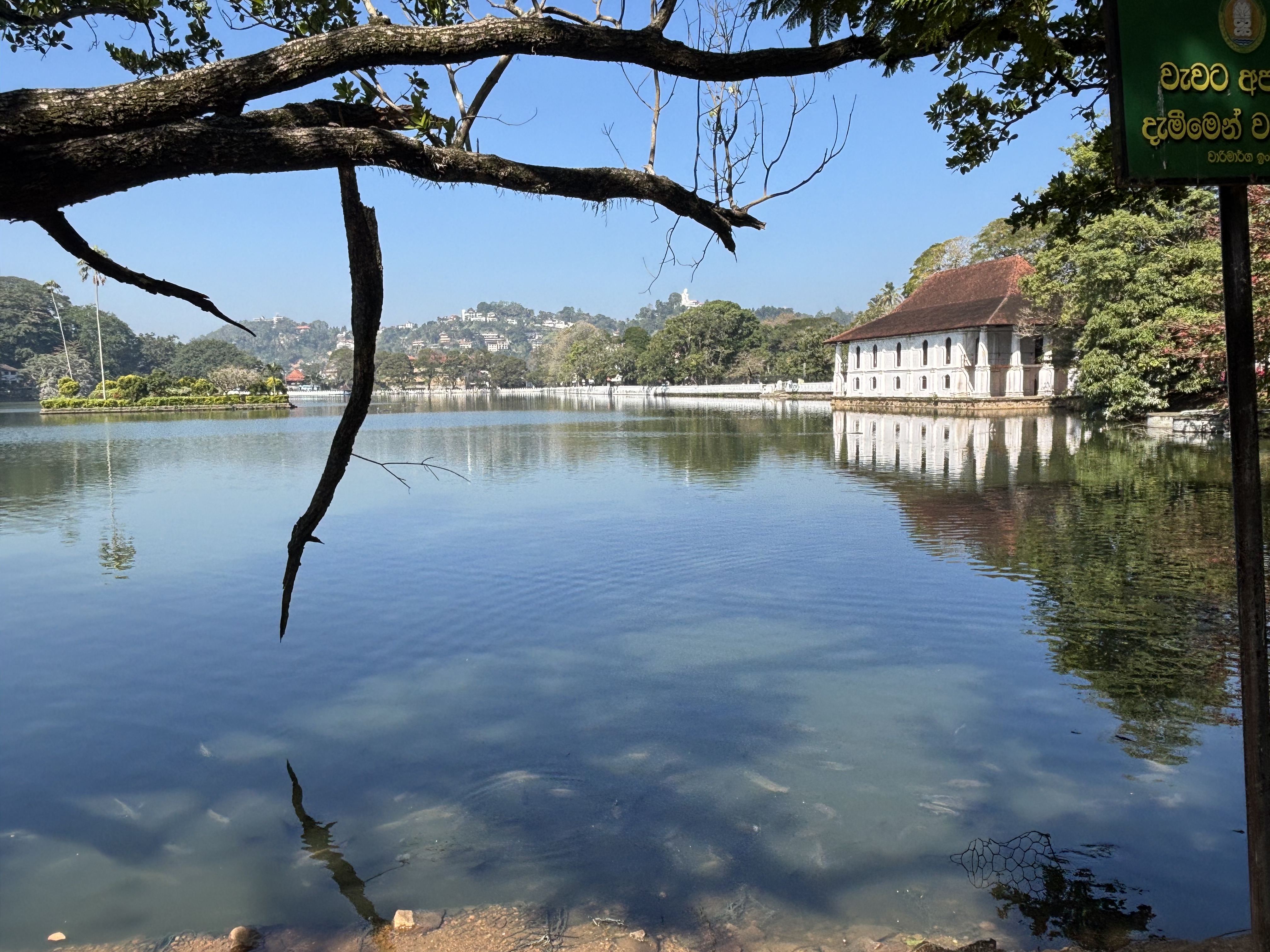
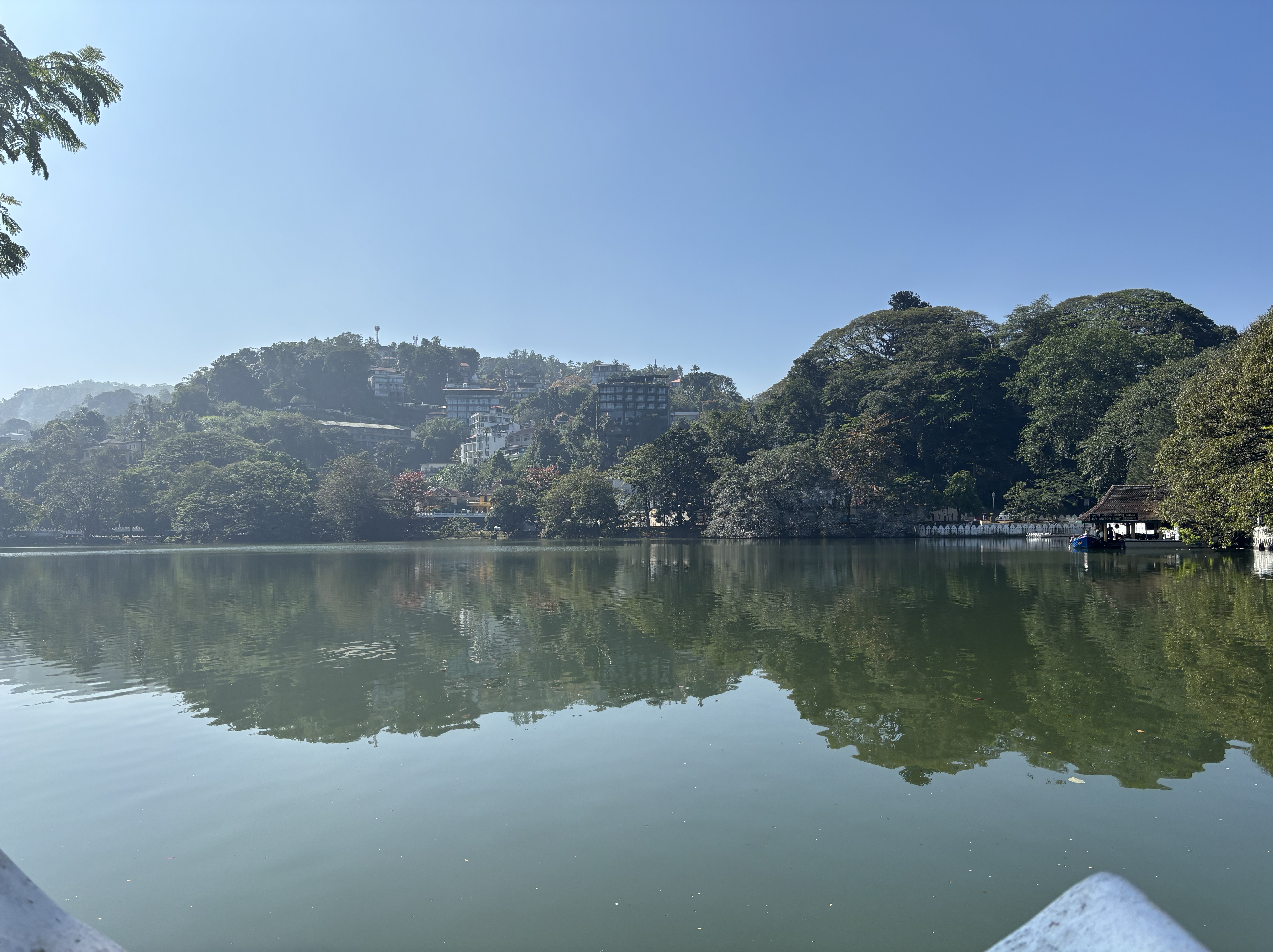
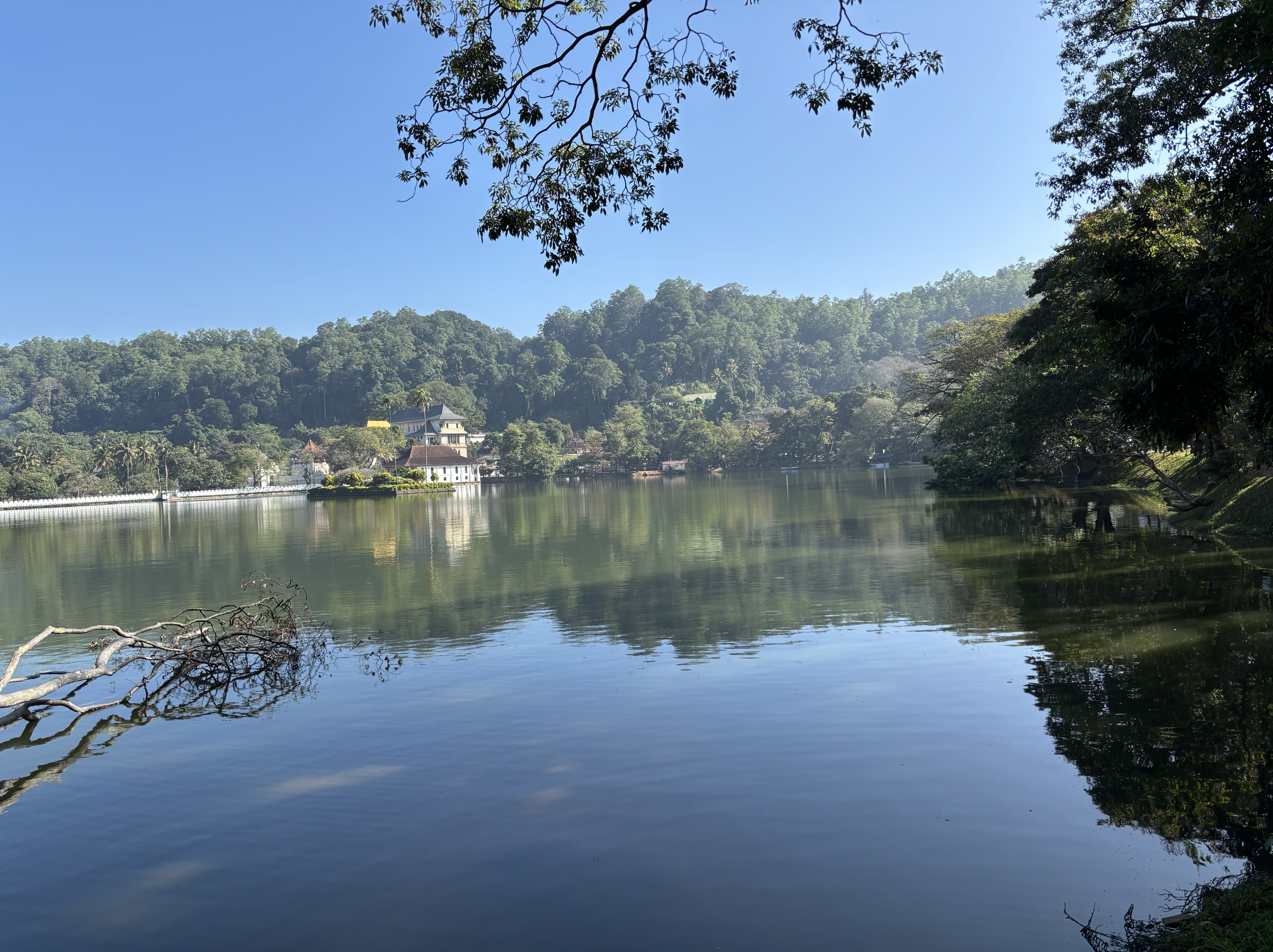
I got back around 1030 in the morning and we spend the reat of the morning and early afternoon at the pool enjoying some iced coffee.
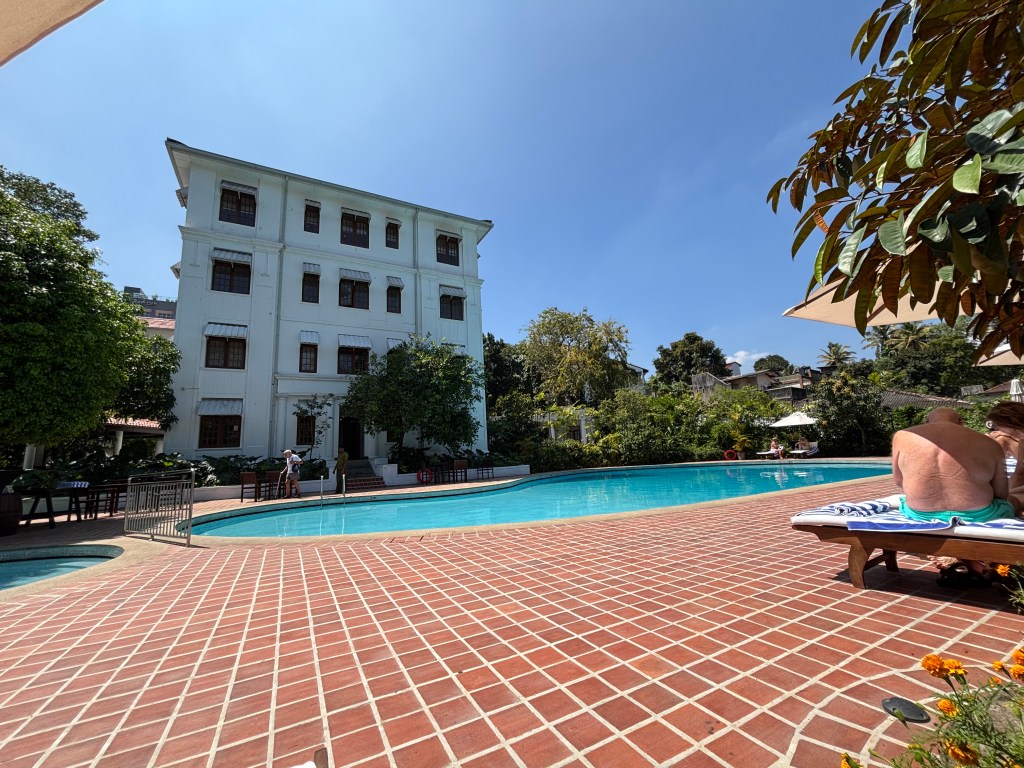
Around 1530 we walked up the the Hideout – about a 7 minute walk from the hotel. The exciting bit was crossing the road. It was very busy. In the end you waited for a gap in the lane of traffic nearest you, crossed and held up your hand hoping the next lane would stop or slow for you! It seemed to work.
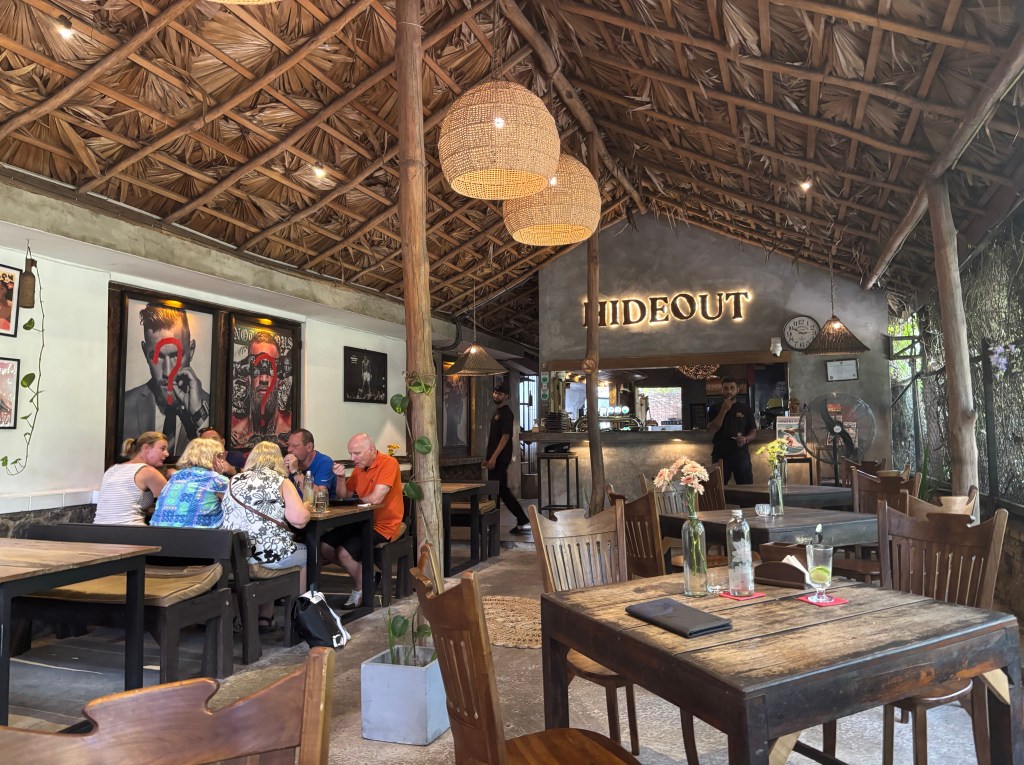
It was lovely thatched bar come restaurant. Having walked here we decided to have a snack and bought Cassava Chips and cheese with chilli’s on the side. Cassava is a a drought-tolerant, starchy tuberous root crop cultivated in tropical regions, serving as a primary calorie source for over 800 million people. Often called yuca, it is used for food (boiled, fried, or processed into flour/tapioca) and industrial starch. It must be properly prepared—peeled and cooked—to remove cyanide! Here they had fried them just like crisps. So far it seems to have been prepared correctly as we are not suffering from cyanide poisioning!
In the evening we tried out a bar that was above the city – Slightly Chilled Lounge.
It is owned by Michael, who moved to Sri Lanka after spending many holidays here and bought the restaurant. The menu is a mixture of Thai, local dishes and British dishes (sausages and mash, fish and chips). It was packed and was clearly very popular. We shared a table with 3 people from the Barmey Army. A had the Spicy Beef Curry and Gillian the Chicken Curry, for starters we had BBQ chicken wings and chicken meat balls. Food was great. He had a good singer on playing popular/well known songs which got everyone involved. We had taken a tuk tuk up the hill and took one back at the end of the evening. We were not that late back and ended up in the bar with Tony, Lynne, Angus and Ian till later than we had expected!
30th January – 1st T20
Walk around the Kandy
The T20s were all in the evening so we had the day to ourselves. Late breakfast, followed by a trip downtown. We ordered a tuk tuk via Uber – seems strange to be able to do this in Sri Lanka – you have the option of tuk tuk, car or motorcycle. The prices are much cheaper than ordering one direct where you are charged tourist prices. I do feel a little guilty paying 50p for a tuk tuk so always given them a hefty tip. Gillian has started to get an aversion to the tuk tuks. This particular driver was even more crazy than the ones we had in Colombo. Stop, start, squeezing between buses and cars and an almost complete disregard for pedestrians. His sense of distance, particularly near distant seemed to be completely absent. It was so bad Gillian agreed to walk back to the hotel!
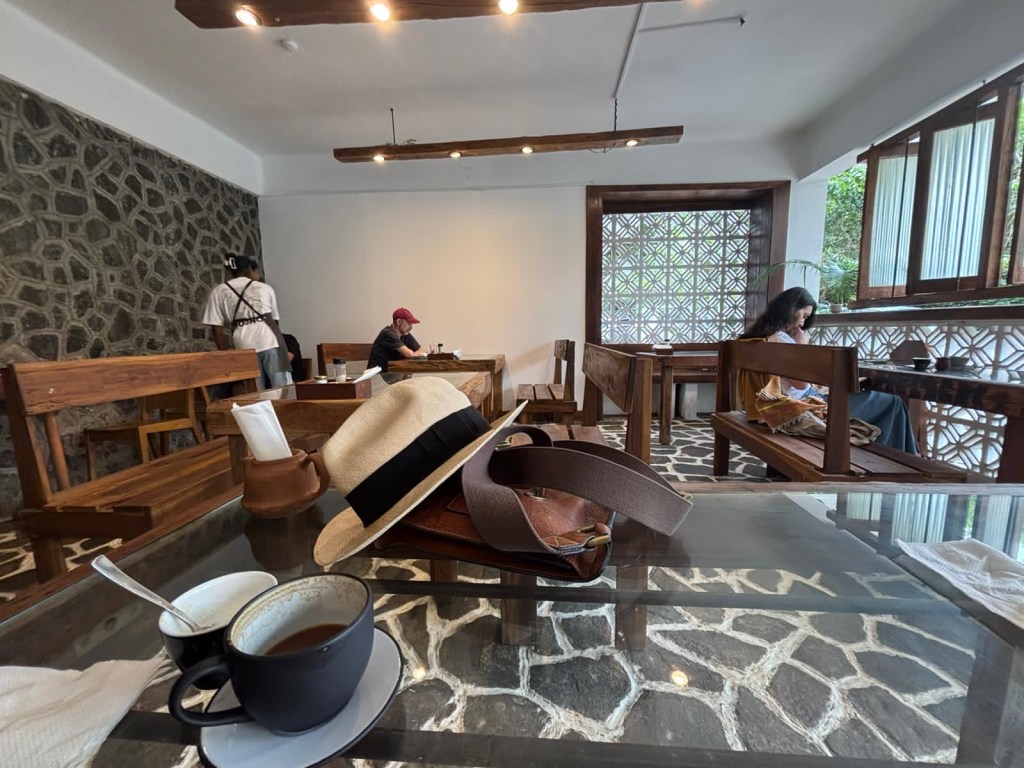
We had gone down to get a decent cup of coffee somewhere quiet. We found via WhatsApp Buono – a very small place tucked off the one of the main streets in Kandy. Probably only sits 16 or so people. Everyone was a tourist probably due to the prices – still cheap for us but expensive for locals. we also shared a chicken rice bowl which was delicious.
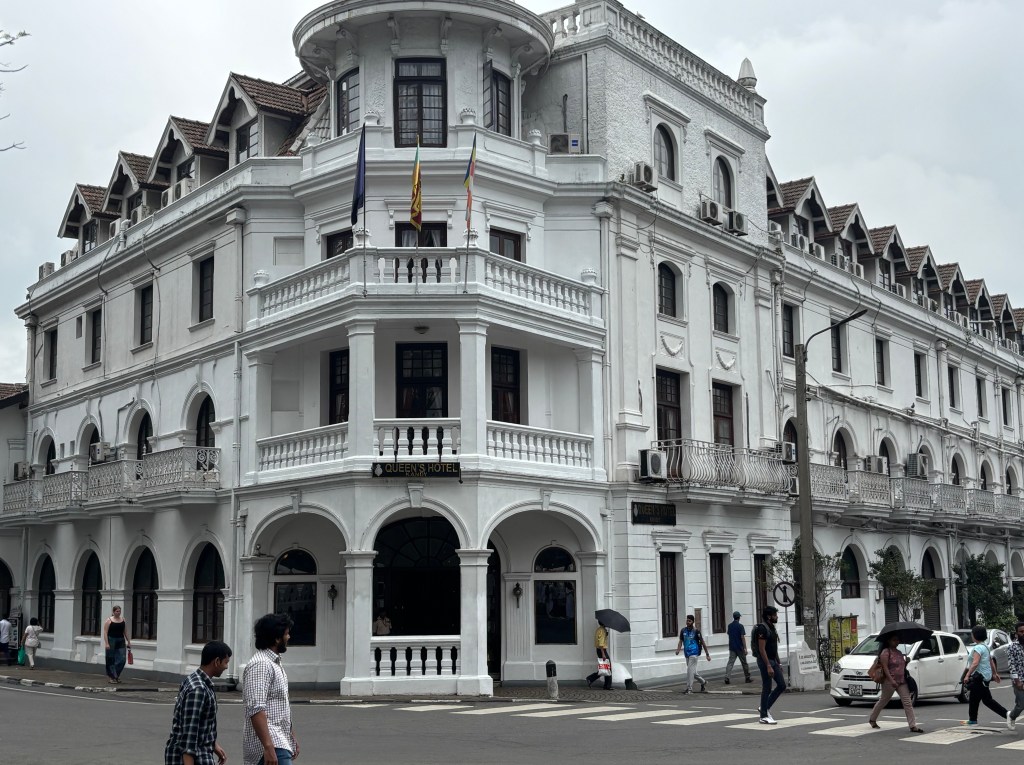
We walked back along the quiet side of the lake together which took around 35mins. Passing the Queen’s Hotel. The hotel was originally constructed as a residence, the ‘Dullawe Walauwa‘, designed by Devendra Mulachariya on instructions from King Sri Vickrama Rajasinha. Soon after the British defeated the Kandyan Kingdom in 1815, – the last to fall in Sri Lanka, it was adapted as a mansion for the Governor of Ceylon, with adjoining buildings constructed to house British troops. It has been a hotel for 160 years and prides itself on colonial style service. We have yet to go in abut will try and have tea or a drink there before we depart.
1st T20 – Pallekele Kandy
Score Sri Lanka 133 v England 125/4 won on DLS method
For the first time in Sri Lanka it rained. And as the evening approached it got heavier. The trip to the stadium which was around 11km away was a bit of a nightmare. Traffic was exceptionally heavy – end working day combined with cricket traffic. We left around 1715 in the evening and got there around 1830. It was still raining and when we got up the top of the stand the entire ground was covered in large heavy plastic sheets. Unlike Colombo our seats were not reserved and it was a bit of a free for all to secure somewhere with a decent view.
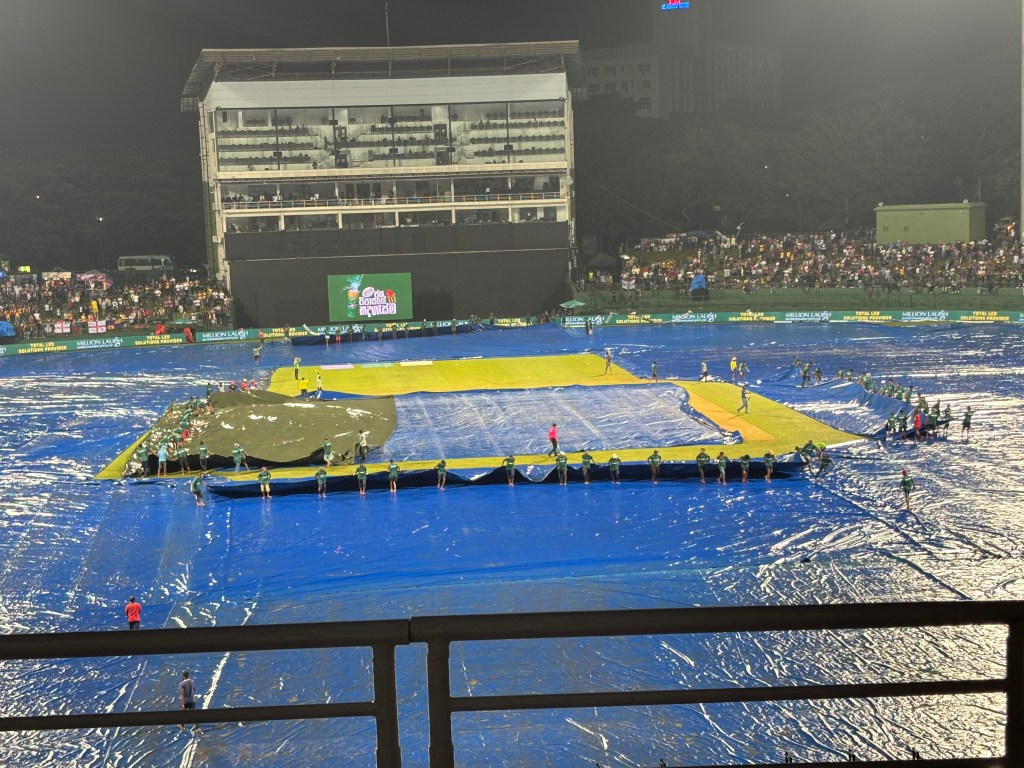
Play was delayed till 2040 and consequently we lost 6 overs in the match – each innings being reduced to 17 overs. It was impressive to see how many people were involved in removing the covers manually. The entire field was ready within about 30 minutes. England won the toss and decided to field first. We were sat next to three Sri Lankans who were simultaneously watching the Australian Open Semi-Final between Sinner and Djokovic. Djokovic won.
Nissanka and Mishara were the opening pair and got off to an average start – 55/1 after 6 overs. Mendis ended up being the top scorer with 37 off 20 balls. England started with the two fast bowlers – Jofra Archer and Jamie Overton. Then by the 5th over the spinners came on – Liam Dawson and Adil Rashid. These two were rated the best with Rashid getting 3 wickets and Liam 2 wickets. Although Sam Curran bowled, until the 16th over of the Sri Lankan innings his performance had not been great until then he got a hat-trick – 3 wickets with 3 balls. (Shanaka, Theekshana, Pathirana.).
England’s openers were Phil Salt and Jos Butler. A good start 14 off the first over, 6 off the next and 17 off the third over. But we lost Jos Butler at the end of the second over for 17. Phil Salt then paired with Jacob Bethell who lasted 11 balls and then Phil Salt paired with Tom Banton (15 balls) and finally Harry Brook. Phil Salt was out for 46 and there was a collective graon that he did not make 50. Harry Brook and Sam Curran were guiding England to victory when the rain came. England were within 9 runs of victory with 2 overs to go.
There were two highlights from the match – Sam Curran’s hat trick and the bowling of Pathirana. He is a ‘sling’ bowler, a very unusual style that was pioneered in Sri Lanka by Lasith Malinga. The style came about through playing cricket with a soft ball – tennis ball – where you don’t want it to bounce. It was very controversial when it was first seen and few cricketers have mastered it – but one who has is Pathirana. It is impressive to watch.
With the late start of the match it was a very late finish and we did not get back to the hotel till after midnight. We eventually got to sleep at 0130 and had an early start the next day.
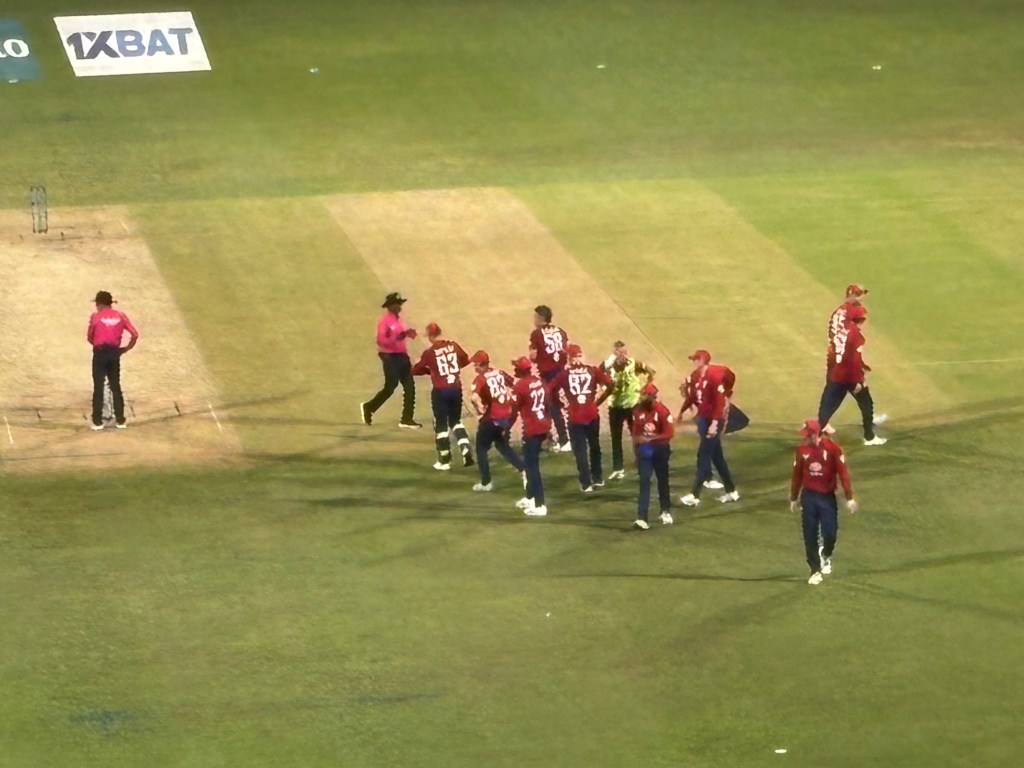
31st January – Tour of Kandy
Sri Dalada Maligawa – Buddha Tooth Relic Temple
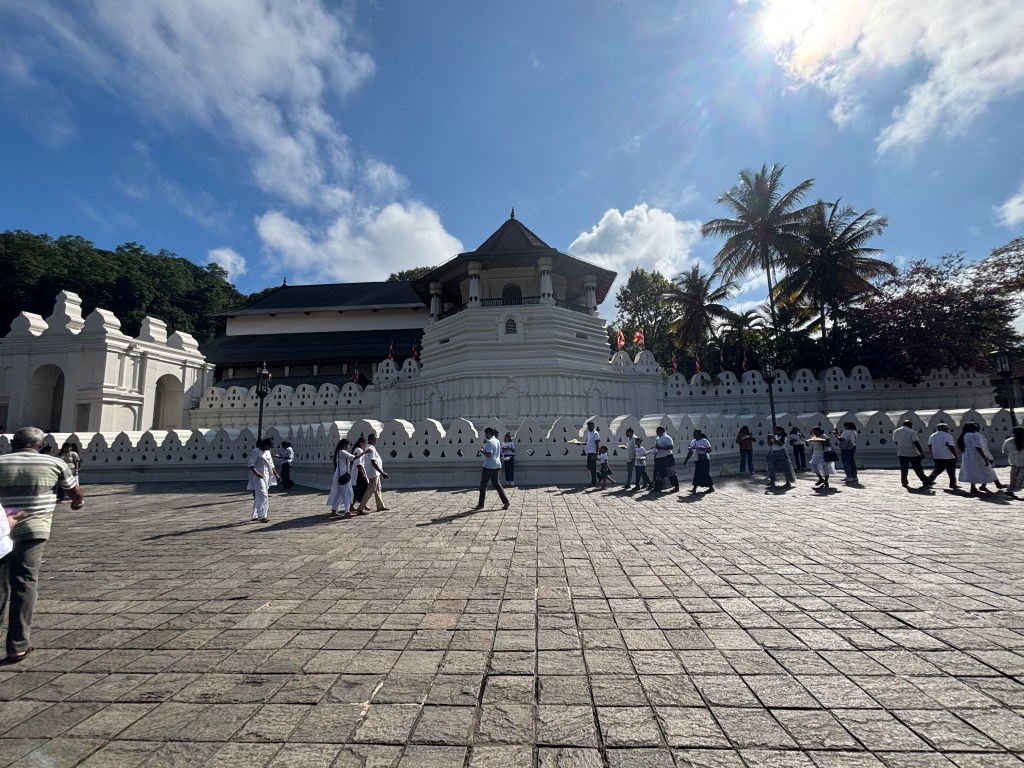
Kandy was the last kingdom in Sri Lanka to loose its independence to the British in 1815. Prior to Colonial intervention there had been a number of kingdom’s in the country which was strongly Buddhist. One of its most scared relics was the left tooth of the Buddha which had been rescued from his funeral pyre. Whoever had control/hold of the relic was considered the senior King or Queen. As Kandy was the last Kingdom, the tooth relic was resident in Kandy in the Sri Dalada Maligawa.
The first “Dalada Madura” in Kandy, which housed the Sacred Tooth Relic was built by King Wimaladharmasuriya during his reign from year 1592 – 1604. This was destroyed by the Portuguese during their invasions. The second temple was built in the same location by King Rajasinghe the Second during his reign from 1635 – 1687, which was burnt by the Dutch. In 1687 King Wimaladharmasuriya the Second built a 3 storeyed Dalada Madura and performed Dalada rituals with great devotion but with time the building was decayed and destroyed. Later his son King Sri Veera Parakrama Narendrasinghe who reigned from 1707 – 1739 built the 2 storeyed Dalada Madura which can see today. The South Indian Kings who ruled the country from Senkadagala renovated and protected the shrine which was built by King Narendrasinghe.
The temple was finely renovated by King Keerthi Sri Rajasinghe. Paththirippuwa or the Octagonal Pavilion was constructed by King Sri Wickrama Rajasinghe who reigned from year 1798 – 1815. Protecting of the Sacred Tooth Relic and conducting religious rituals have continued without a break to the present day under the supervision of the three chief custodians of the Tooth Relic.
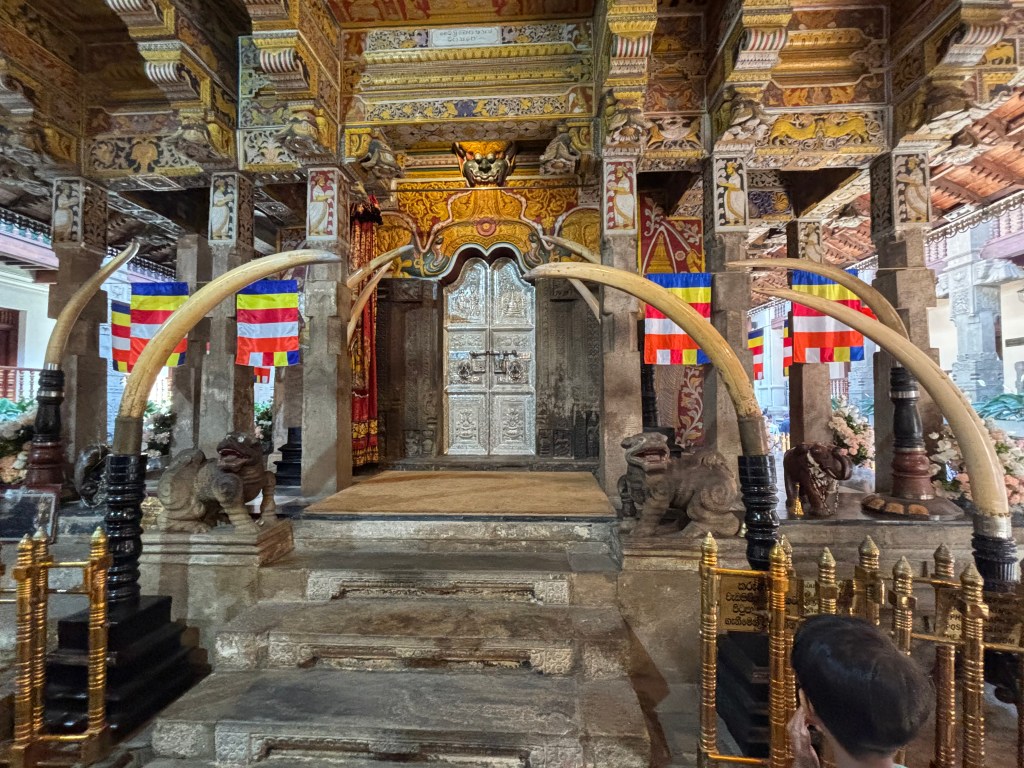
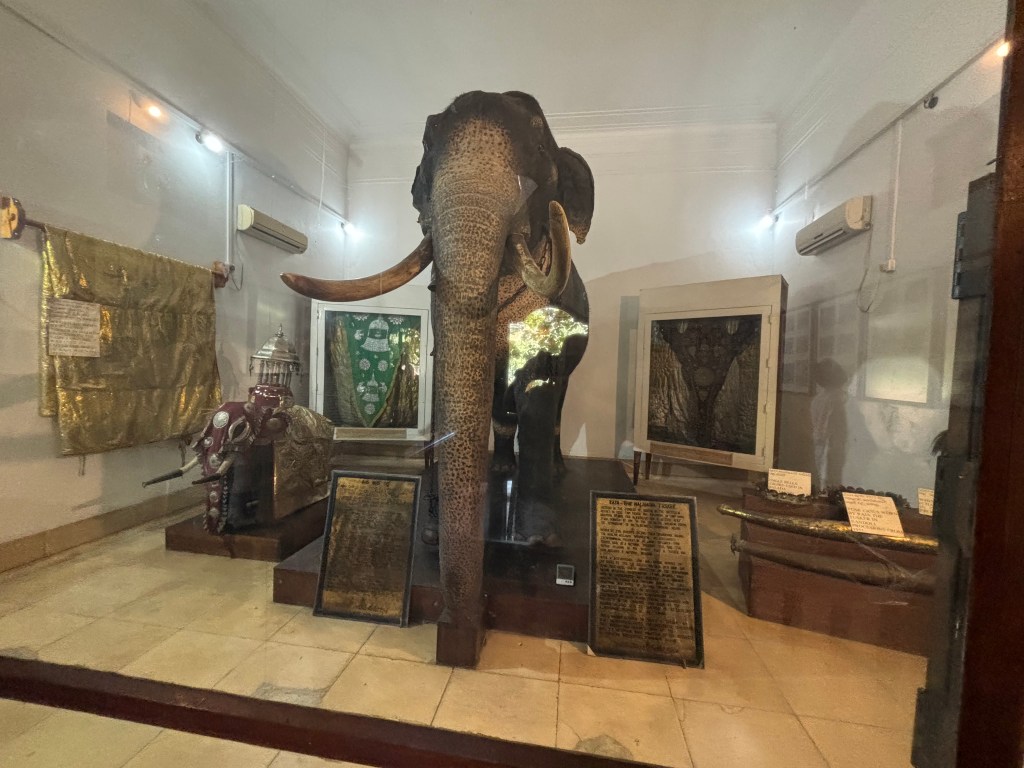
The British understood the importance of the Tooth Relic and as part of their ‘takeover’ or treaty with ehe Kingdom of Kandy, they undertook to bring back to Kandy the relic and hand it over to be placed in the temple as a permanent location. A great ceremony was created with drummers, dancers and a great ‘tusker’ (elephant) whose tusks were capped with gold who brought it back to the city.
Inside the temple grounds is the Audience Hall where the Kandyan Convention was signed in 1815. It features Kandayan architecture and intricate hand carved wooden designs. It is an open structure with a roof and there is a replica in the centre of Colombo – Independence Square. This Convention effectively brought to an end 2,500 years Sinhalese Monarchy
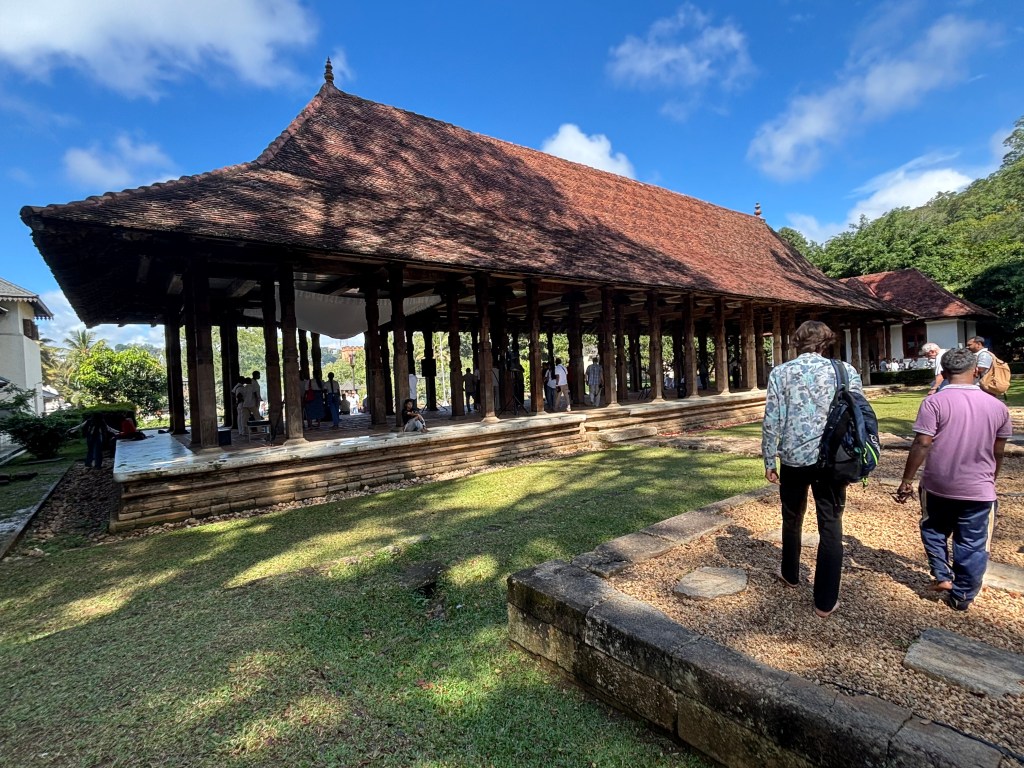
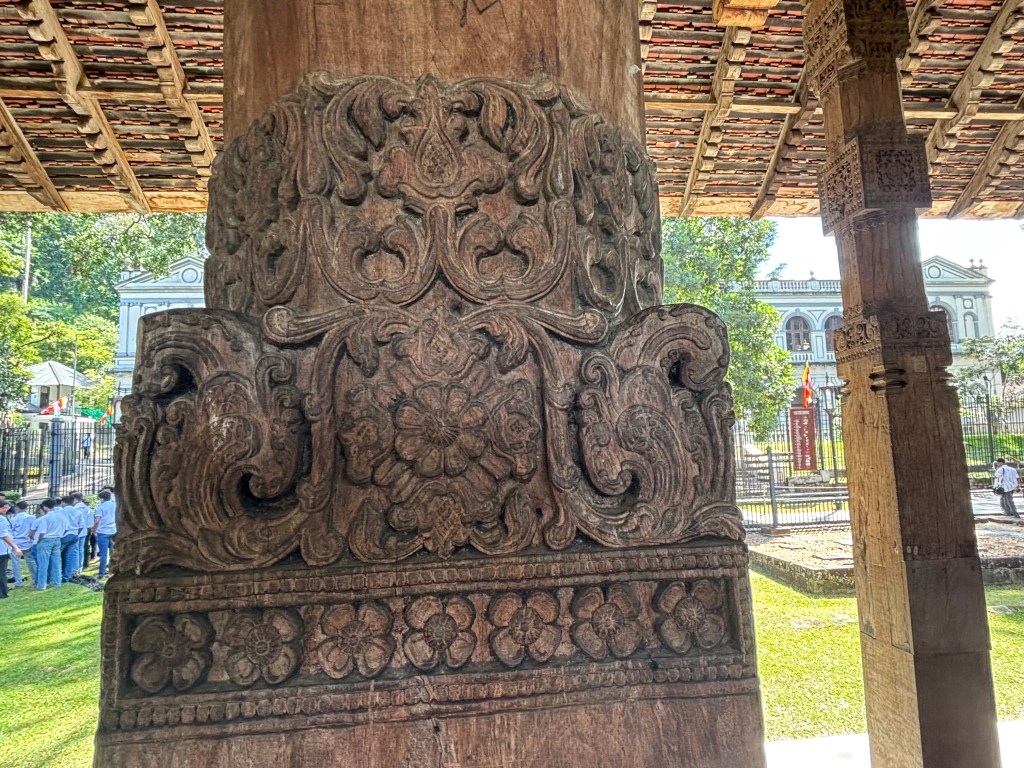
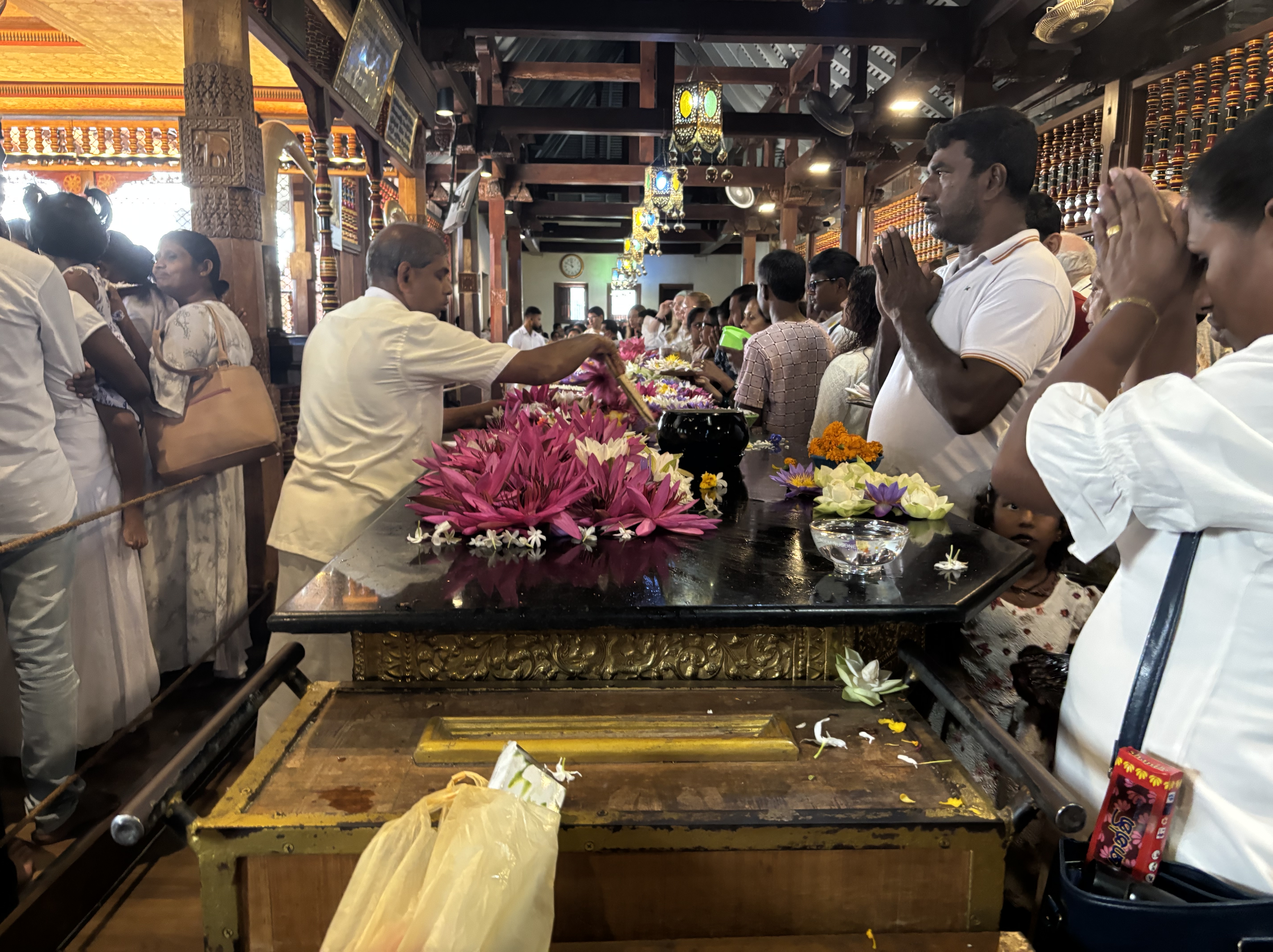
The temple itself is a huge and complicated structure and set of buildings. We had arrived at the time of offerings to the Buddha. As this is one of the most venerated temples in Sri Lanka it was extremely busy with pilgrims not just from Kandy but from across the country. Whilst it seems to be accepted that tourists are part of the scene, it does sometimes feel as if we are intruding on a private and scared ceremony. On the other side of the coin, tourism brings in a serious amount of money which contributes to the upkeep of these UNESCO Heritage sites.
Botanical Gardens
Following the visit to the Temple we took the coach across the city to the Horticultural Gardens. The total area of the botanical garden is 147 acres (0.59 km2), at 460 meters above sea level, and with a 200-day annual rainfall. The history of the Royal Botanic Gardens dates as far back as 1371 when King Wickramabahu 3 kept court at Peradeniya near Mahaweli Ganga. Later, in the reign of King Kirti Sri from 1747 to 1780 this was made a Royal Garden and from 1780— 1798. The present Botanical Gardens were formed in 1821 six years after the final conquest of the Kandyan Kingdom. By 1843, with the donation of seeds and plants from Kew Gardens in London together with a collection from Slave Island, the Botanical Gardens was formally recognised. The gradens are boarded by the River Mahaweli – the longest river in Sri Lanka.
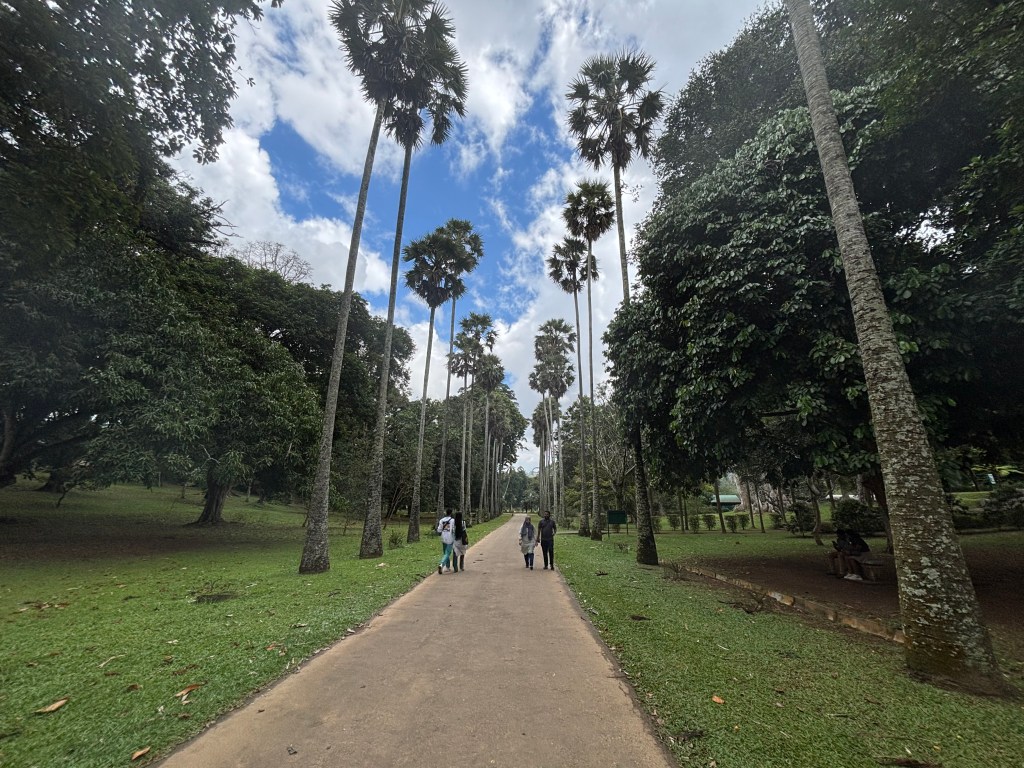
We decided to wander around the gardens by ourselves. A beautiful setting and whilst very popular it is so large that it is easy to find places where there is virtually no-one around. Gillian very much wanted to go to the orchid house. What struck us that the orchids were not plated in soil but what looked to be charcoal lumps. Orchids require specialised, highly porous, and airy, potting media rather than traditional soil, as most are epiphytes that breathe through their roots.
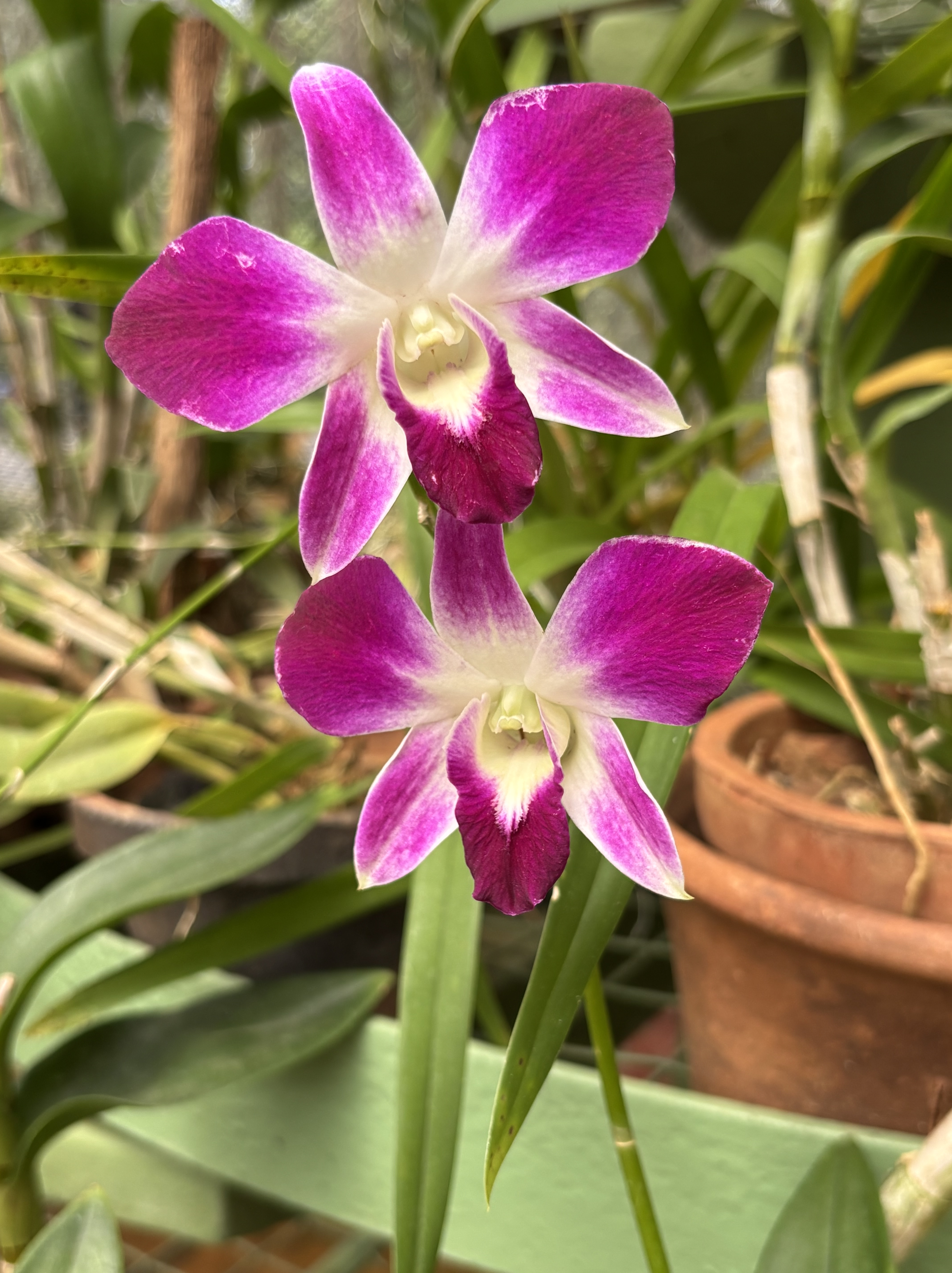
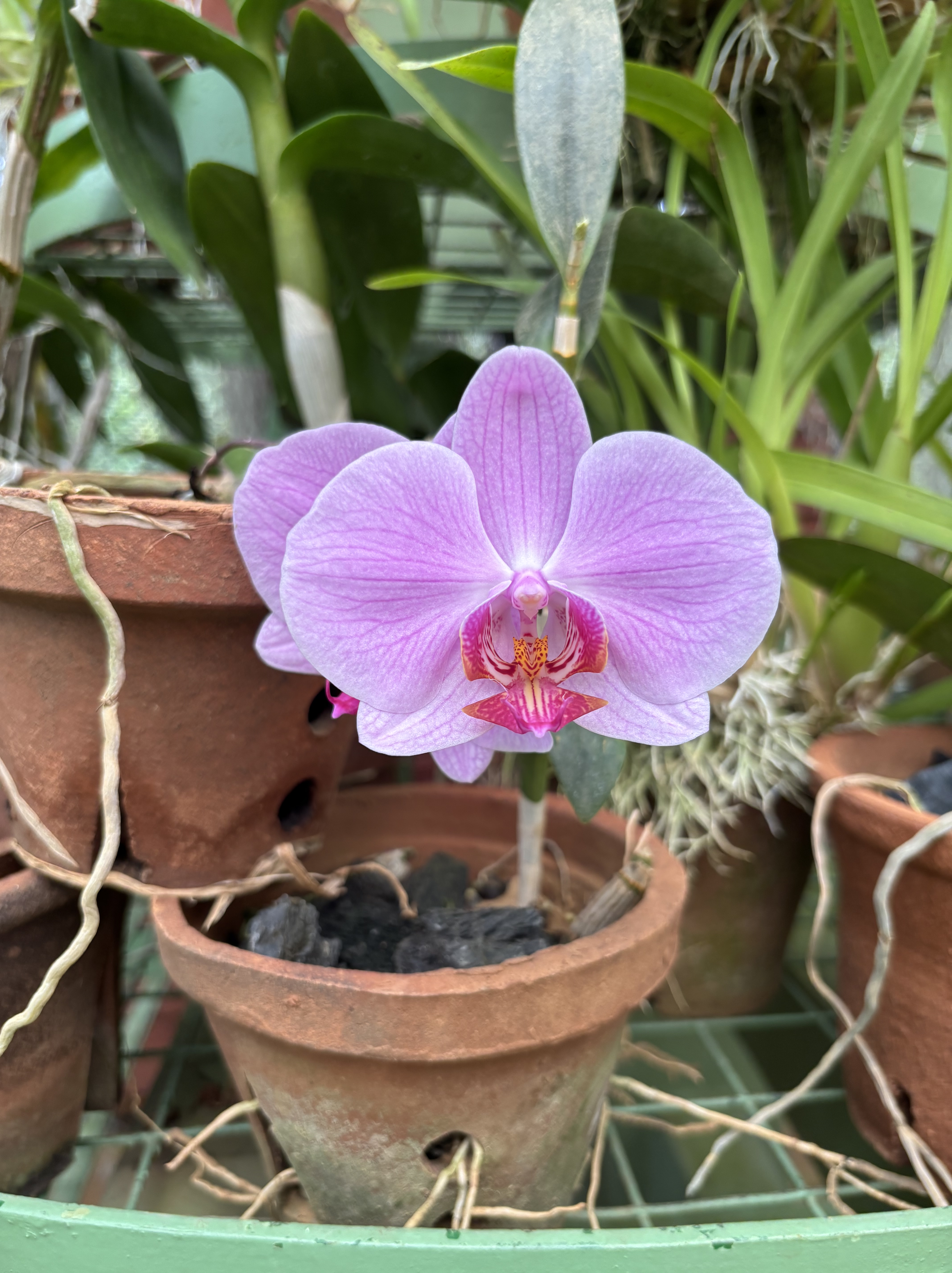
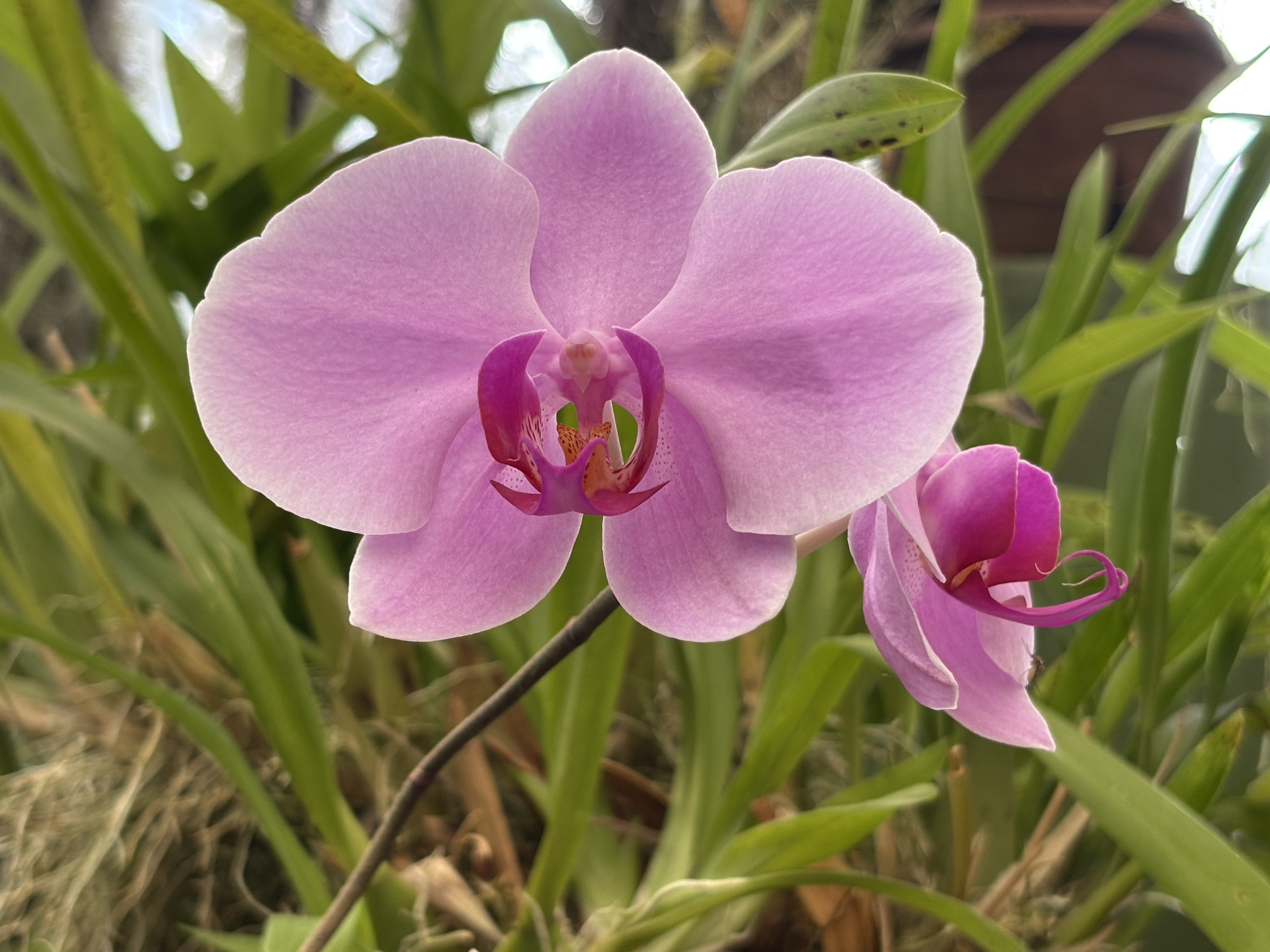
From here we walked through the Rose Garden and Conservatory where ferns were kept. Before walking up the hill to the Canteen.
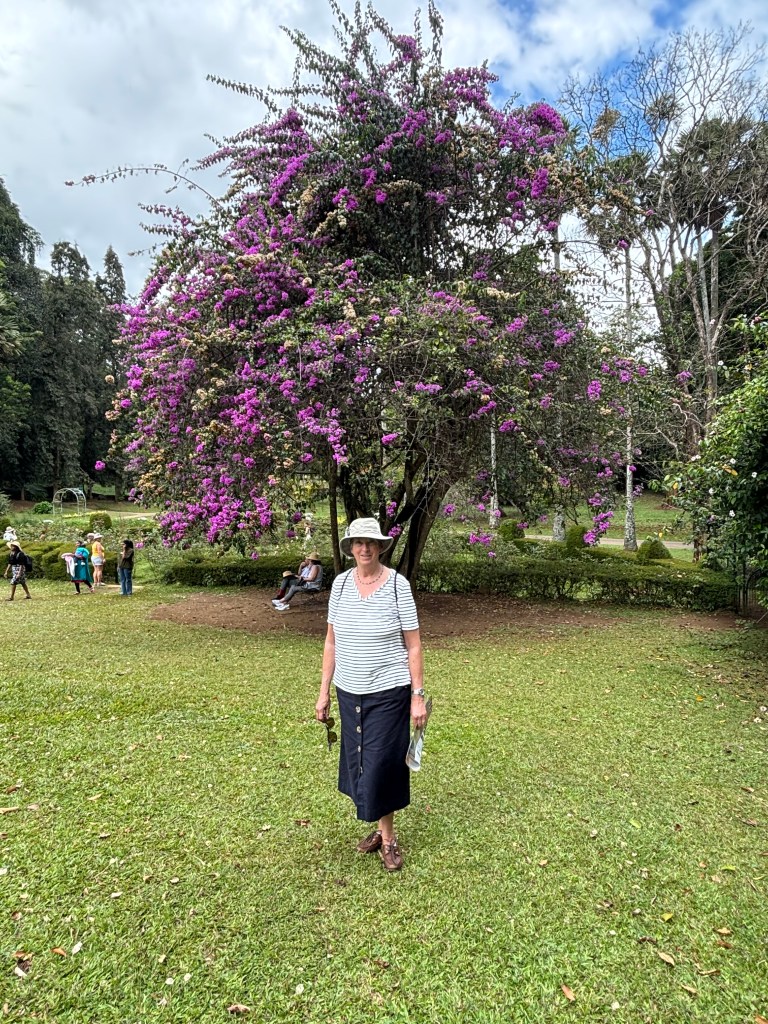
The Canteen was not the restaurant on site but looked like where the workers went – but it was open to the public – I think! We stopped and had a tea, iced coffee and a couple of samosas. Very pleasant with just a 4-5 garden staff having a late lunch.
From here were strolled through the arboretum – a 34.5-acre, unique dry zone forest sanctuary established by Sam Popham in 1963. It focuses on the conservation of indigenous trees and biodiversity. The site serves as a vital educational and research facility, featuring over 130 species of trees. The trees were magnificent; tall, majestic with huge root systems. It was like walking though a small forest with the sound of birds and as we got closer to the river the chatter of fruit bats hanging from the trees.
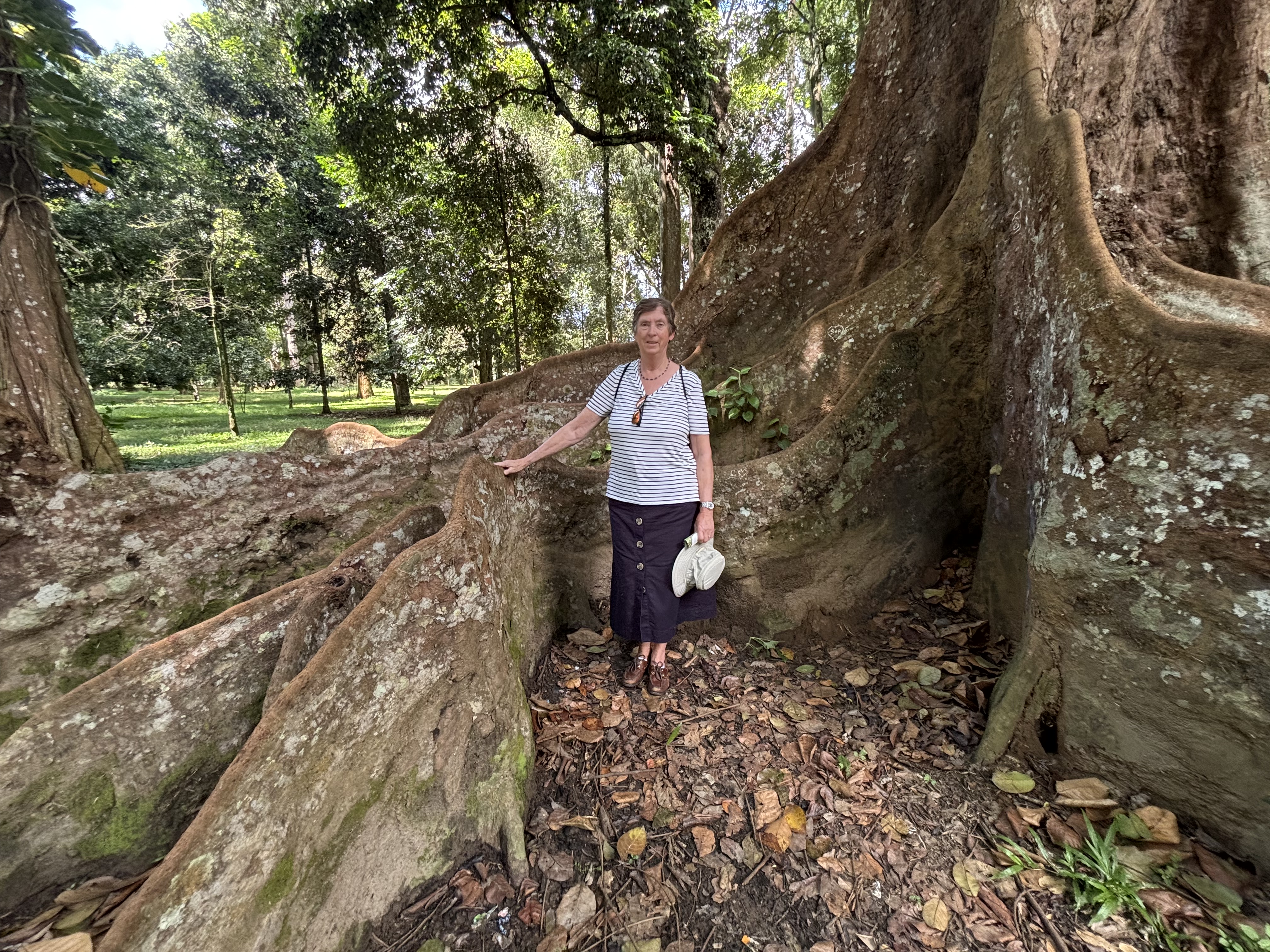
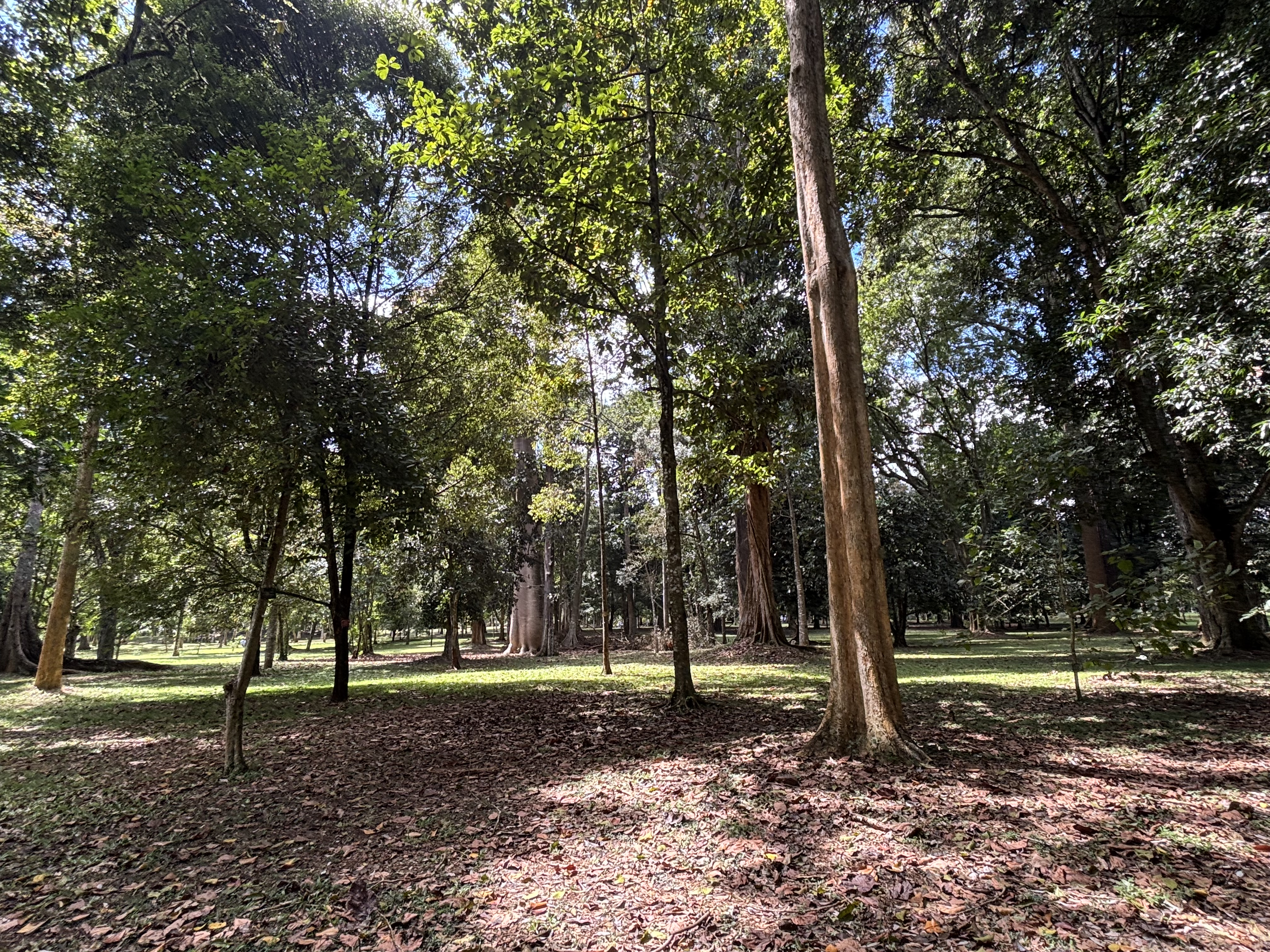
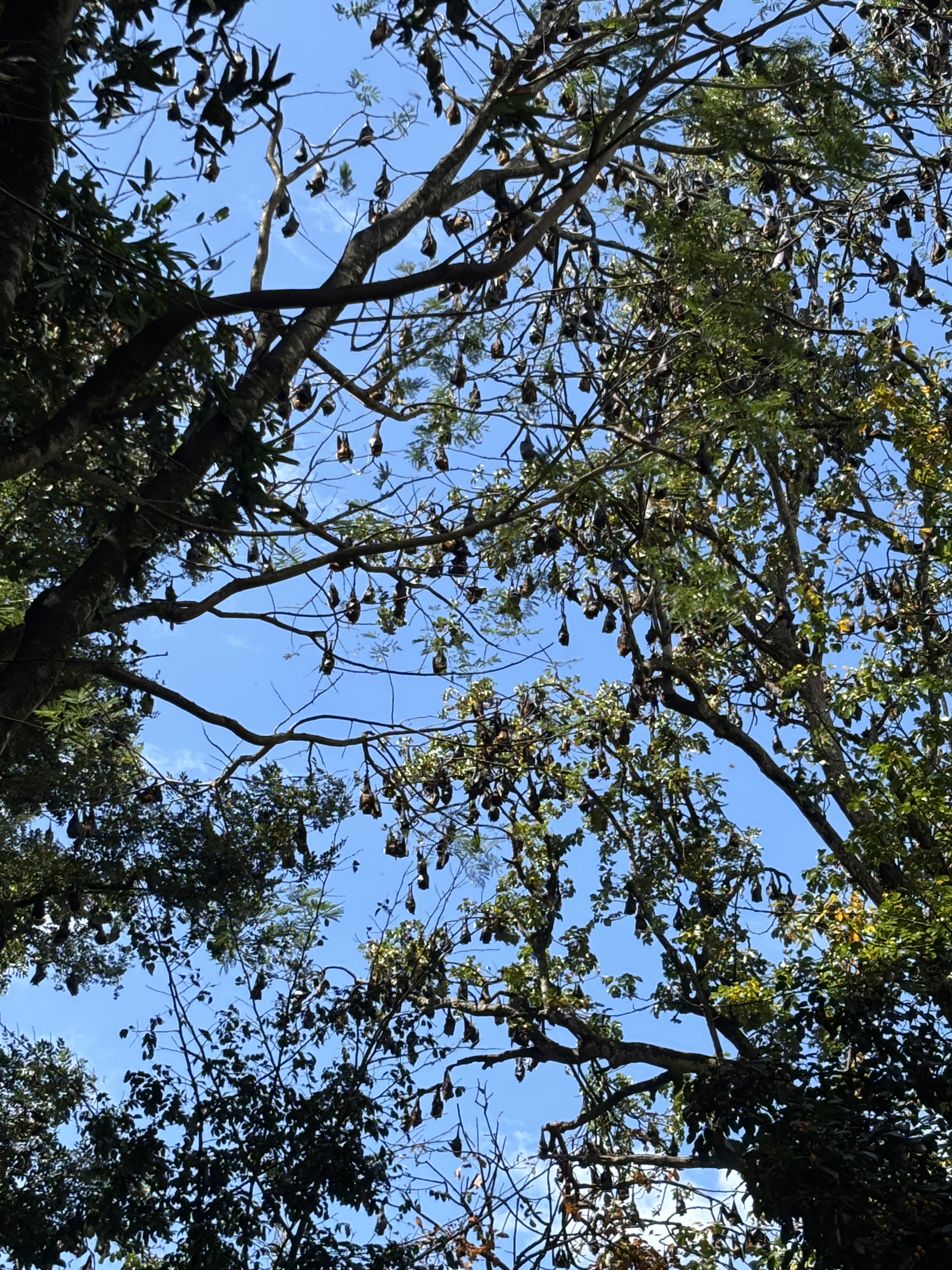
We timed our departure just right as the heavens opened as we climbed into the tuk tuk. A much safer driver than our last one! We can well believe Kandy has over 200 days of rain per year!
We had an early supper – Gillian a lamb chop and myself Sri Lanka Rice and Curry (Chicken) in the hotel.
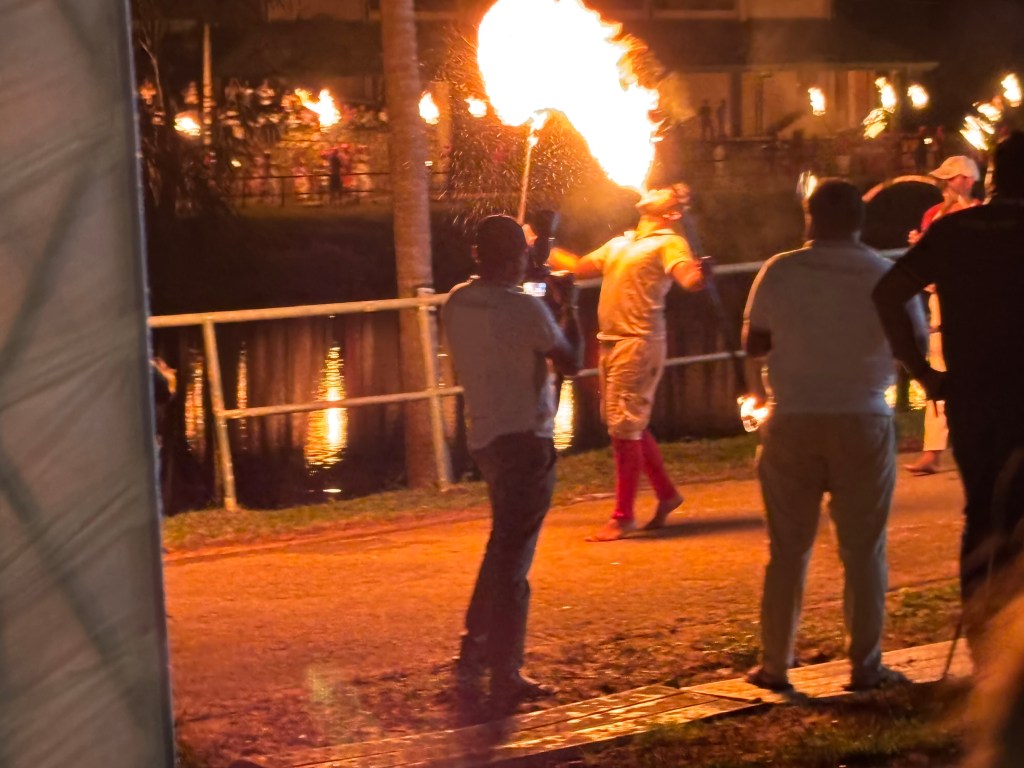
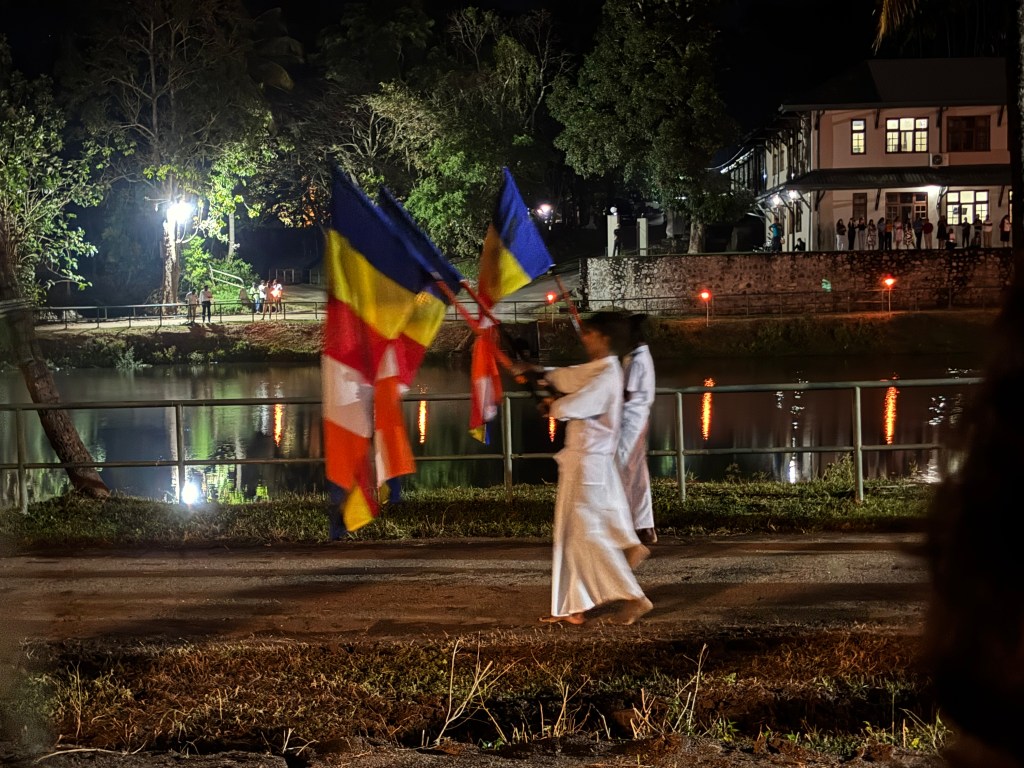
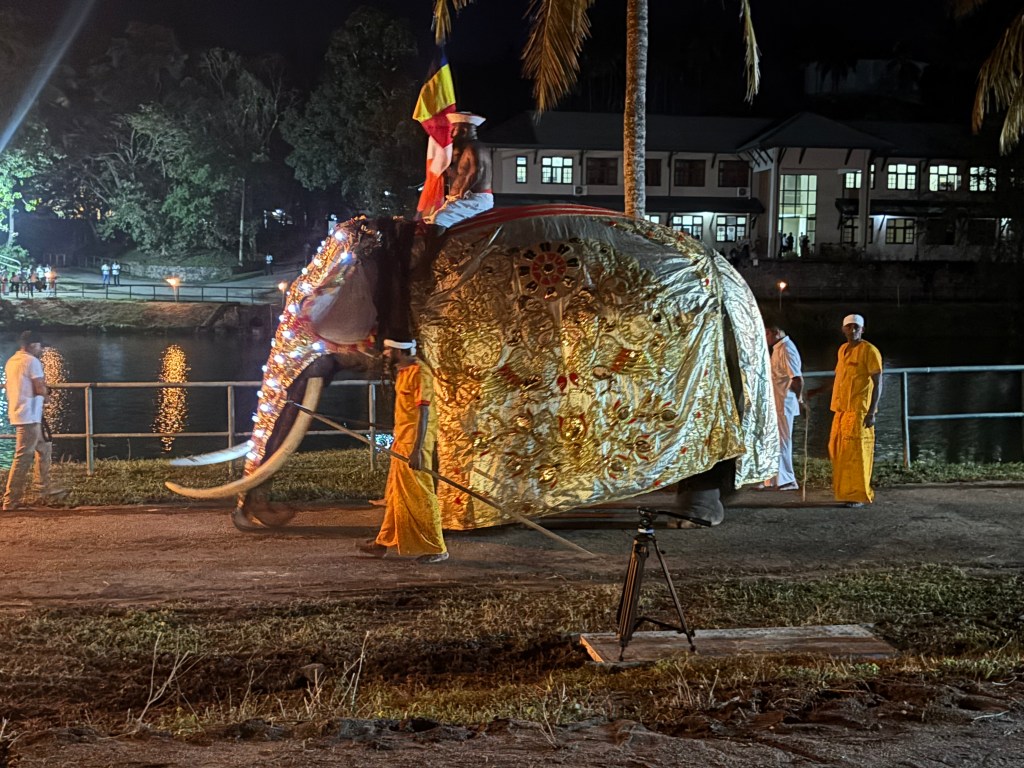
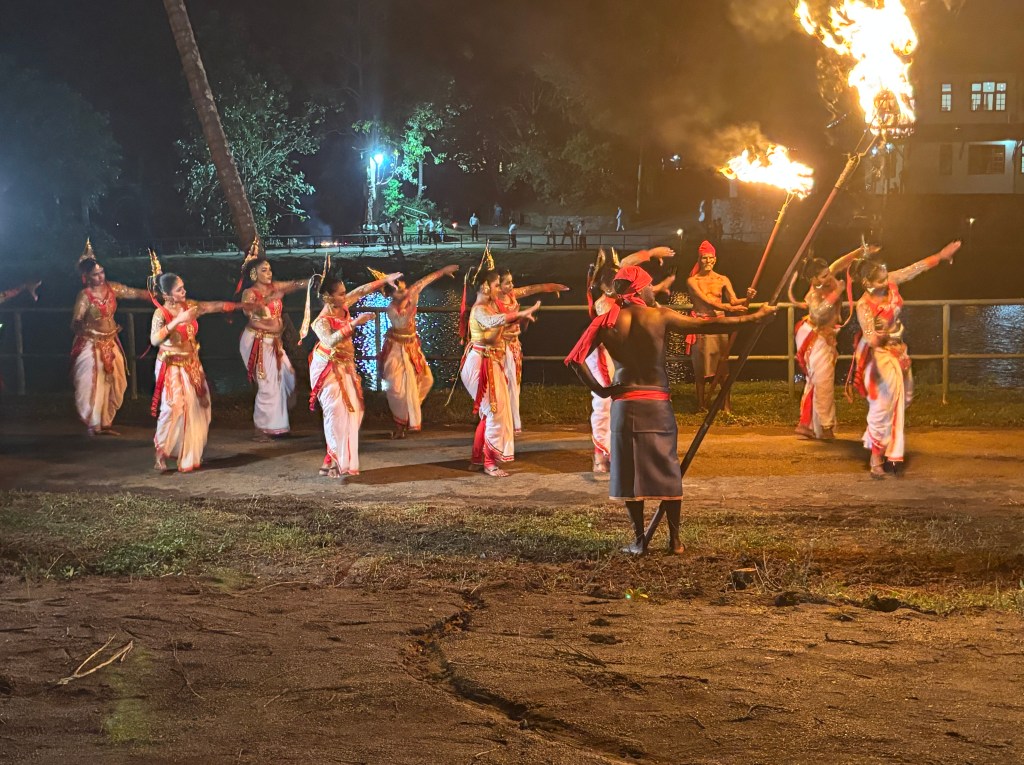
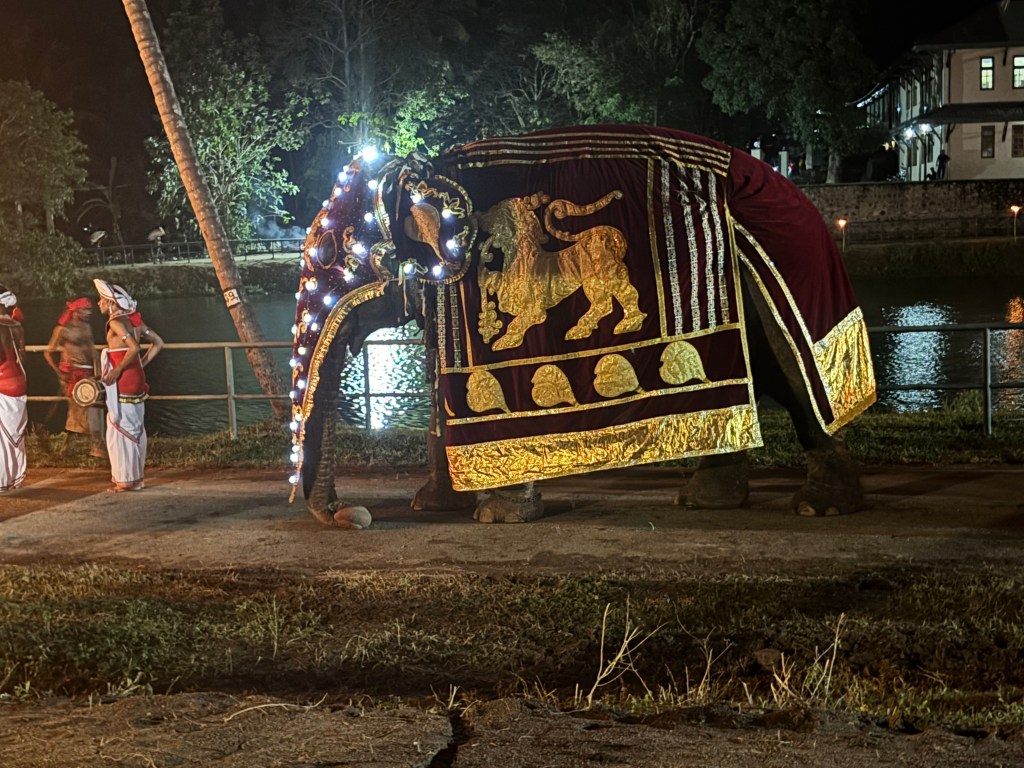
Evening Performance/Rehearsal of the Esala Perahera
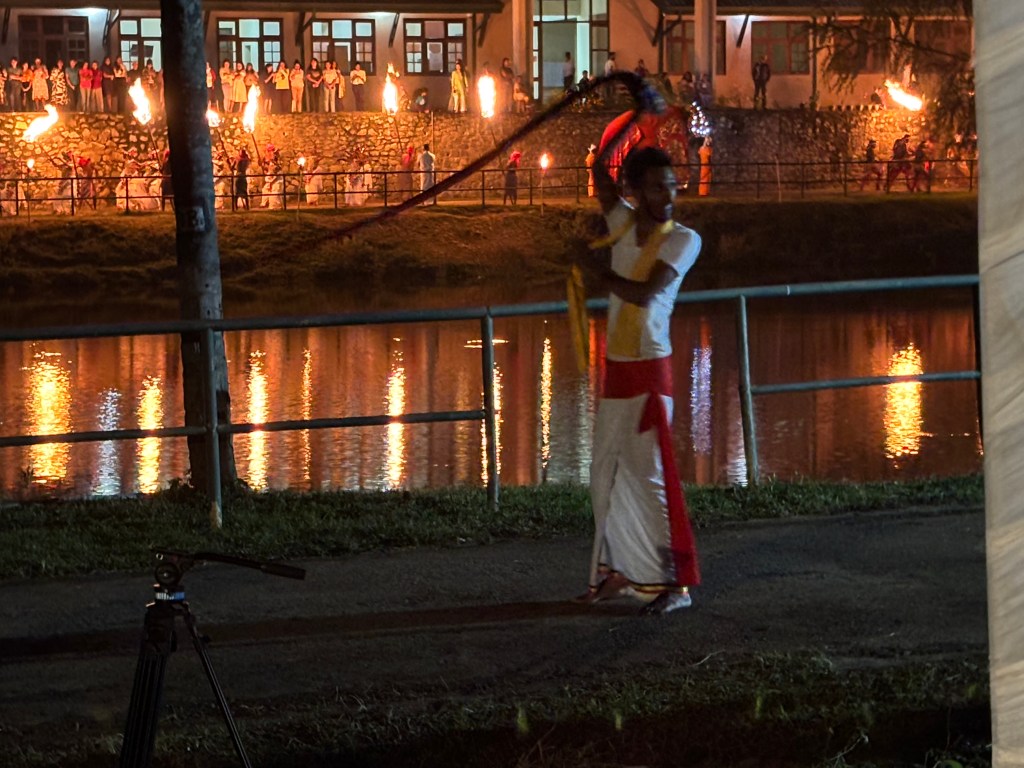
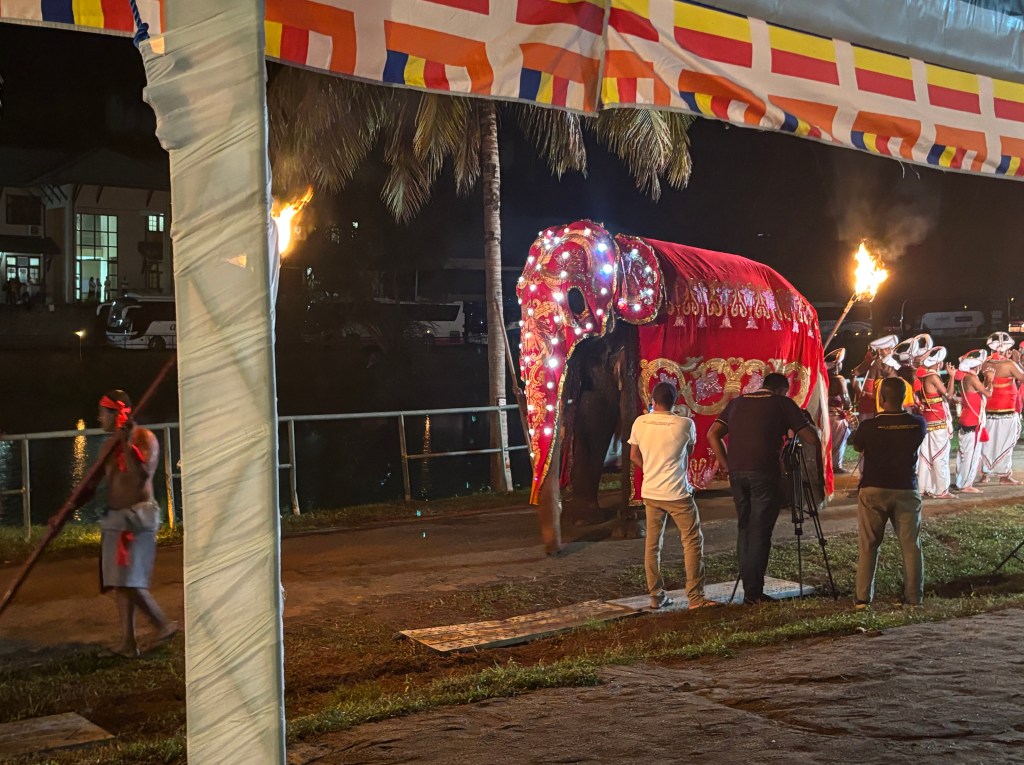
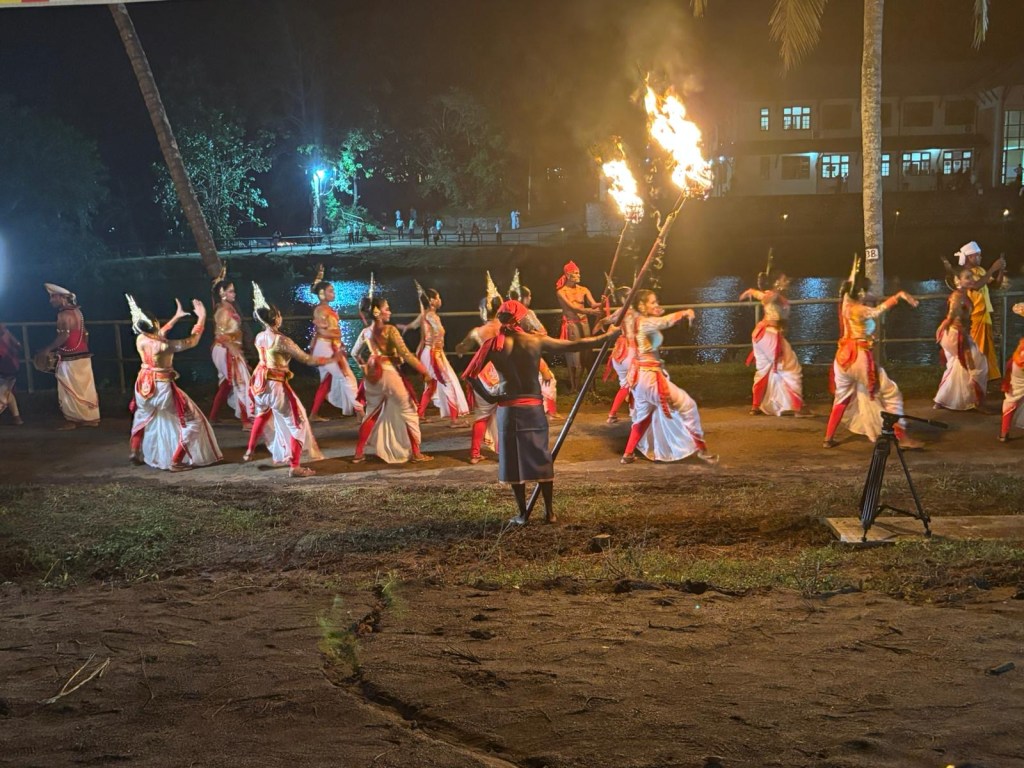
This took place at the Buddha University just outside Kandy. The Esala Perahera is an annual ceremony that takes place around August each year. I got a sense it is like our Easter, the exact timing is linked to a seasonal activity/moon state. The ceremony dates back to 3rdC BC. The present form of the Perahera dates back to the period of the Kingdom of Kandy; and the tradition of parading the Sacred Tooth Relic is over 1,500 years old. The event is a fusion of two different ceremonies – the original seeking the help of the rain gods for the coming rice season and the second to honour the Lord Buddha of which the tooth is seen as representing the living person of the Lord Buddha. The actual ceremony takes place over 12 days and this evenings performance was a mini-dress rehearsal put on for us.
The procession consists of:
- Whipcrackers – to clear the way and announce the arrival of the Tusker
- Buddhist Flag bearers with an official riding the first elephant
- Traditional dancers and drummers
- Devale Elephant – Tusker – carrying the sacred relic
- Basnayake Nilame – lay custodian of the sacred relic
- More dancers and performars
Although ours was a shortened ceremony it still took them 60 minutes to pass the stands. The stamina of the musicians and dancers was incredible. They never stopped and these were not simple swaying dances but full blooded physical dances. The elephants visibly swayed with the music, each decorated in elaborate ‘robes’.
1st February – 2nd T20 – Poya Day
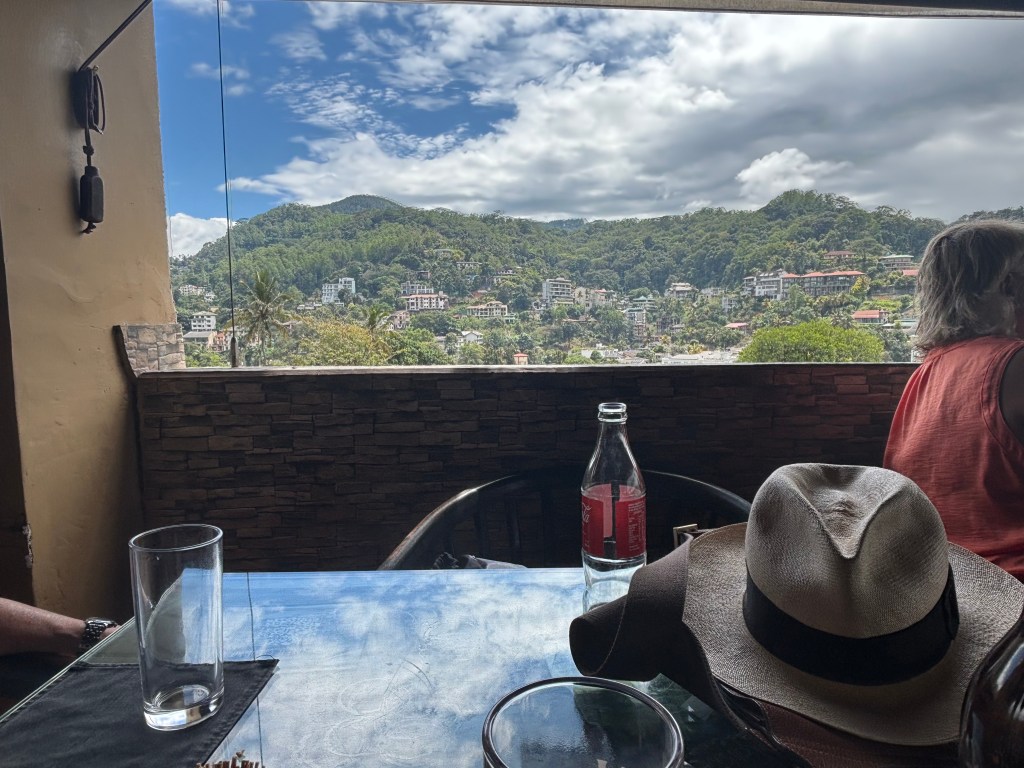
Poya is a full moon day and is a Buddhist day of prayer and reflection. The significance of the day to us is that no alcohol can be sold or drunk in public. We had as lazy morning by the pool and decided to go back to Slightly Chilled Restaurant for lunch. The added advantage of lunch here was were the great views across the city and hills above Kandy. The food was as good as before with Michael welcoming us back. It is a very social location and on both occasions we were here we chatted to some interesting people. This time is was to a woman who was working in a secret location that looked after young girls 12-14 who had been the subject of domestic violence or sexual abuse. In the short time she had been here she felt that there was an unpleasant under-culture in some areas where women were not treated well. On a more upbeat note, she was an avid cricket fan from Headingly, Leeds and we tried to persuade her to try a tour with Not Out!
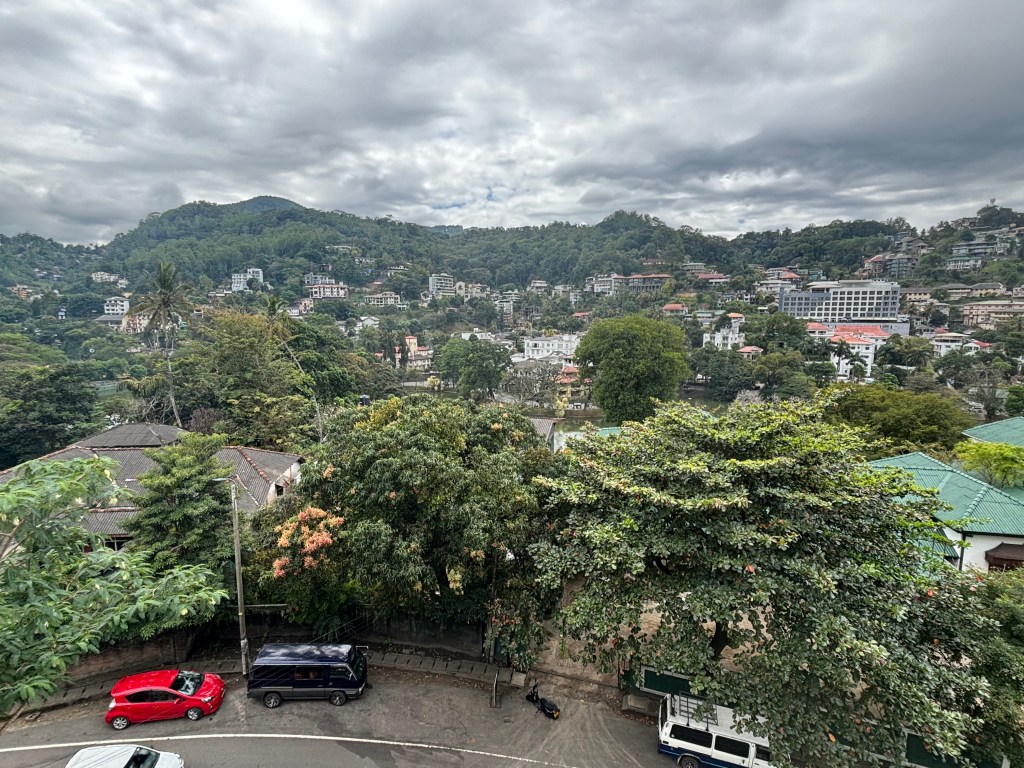
2nd ODI
Sri Lanka 189/5 v England 173/4 after 17 overs. Won on DLS
We arrived early so we could get some font line seats in the Stand – which worked. As it was a Poya day there was not alcohol for sale just soft drinks and the usual hot dogs which they seem to love. I have tried a couple and they are pretty tasteless! Having had a big lunch we were okay for food.
At the start of the match there was no sign of rain and we hoped for a full T20. England won the toss and decided to field first – again they wanted to chase. Sri Lanka got off to a great start – as usual they make the most of the 1st powerplay of 5 overs – 55/4. Nissanka was the first to having made 34 off 22 balls (Archer), next to go was Mishara in the 10th over 36 off 30 balls (Will Jacks). By now Sri Lanka were 106. Mendis was in next and he made a fast 32 off 17 balls, followed by Rathnayake with 40 off 22 balls. England bowlers had a bit of a hard time – no more so than Jofre Archer who had a number of chances dropped in the field. The average of dropped catchs for most bowlers is 70% and Jofre Archer is 40% but he got two in the end which included Raynayake who was the last wicket to fall.
England’s start was a lot more sedate. By the end of the 1st powerplay they were 39/2 with Phil Salt out first ball off Pathirana – the Slinger. At this point the odds of England winning on the predictor was 24%. During the 7th over, rain arrived and play was stopped with England on 57/2. With amazing efficiency an army of people covered the entire playing surface with covers in a few minutes. There was a considerable delay during which I received messages from Julian Bunce in the UK who was watching the match on Discovery+ and asking if play was going to resume soon. For the next 30 minutes I gave him a running commentary. During the rain interval the camera crews picked out groups in the crowd who were singing and dancing to the beat of the disco music. Usually it is the Sri Lankans who prove to be the best movers. However there was one British guy who got the loudest cheer by far for his moves. So much so that they repeated the clip of him around 3 times!
Play did start and England realised that they needed to start making shots to win this reduced over match – 17 overs. Joss Butler went in the 9th over for 39 off 29. Harry Brook and Tom Banton then came in. It was Harry that added the much needed momentum and sense of urgency with his 36 off 12 balls. This helped England catch up with the DLS target. Once he was gone it was down to Tom Banton and Sam Curran to get England to the revised target of 168. It did go down to the last over but with Harry Brooks great effort the pressure had largely been taken off England. Sam Curran was awarded man of the match for his 54 off 33 balls.
A late night with an 2330 finish and back at the hotel for 0030. A great match.
2nd February – Rest Day and Final Dinner
Tour of Kandy
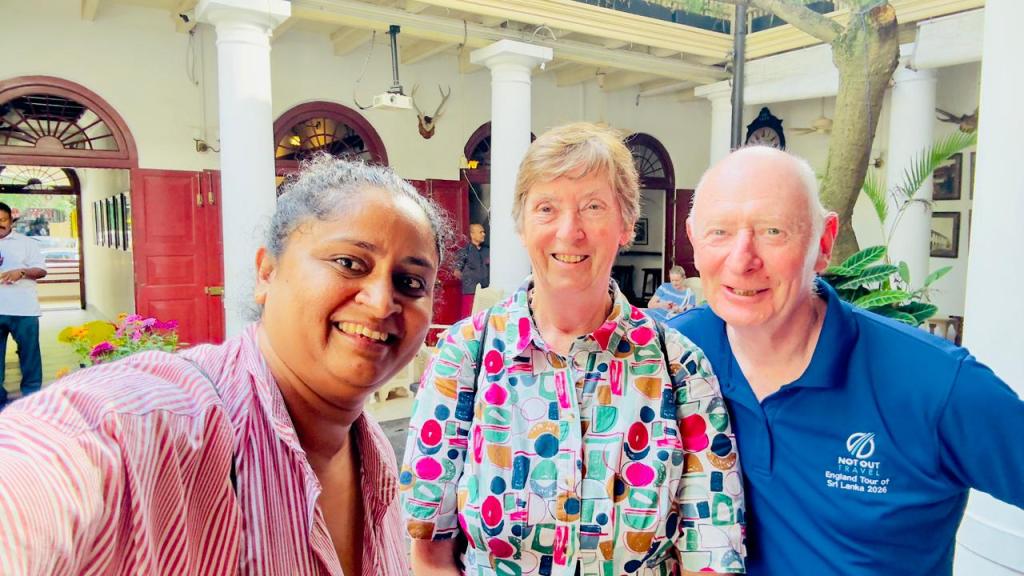
After catching up with the blog by the pool, we took a tuk tuk down into Kandy to meet with Buddhima. We used Withlocals again – we were quite tempted by the home cokking class at her house with her mother – but this was a 6 hours session and we had the final dinner this evening. So we chose the 3 hour 10 tastings of Kandy. We met Buddhima at a local bakery and set off for the local daily market. This was divided into sections – vegetables, fruit, fresh fish, fresh meet – all with their distinct areas.
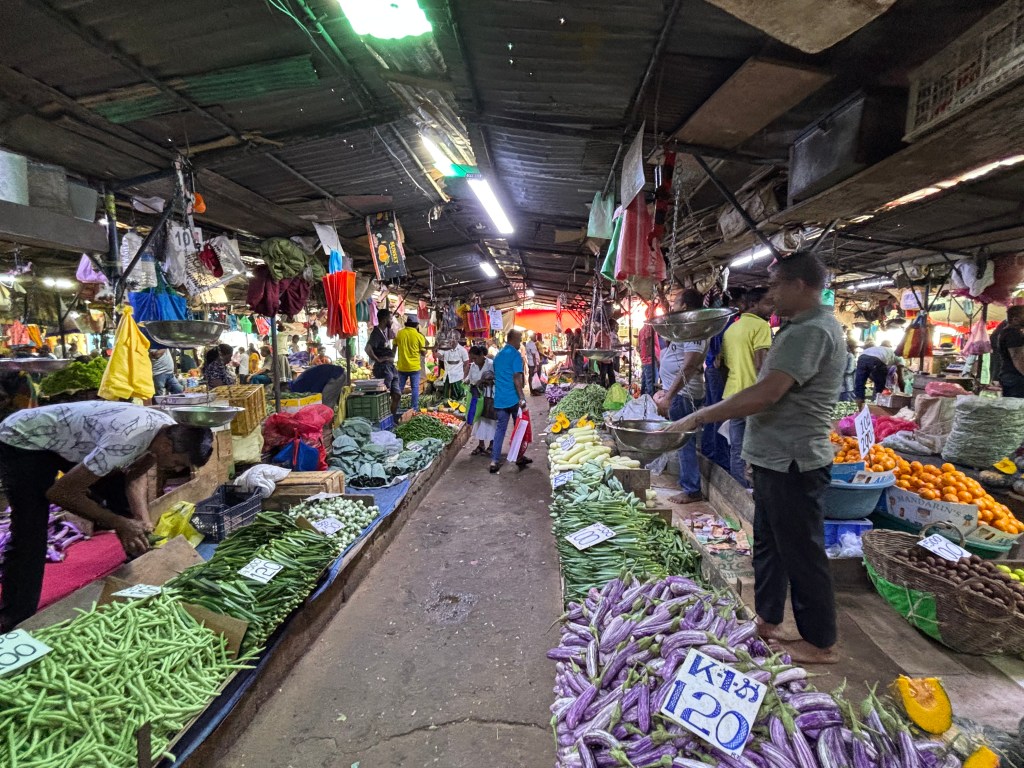
Stalls were laid out immaculately. Sellers jostled with one another for custom – but in a very polite way. Buddhima explained that in general each individual would use the same vendor every day – market was generally a daily trek. Vegetables, spices and fruit plus rice in various guises was the daily diet. People tended to be wary of fresh fish due to the distance it had travelled – Colombo – and much preferred dried fish. An average family would get through 3kg of rice per week and spices were needed to add flavour and texture. Meat was hardly ever eaten. There were no large dairy or meat herds – just locals who kept a couple of cows and a few chickens. ‘Mutton’ was actually goat rather than lamb/sheep. Milk was full fat powdered. There was insuffcient fresh milk to go around and it was too expensive. Despite the agricultural land in Sri Lanka much was still imported including rice.
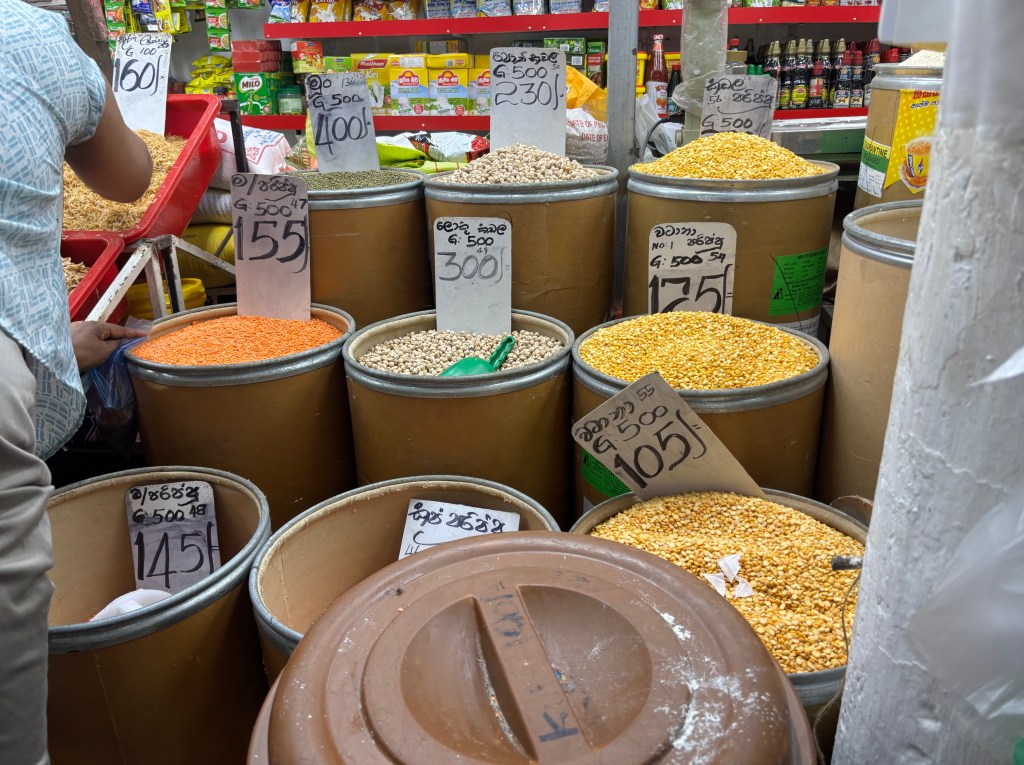
We tried a number of different fruits including passion fruit, red banana, star fruit, mango plus others the names of which I cannot recall. I hardly ever eat fruit at home – it is fairly tasteless. here the fruit has texture taste and a sweetness we cannot find in imported fruit.
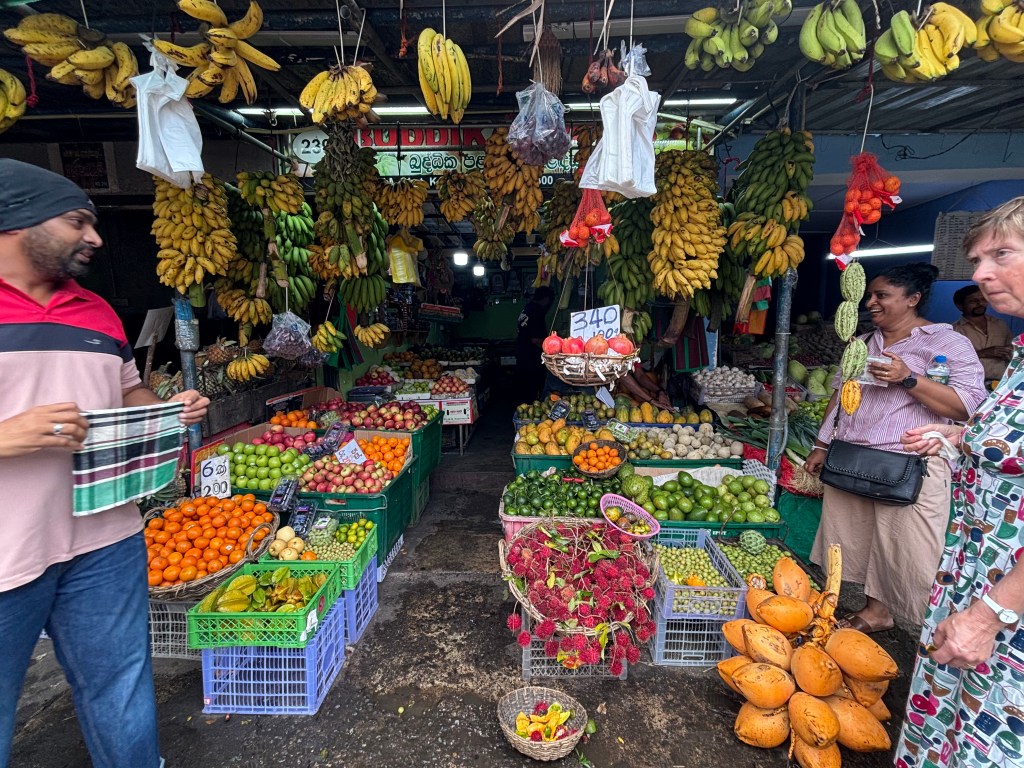
We stopped at a spice stall and Gillian bought some curry powder to take home. However choosing was not straightforward as they have different curry powder for different dishes – meat, chicken, vegetable and fish. we think we bought a general purpose one!
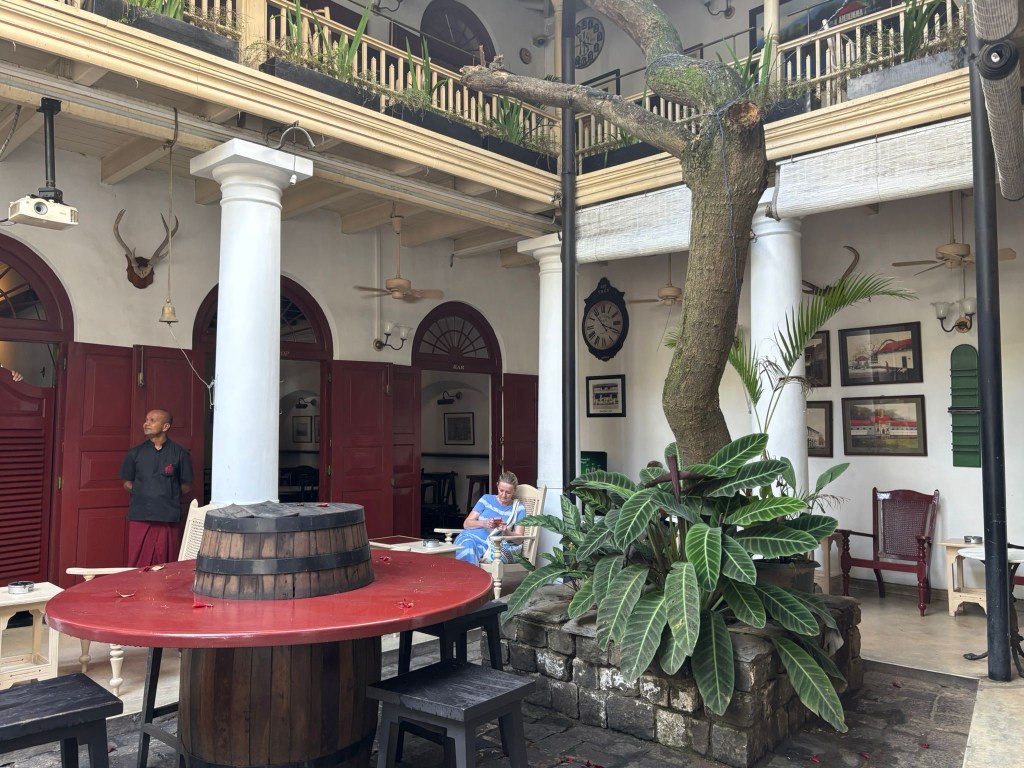
Back on the street we stopped at a stall that sold sweet snacks. These were both treats for children as well as snacks for adults. Boddhima bought a selection for us which we munched our way through during the last T20 the following day. We then stopped at a bakery for samosas – meat and vegetable which were delicious. Already quite full, we were hosted in an old bar for a glass of arak. Sri Lankan arak is made from the fermented flowers of coconut trees. As we sat in the shade of a courtyard we talked about the challenges of bringing up families in Sri Lanka. Buddhima’s husband had been forced to find work overseas and worked as a grinder in a S Korean shipyard. He could afford to come home for one month every 12 months and he had been doing this for 11 years. But he earned enough to get their two boys through private school and hopefully into university which was highly competitive. Boddhima worked as a guide but had been a teacher. When her father dies in a car accident when gave up teaching to look after her mother and the two boys. The location we were in used to be the house/mansion where the King kept his mistresses. These were separate from his concubine and his wife. But they were officially recognised and known as Gold, Silver and Bronze with places allocated to them at ceremonies.
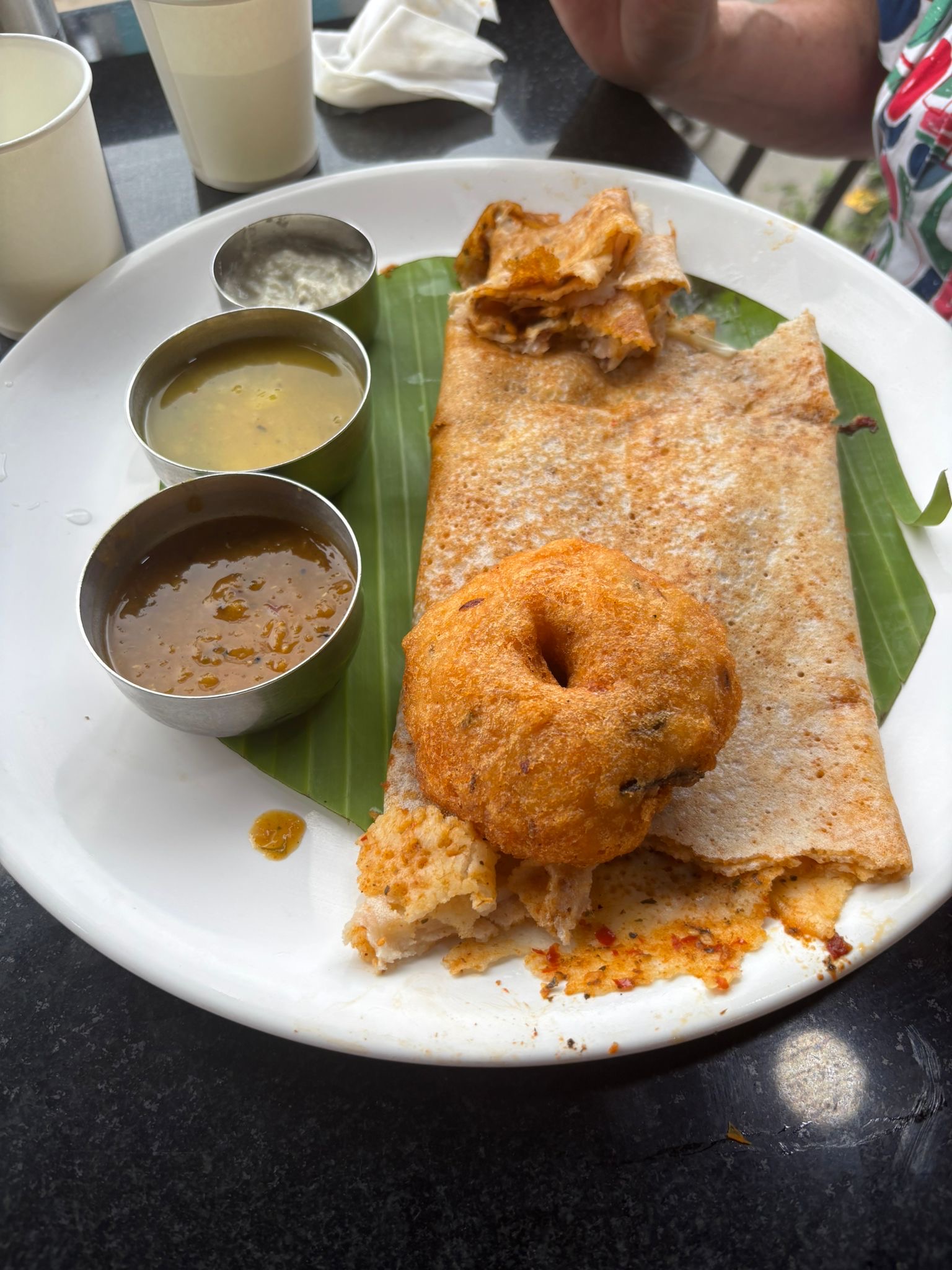
We crossed the road from the bar to a cafe which sold traditional lunch time snacks. IKara Dosai – with Coconut chutney,potato curry and Sambaru and the fried 🍩 is called- ulundu wadei – made with skinned black gram seeds ( Ulundu / Undu ) with rice fermented in coconut milk.
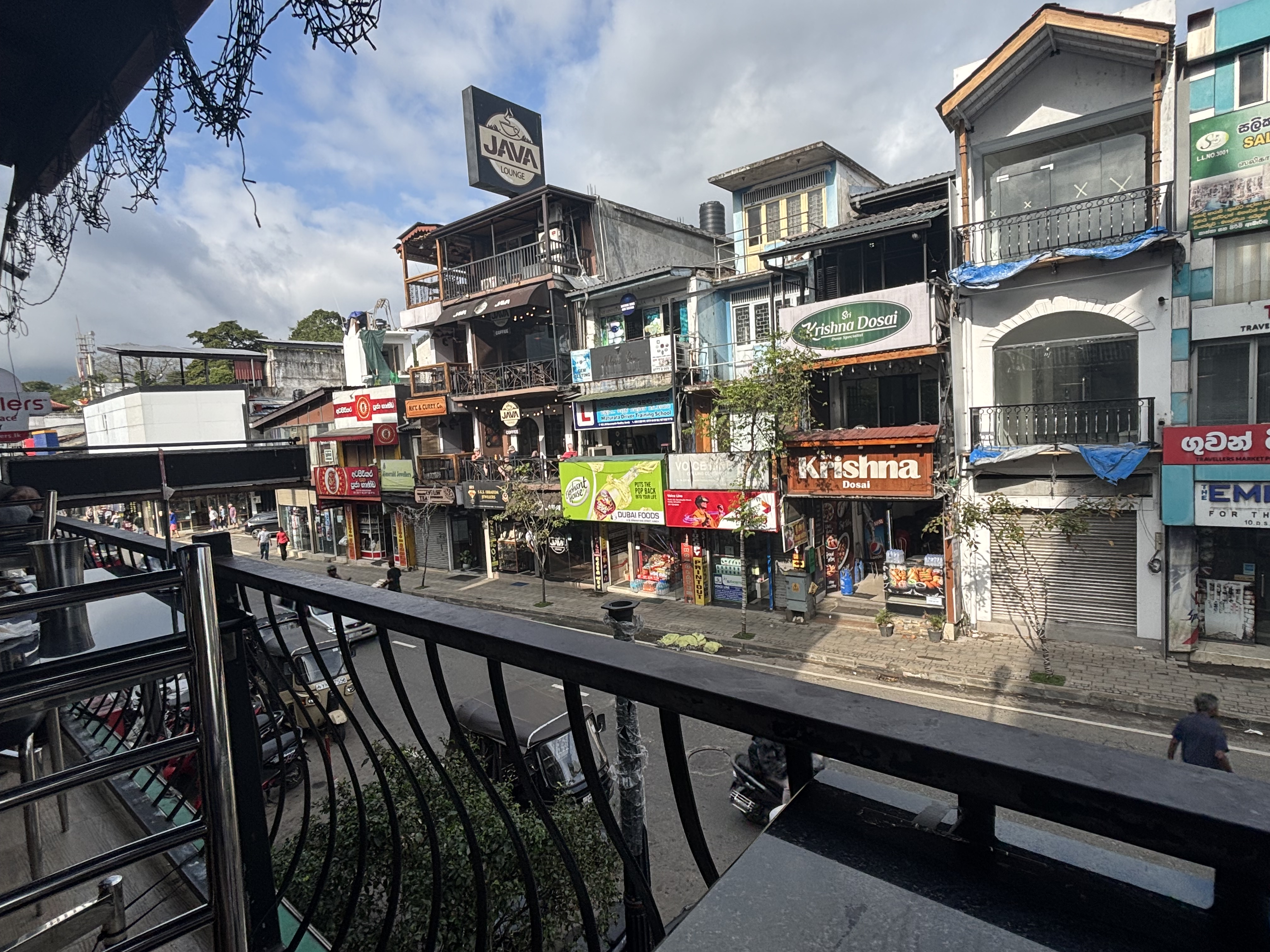
We thought this would be it – but we had another meal to come at one of the oldest bakery’s in Kandy – Kotu Rotti. This is a rice based dish, again with dips. The equivalent in UK would be bubble and squeak. It is the left overs chopped up and mixed with a small amount of rice and served as a snack. However a ‘snack’ at this stage felt like another meal – we were very full. We shared two – one meat and one fish. This was followed by dessert of buffalo curd with palm syrup – Kiri Pani. Delicious and refreshing. We said farewell to Buddhima and caught a tuk tuk back to the hotel. We had an hour to get ready for the buffet supper and talk by Steve Harmison.
Farewell Dinner
We were not yet ready for another meal! The entire Not Out Team gathered at the Mahaweli Reach Hotel – a large hotel that was a mixture of modern and traditional architecture. We sat with Tony and Lin and had a very pleasant evening. Steve Harmison’s talk was entertaining. Apart from the stories the discussion around bowling plans was very informative. it was not something I had given thought to. SH talked through the importance of the first 30 balls and how the bowlers would each work together and have a detailed plan based on the opposition’s opening batsmen. A sign of a well rehearsed team was one where the bowlers acted as a team working in tandem rather than as individuals.
We left around 2245 and were glad to be in bed by 2330.
3rd February – Final T20
England won toss and batted first – 128/9 v Sri Lanka 116 (19.3 overs)
Our final full day! We spent the morning sitting in the lounge area and then went to Hideaway Lounge for lunch. We were still full from non stop eating the previous day so constrained ourselves to sharing a melon and feta cheese salad. More than enough to keep us going till the final match.
We arrived at the ground in good time to secure front row seats. With the snacks from yesterday we had more than enough to keep us going although I could not resist one last crispy chicken burger!
The Turner Prize – all will become clear
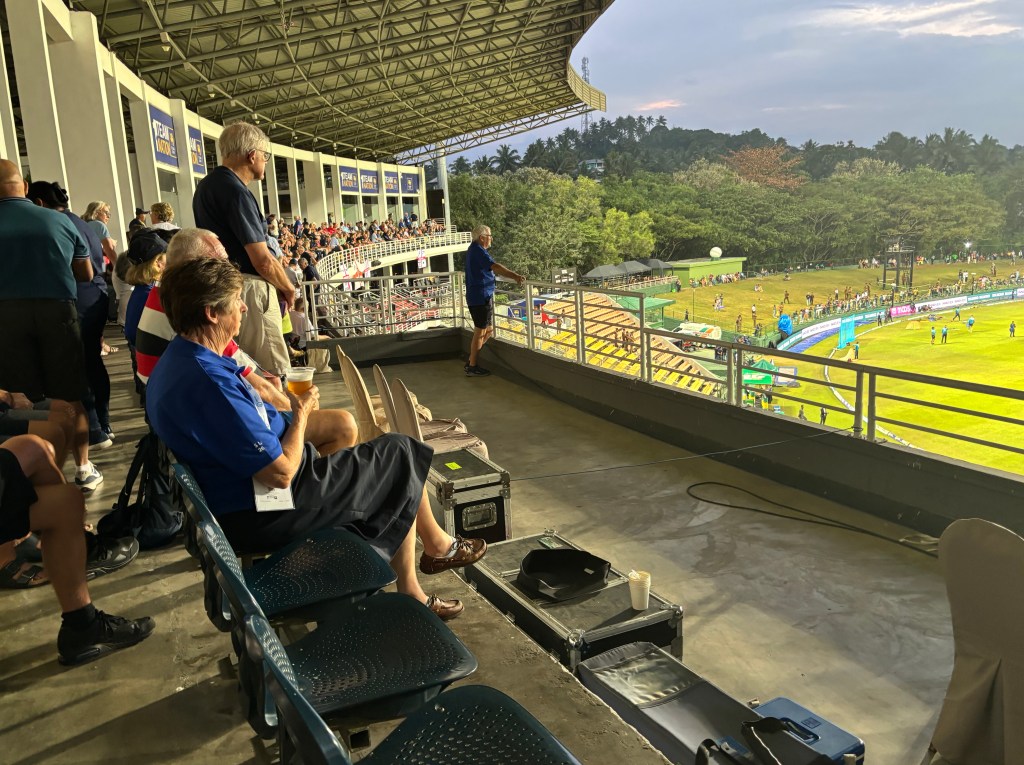
England had already won the T20 series and were two up. They again won the toss but rather than chase they decided to bat first and set a total. I think Harry Brooks just wanted the team to get a feel for setting a total and then bowling out the opposition. We sat back full of hope and expectation. that lasted two balls when Ben Duckett was out for a duck. Well we still had plenty of depth in the batting. Then Jacob Bethell went for 3 after 7 balls, then Tom Banton for 7 off 7 balls, then harry Brook for 4 off 3 balls. By the end of the 6th over we had lost 4 wickets for 35 runs. By the 10th over we were still only 59/5. Phew not what we were expecting. Sam Curran came in and did somewhat steady the ship making 58 which proved to be the highest score from any batsmen on both teams. Liam Dawson made a credible 14 but perhaps not in the most elegant way.
When it came to Sri Lanka’s innings they suffered the same fate as England. Luke Wood who was called in at thelast minute struck with his third ball and Mishar was gone for 0. But Sri Lanka were looking confident 65/4 at the 10th over. Dawson had got Nissanka in the 4th over, Rashid got Rathnayake in the 8th over and Jacks got Kusal Mendis in the 9th over. By the 13th over Sri Lanka were 90/4. We did not think that England were going to win this. 15th over they were 97/5. But then it fell apart for Sri Lanka – Jacks taking out Liyanage with the frst ball of the 15th over, then Bethell with 3 wickets in the 17th over with the final wicket also going to Bethell in the 19th over. Bethell figures were 4/11 and Will jacks 3/14. As the commentator in Crikinfo stated – this pitch should be entered for the Turner prize.
We had hoped to have a last drink and celebrate in the bar when we got back – but for the first time it was closed!
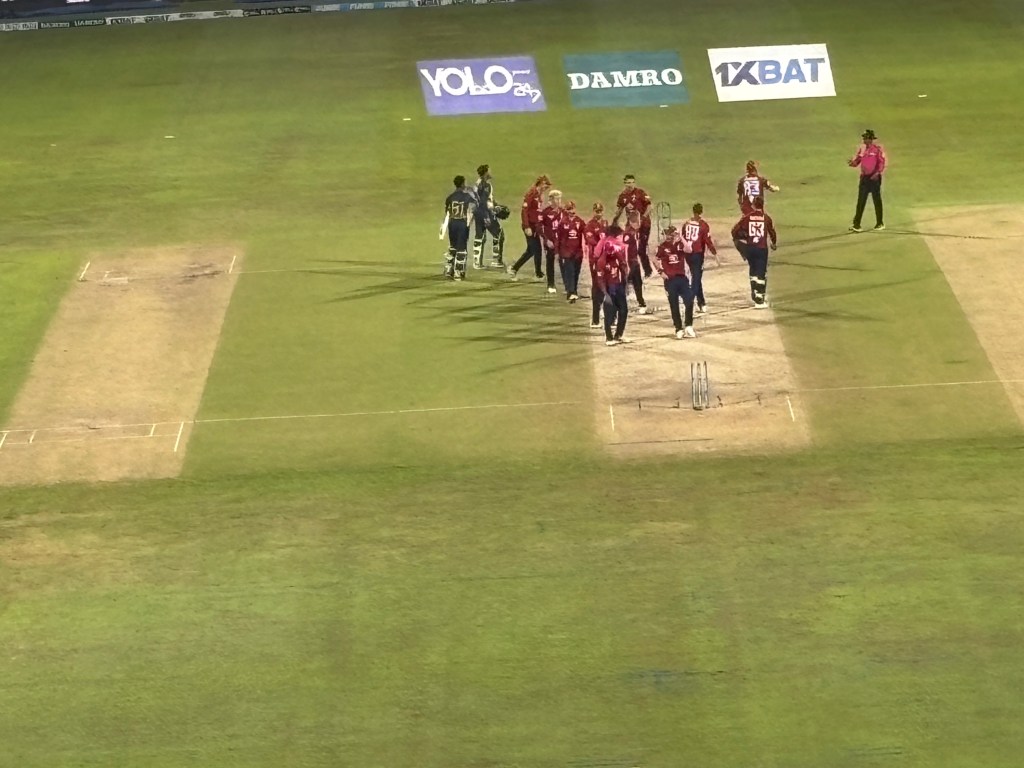
4th Feb – Final Day
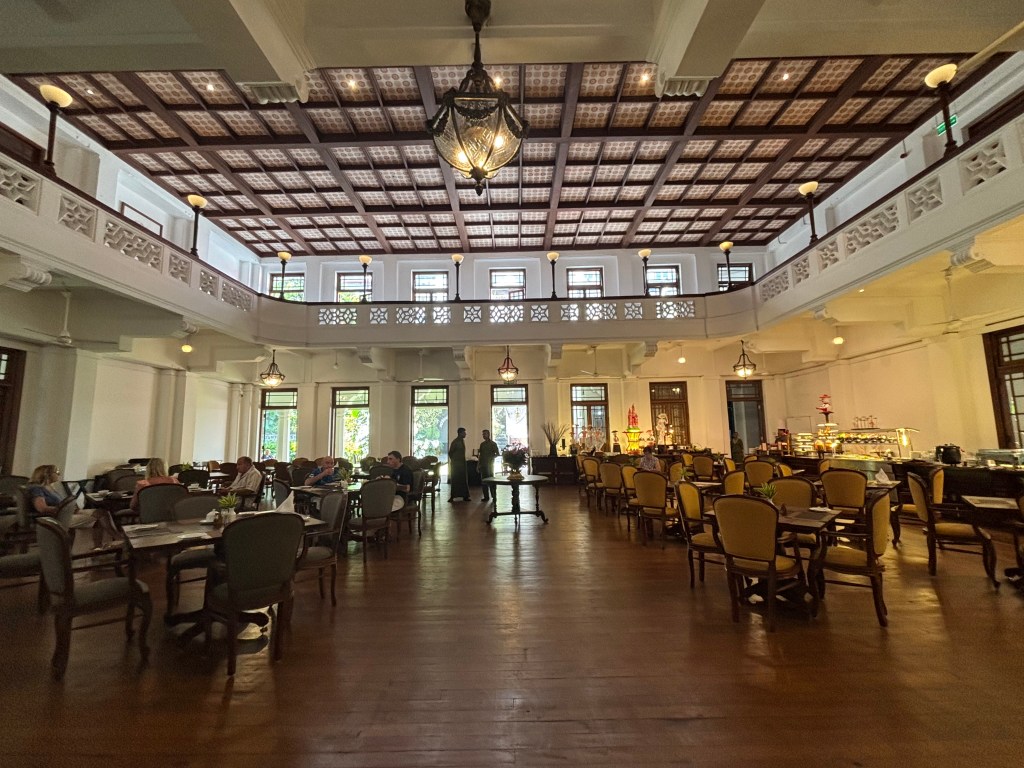
Our last breakfast in the magnificent breakfast room. We sat around the pool awaiting our taxi to take us to the airport.
Sony had arranged for a taxi to take us to the airport. A bit of a risk – we did not know him – but one of the tour guides had used his services before. Having WhatsApp him a couple of days before we had constant messages from him asking us if we still wanted him, did we want a tour in his tuk tuk, would we like to do some sightseeing to the airport – 10/10 for perseverance and sales! Sony turned up with his ‘sons’ and a small (and old) sort of campavan fitted with seats. To be fair to the driver, he was probably the best we had in Sri Lanka and he coaxed the vehicle down to the airport in Colombo. The seats left something to be desired – the springs had passed their sell by date and both our bottoms were a bit numb by the end. However they were so pleased with what we paid them (probably far above the going rate) that their smile o their faces made us forgive the state of the vehicle.
We had a 4 hours at the airport but it went quickly. We found a nice Sri Lanka coffee shop tucked away in the corner where we spent most of the time. And yes – we bought some – 3-34 years of tea and probably 6 months worth of coffee with which to return to UK.
The 4hr flight to Dubai was uneventful and the aircraft was not that full. A couple of hours stop over where we had a cup of coffee and then 7 hours back to UK. We managed to sleep on the second leg and whilst not entirely refreshed we arrived at Heathrow in the rain and cold.
So ended a great holiday and cricket tour.
 Purrfect Tale