Friday 12th August – Familiarisation Day
A number of weeks ago I had responded to a request on Facebook for an ask for help with an adventure training exercise being undertaken by Term 2 Officer Cadets at the Royal Military Academy Sandhurst. They were initially looking for a mate which on my part required very little work. As it was an opportunity of another week’s sailing and with RMAS where I was a Company Commander of Common Commissioning Course 951 and Chief Instructor Term 2 in 1996, it appealed to me. Shortly after volunteering it began to get a bit more complicated for Tyler who was organising the AT. Firstly the skipper dropped out, which meant I had to step up and being a civilian I needed to take out 3rd party insurance. Then there was a ban on overseas adventure training. So the initial plan of firstly France and then the Channel Islands went out the window. This was not particularly logical for sailing as arguably it is cheaper to sail to France, stay in marinas and eat ashore than in UK. But as I used to say to my team – don’t fight the pink’ – just go with the flow. Time and tides dictated the eventual plan which took us to Weymouth.
As an aside pink paper was used to print the answers to all the military problems posed to Officer Cadets on exercise and issued to the Instructors.
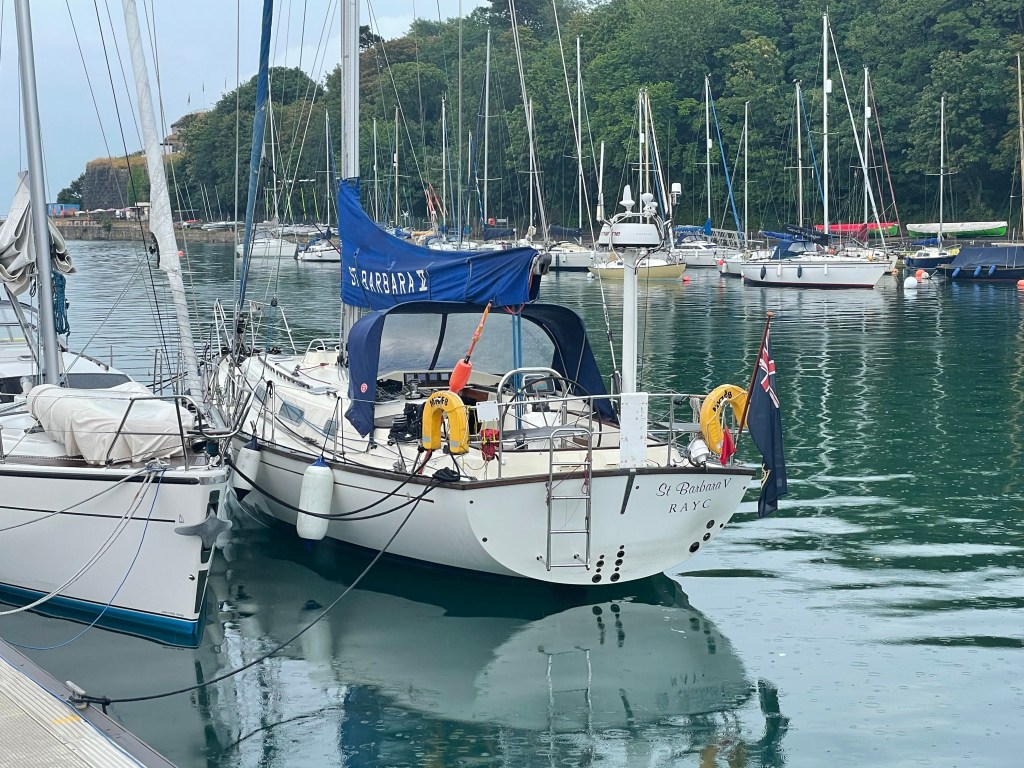
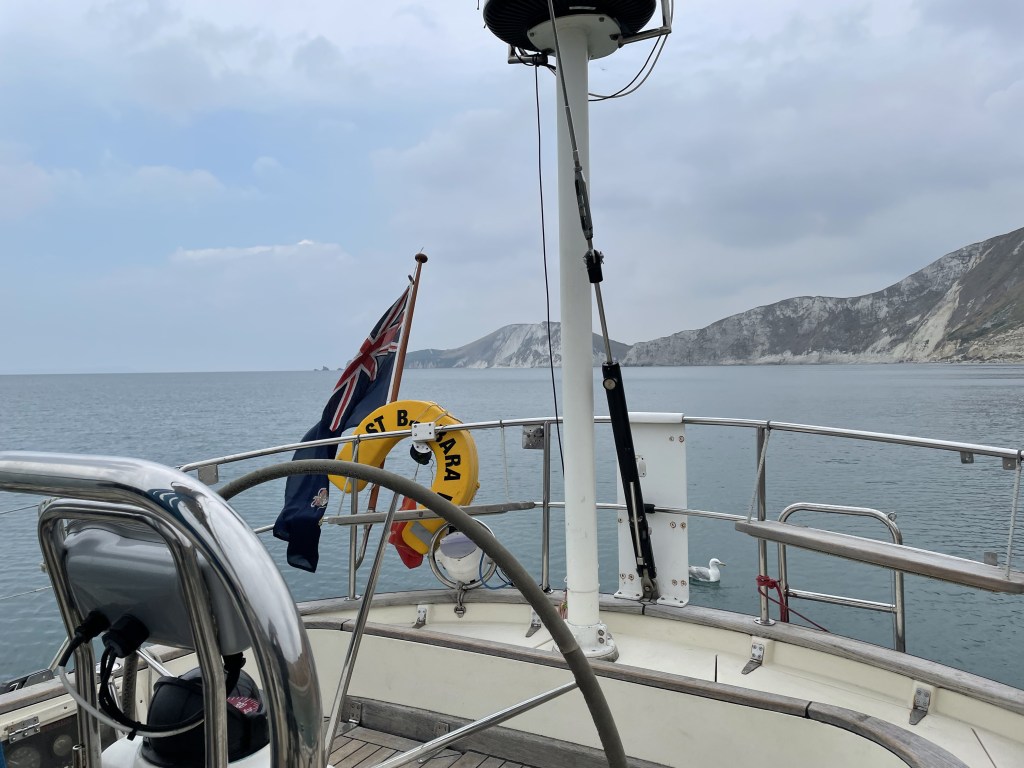
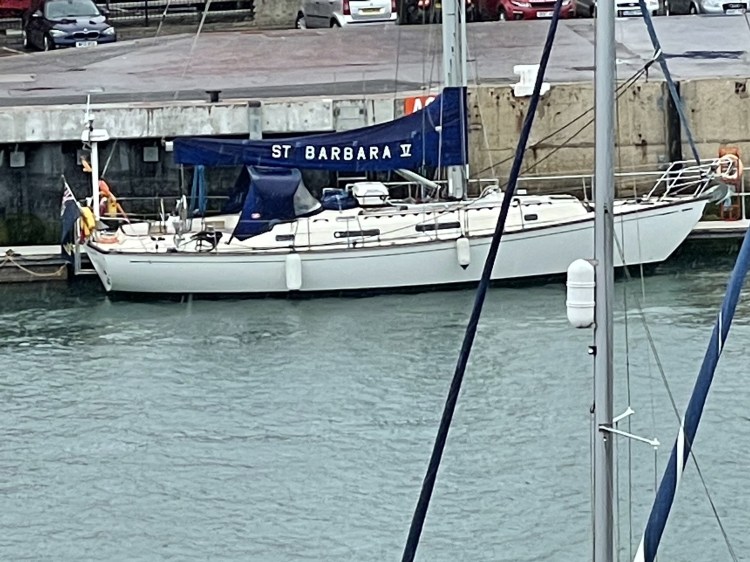
RMAS had charted a Royal Artillery boat St Barbara V – a Rustler 42. The ‘V’ gives it away as being the 5th RA yacht with this name. Margaret Widdop remembers seeing the ‘I’ somewhere off Yarmouth quite a few tides ago! Given the sizer of the boat and the complexity of some of the systems there was a need to undergo a familiarisation course at Gosport – hence the trip down there on 12th August. A baking hot day. I was expecting to be test under motor but in the end it was a laid back approach having understood that I was reasonably well qualified and experienced. The Bosun – Ed Middleton – was a Bombardier who had been looking after the RA yachts for a number of years. He efficiently took me through the various systems from power, water, fuel, filter, instruments, heads, sleeping arrangements and sails. We spent a good 3 hours casually chatting before I departed back home.
Sunday 14th August – Taking Command
Most of the Officer Cadets were travelling down on the Sunday evening – I followed suit as the alternative was an early start on Monday to take over the boat and set sail. I felt a good nights sleep and a not too early start would be better. By the time I arrived they had gone out for a meal and drink. I confined myself to a couple of beers as well as buying some fresh milk once I had spotted they had filled the boat up with UHT – it does not make for a good cup of tea early in the morning – essential to get me going.
I had brought with me a sextant and the electric outboard motor for the dinghy. The plan was to spend one night at anchor and some instruction on taking noon sights to calculate latitude.
Monday 15th August – Gosport to Yarmouth
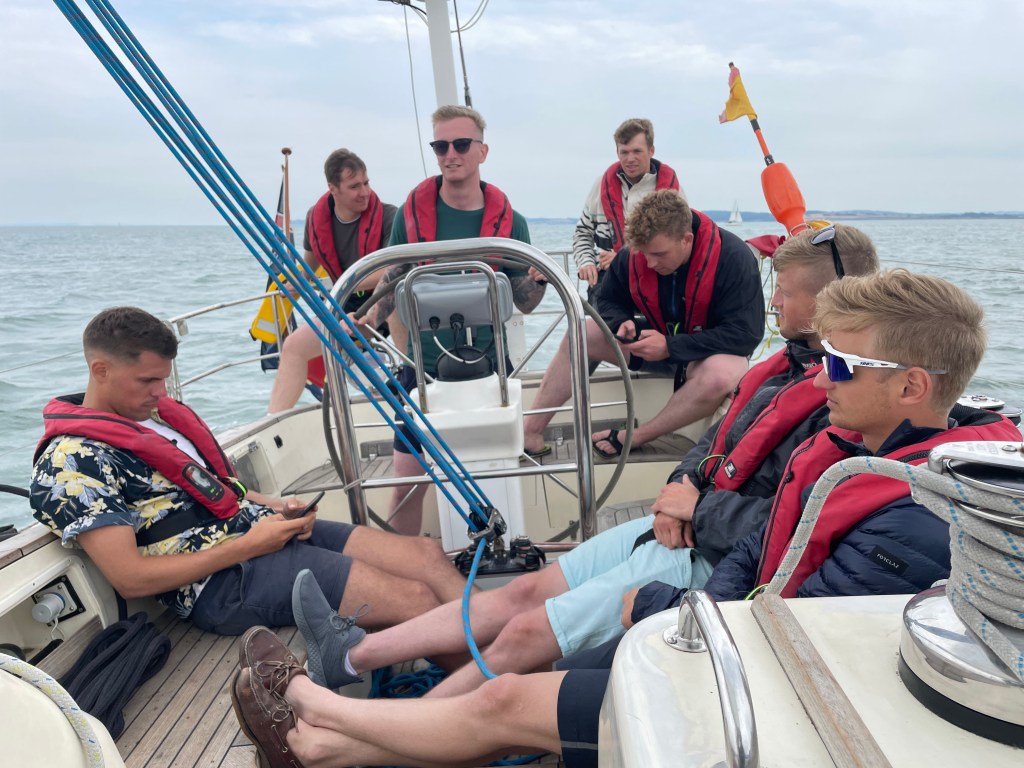
Ed came down in the morning to make sure we were all content and I could quickly ask him a couple of questions on water and fuel tanks. The boat had 3 water tanks and two fuel tanks both each with a breather and each with a switch to fill/use. Having absorbed quite a bot on Friday, I was struggling to remember all of the details!
We then went on to the the safety brief and walk around the boat:
- Tyler – organiser between ranges, exercises and command tasks. Competent crew.
- Liam – Day Skipper
- Stephen – Comp Crew
- George – Comp Crew
- Thomas – Comp Crew
- Benjamin – Novice
- Norman – Novice
The crew had parked off and rotated around the different roles during the week:
- Mother watch – cleaning, cooking and coffees
- Logs, Blogs and Photos – responsibility for capturing the days events as they had to produce an expedition report post the event
- Navigators
We departed for Yarmouth around 1030hrs. It was the first time I had ben through the Portsmouth Harbour entrance for probably 10 years or more. It brought back memories of sailing Victoria 34s and the Royal Signals yachts all of which were berthed here. I tried to maintain the enthusiasm for sailing once in the Solent but not only was there no wind but the strength of the tide which had yet to turn in our favour was pushing us backwards. So reluctantly the motor was used until we got near Osborne Bay when the wind at last picked up. We were then able to tack our way in a SW down to Cowes. The sail down the Solent taking a SW nearly always turns into an unofficial race with the other yachts judging when to tack as they near the IoW or mainland shore. There is a balance between making most into wind and speed. We managed to hold our own in St Barbara. Just past Newtown Creek, the wind had got up to the extent that we needed to take in a reef. St Barbara had traditional slab reefing. Two go forward, one to hook the first reef onto the bull horn and the second to winch in the reefing line. A third controls the main halyard and a fourth steers us into wind.
On reaching Yarmouth we had decided to pick up a buoy outside. We were due to leave very early the next morning to catch the tide down the Needles Channel and part of the way across towards Weymouth. Being pinned inside the harbour with boats rafted up outside would make our departure quite complicated as well as getting others up at an extremely early hours. Liam helmed us neatly onto the buoy, stemming the strong tide. It was picked up at first attempt.
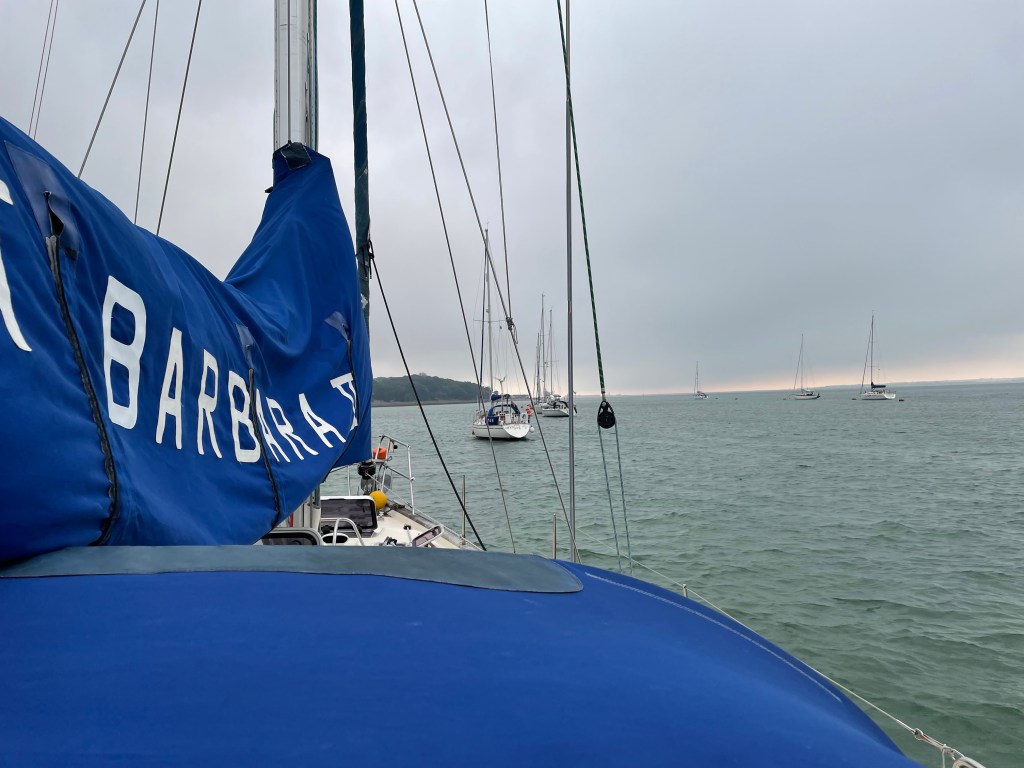
I had been warned that an essential part of the adventure training was the need to conduct planning on shore preferably with beverages to hand. With this in mind I called the water taxi across to take us ashore. Most of the crew were downstairs so when he offered to take us all there and back for £10 he thought he had struck a great bargain. He was somewhat taken aback when 8 of us appeared on deck – we definitely came off better.
Once ashore we went to the Bugle for that planning meeting. It was the first time I had a chance to sit down with all of them for a chat. There must have been a little nervousness on their parts as to who I was – no doubt some concerns that I might have been a grumpy retired Brigadier! Hopefully I put them at ease and we had a relaxing couple of hours.
Back on board a meal was cooked and we sat around the huge table downstairs for a communal meal. It was an early night as we had a 0400 start in the morning.
Sleeping arrangements were cosy. Two up forward, one on the skippers bunk behind the chart table, two either either side in the saloon with ‘stretchers’ that could be pulled out above each of the berths for another two bunks. I had the luxury of the stern berth cabin which I shared with the outboard motor, sextant and various navigational books.
Tuesday 16th August – Yarmouth to Weymouth
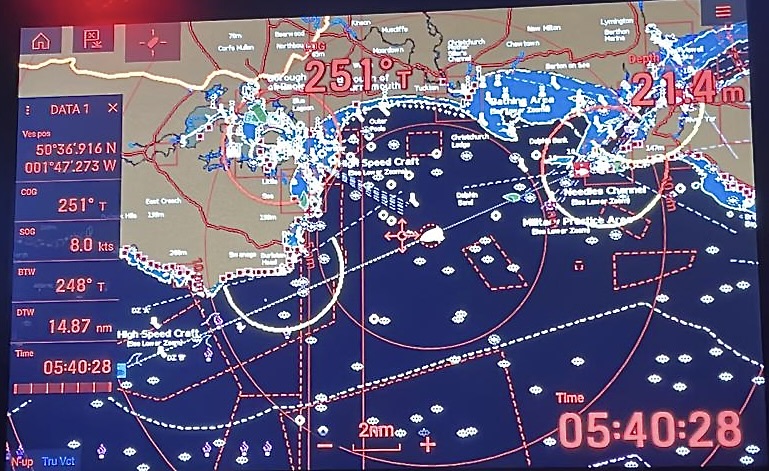
Reveille 0400. All were up and ready within 15 mins. We slipped the line from the buoy and turned to motor down the Needles Channel with no wind. It was pitch black with only one other sailing boat in our vicinity. All of the crew were wanting to get sufficient days, miles and night hours to enable them to take their day skipper’s assessment. Hence the early start did not prove as unpopular as I had expected. Although as one of them pointed out, the requirement was to be sailing during darkness – but it did not stipulate that you had to be on deck! Although a straight forward leg of the journey, it did highlight the challenge of navigating in a channel with many lights at night from cardinals, to port and starboard lights as well as special markers. Working out which was where and what was in front or behind required both concentration and good chart work.
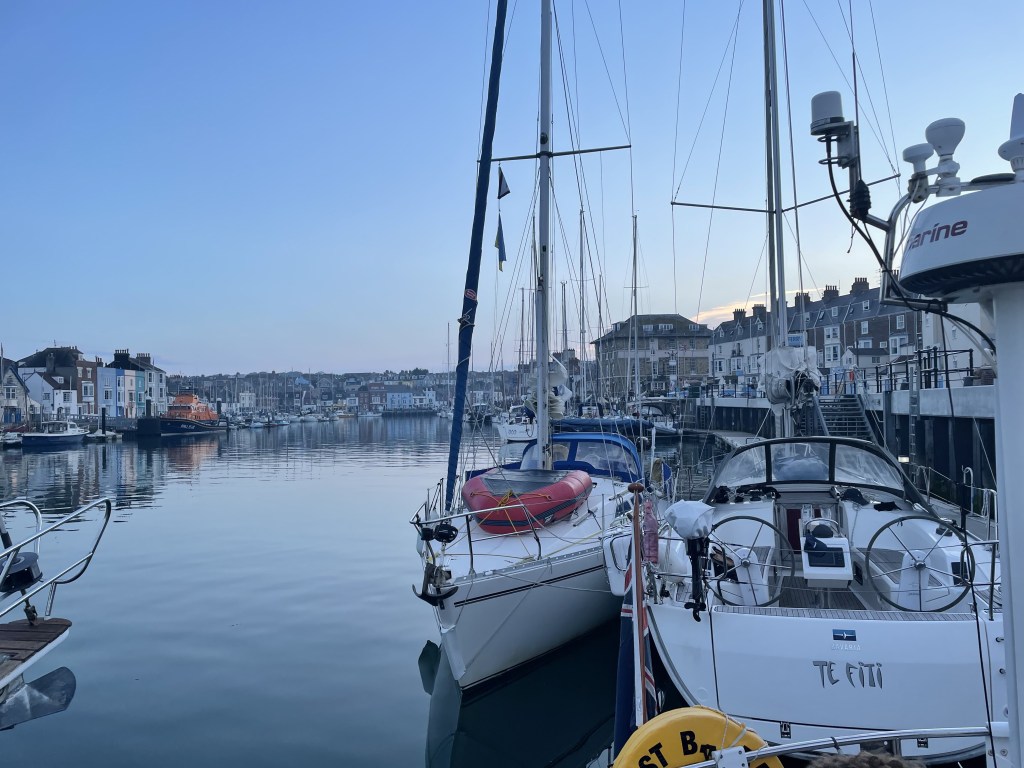
It was another quiet passage down the Needles and once clear we steered a course direct for Weymouth. I had checked what was happening on the firing range near Lulworth and it appeared that the Army were on holiday for a week. This enabled us to sail close in to the major headlands of Durlston and St Albans Head. We did manage to sail about 50% of the way as the light came up. The hourly log was completed and we marked our passage off on the chart. I had booked a berth at the Town Quay but had not expected to arrive quite as early as we did. Weymouth was one of those ports I had not been in for a long time. Normally when we are going to or from the West Country we use Portland Marina which is much closer to the Bill. But having now been to Weymouth it is on my must go to again list. A lovely protected entrance between two piers and a motor up the entrance between lines of moored boats, an old fort and the lifeboat station.
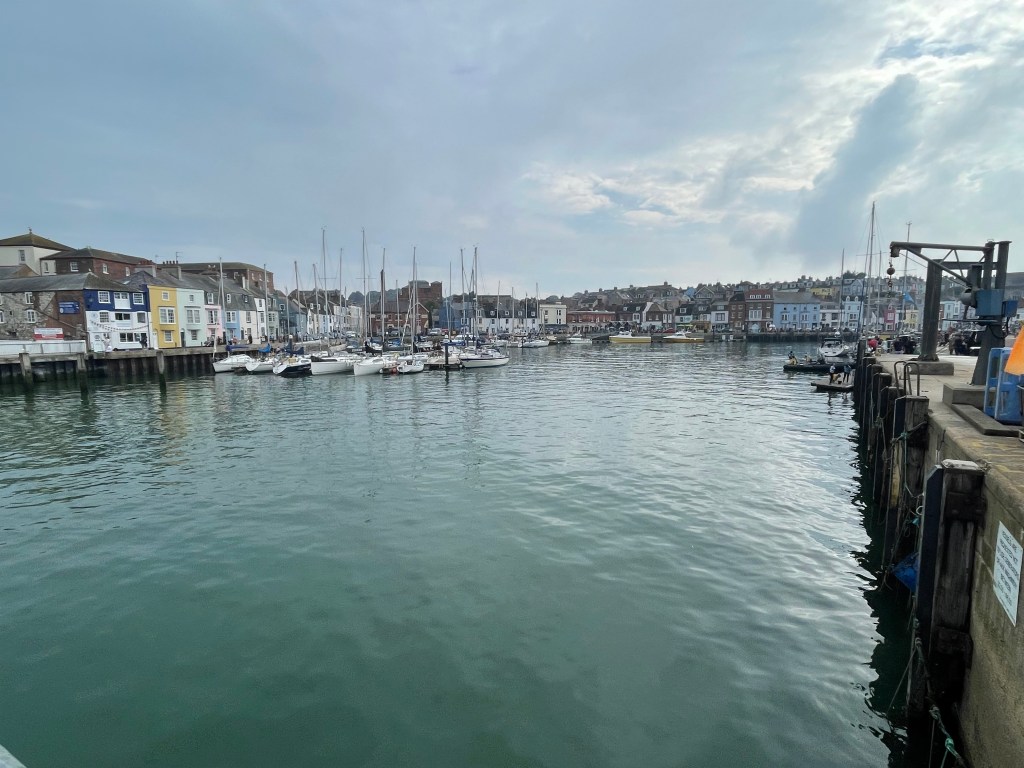
We were given a berth alongside another boat despite there being a spare alongside berth. But never argue with the harbour master! It turned out the boat we were moored alongside was being sailed single handed by a person from Germany. He was wanting to leave that day and was worried we would not be around when he wished to leave. After some deliberation and at the risk of causing fury with the Harbour Master we manoeuvred our boat to the spare alongside berth- one on the helm with the motor on and two on board controlling bow and stern line with two on the pontoon taking the lines. The crew then went off in various directions for shopping, fish and chips and a drink – to plan the next leg I hasten to add. I took the opportunity to take the rowing boat ferry across to the other side and walk up to Nothe Fort on the other side of the harbour. A very chatty ferryman who was a member of the RNLI Lifeboat Crew was on the oars. We sat together for 20 mins chatting about rescues and lifeboat design and development. After which he refused to take any money from me.
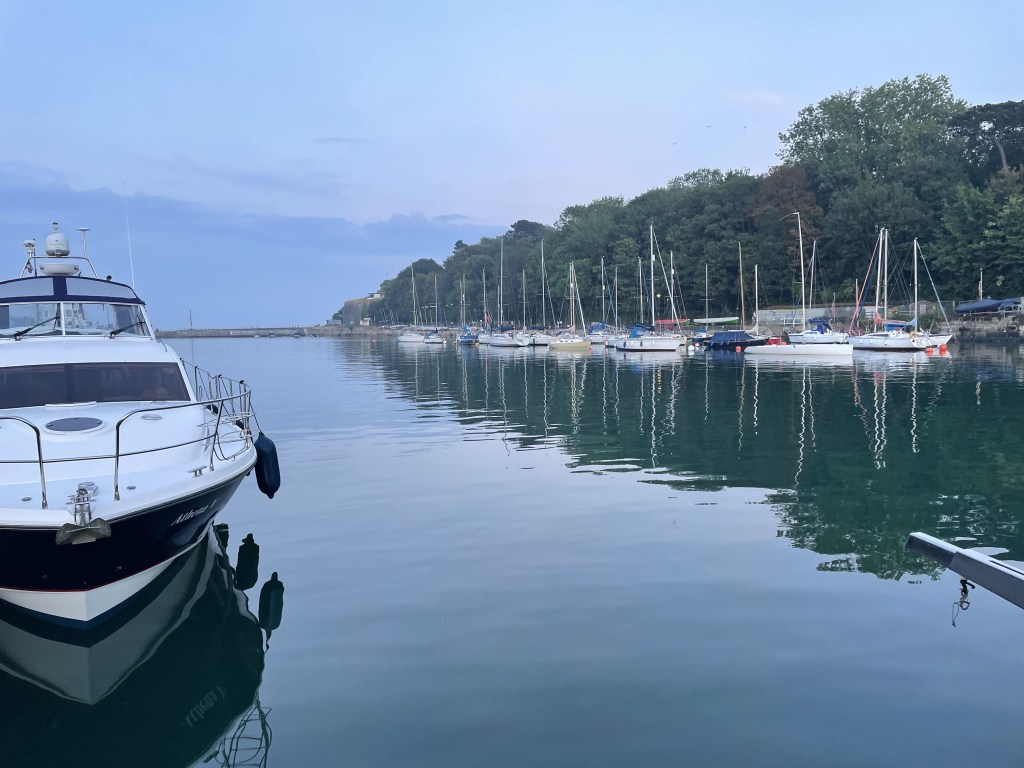
Outside the Fort my eye was caught by a discreet memorial to HMS Barham a UK battle ship sunk in the Mediterranean on 25th November 1941. The memorial was put there by the survivors of the battleship. There was no indication as to why Weymouth. It made me do a little bit of research and inevitably a sad story emerged. HMS Barham was operating near Crete and was part of a large fleet consisting of 3 large battleships , 12 destroyers and HMS Elizabeth, the flagship of Admiral Cuningham. The battleship was hit by a salvo of torpedoes and sunk in 4 minutes whilst still steaming at full speed. 868 died and 474 survivors were picked up some over a mile astern. The torpedoes had triggered an explosion of the ammunition magazine. In those days few sailor could swim and many of those who died drowned. Sitting atop the harbour looking out to sea, the sadness and tragedy of the event seems that bit closer.
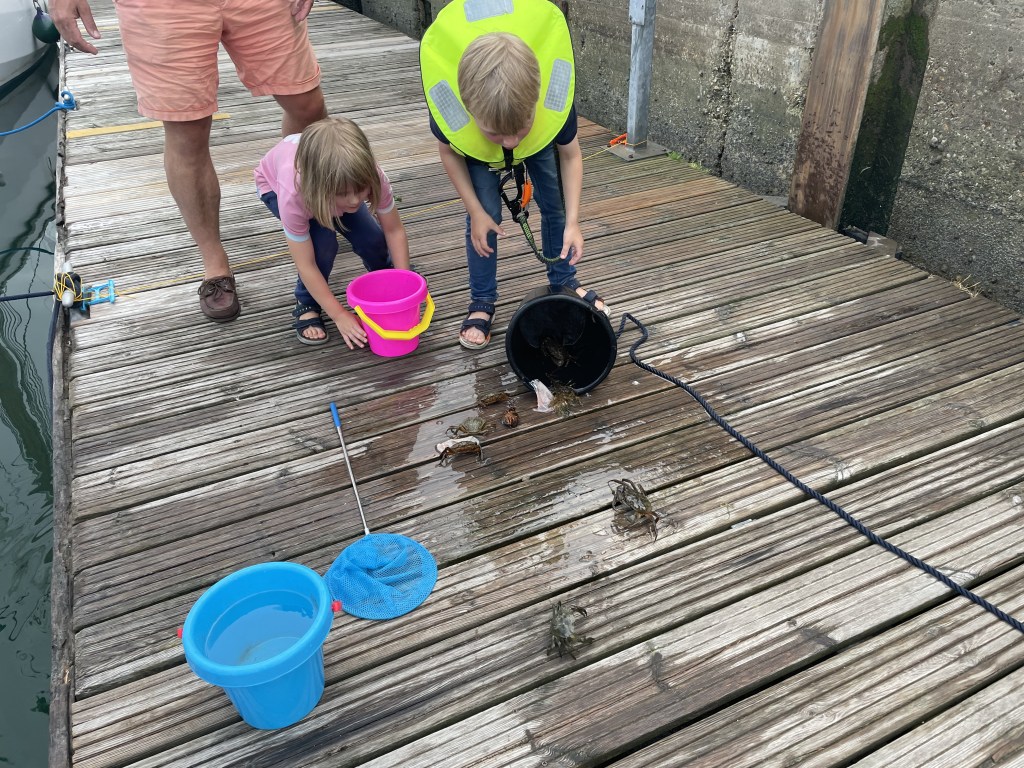
Wandering back to the boat, I stopped off to have a generous ice-cream which I did not really need but was in want of something to lift the spirits. By now it had become quite busy on the quayside. There was a Contessa 32 from the Royal Southern Yacht Club on the quayside. I had met them before at a rally in Yarmouth. It was a full boat for the visit to Weymouth with the family including two children and one set of grandparents from South Africa. Whilst chatting with them, the children who had been crab fishing decided to have a crab race with the ones they had caught. Each of us choosing our favourite crab as they scrambled somewhat eloquently across the pontoon and into the water.
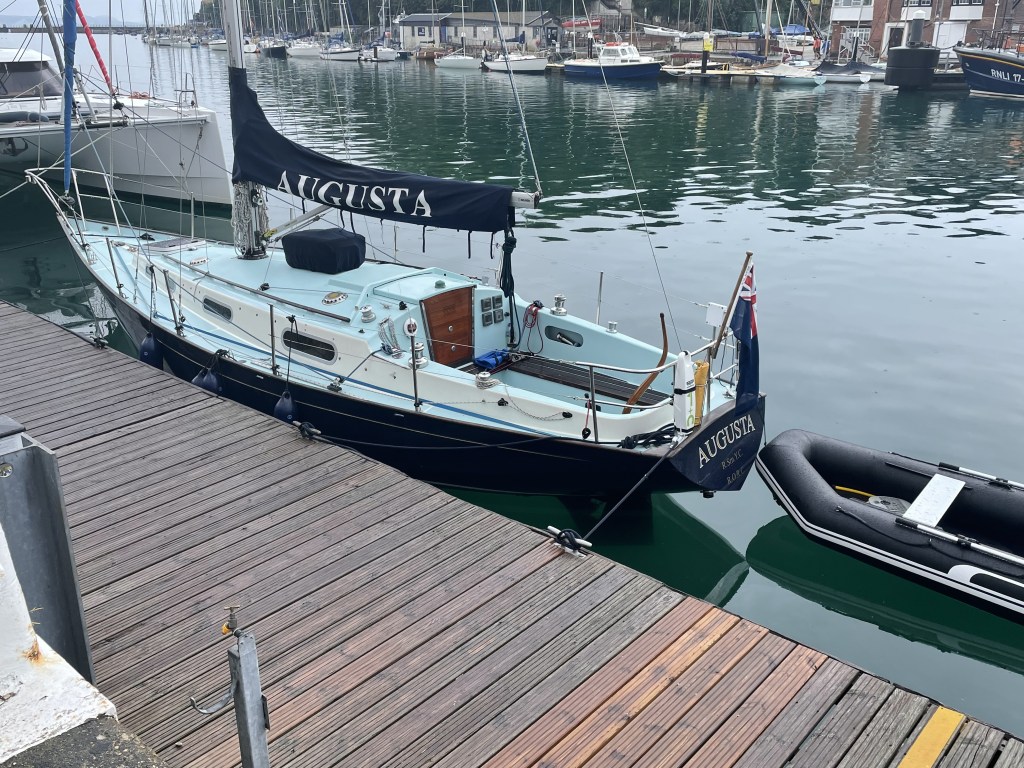
We ate on board again in the evening before going out for a drink. I joined them for part of the night but could see the warning signs as they began to order exotic looking jugs of cocktails of various colours – red, green and yellow. I definitely decided that this was the time to bow out and leave them to it! I retired to bed but was awoken by them returning at around 0300 in the morning. It was slightly comical to hear them trying to be quiet with lots of ‘sshhhhhh’ in a voice that they thought was not too loud but in fact was enough to wake most of the boats around us. One then decided to fill their water bottle using the foot pump at the sink. After much pumping seemingly to little effect I was on the verge of getting out of bed and saying ‘I will fill the bl*** bottle’. Fortunately he either succeeded or gave up as by 0315, the boat was once again peaceful.
Wednesday 17th August – Weymouth-Poole
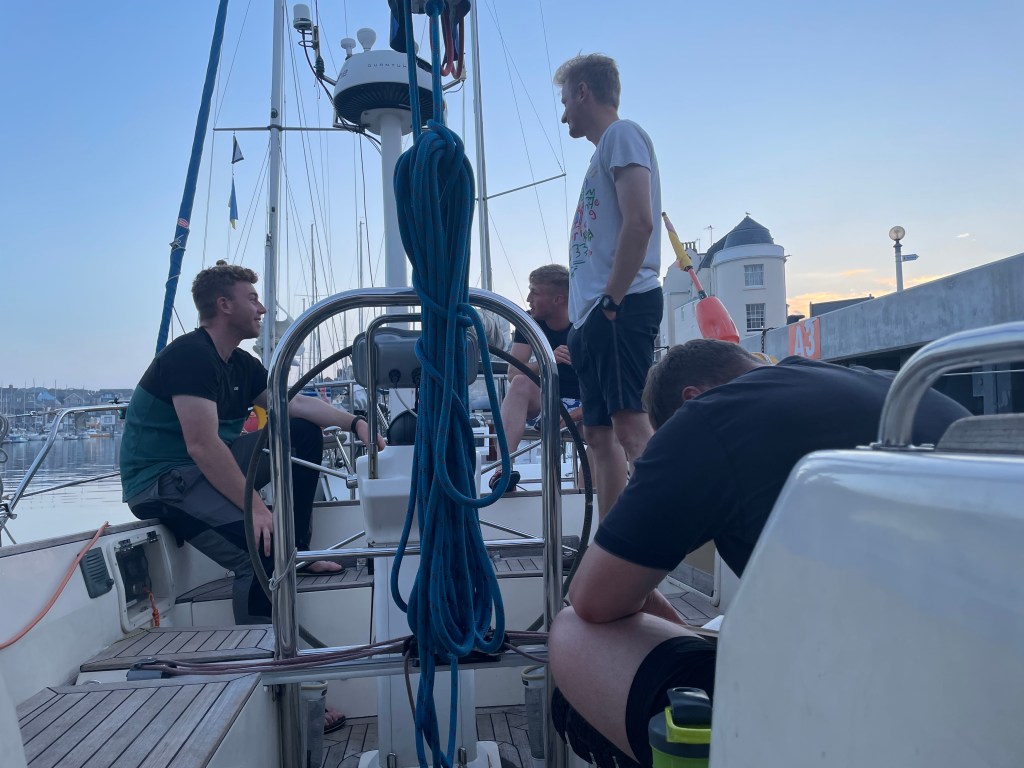
Not an early morning start which was just as well given the time they got in last night. However it was impressive that when the shout of reveille went up they were all out of their bunks. When planning the trip the intention was to anchor in Studland Bay. Once we started there was a plea to have somewhere that they could have a decent run ashore. Whilst it might be billed as an adventure training exercise, they were also recovering from what is the hardest term at Sandhurst. Simplistically Sandhurst is divided into Term 1 – teach the basic skills and drills, Term 2 – assess and Term 3 – develop. For Term 2 there are a lot of exercises in the field each being given leadership tasks and assessed on their performance. It is the highest stress term. By the end of it there is a sigh of relief that they have got through the worst of the course and can begin to look forward to commissioning. They had all been allocated their ‘cap badge’ or Regiment and their individual uniforms ordered. Hence a desire to have some downtime. To that end Studland Bay was cancelled! The alternative plan was to go into Poole Town Quay. We left with a brisk wind. With the military ranges closed we could sail along the Jurassic Coastline.
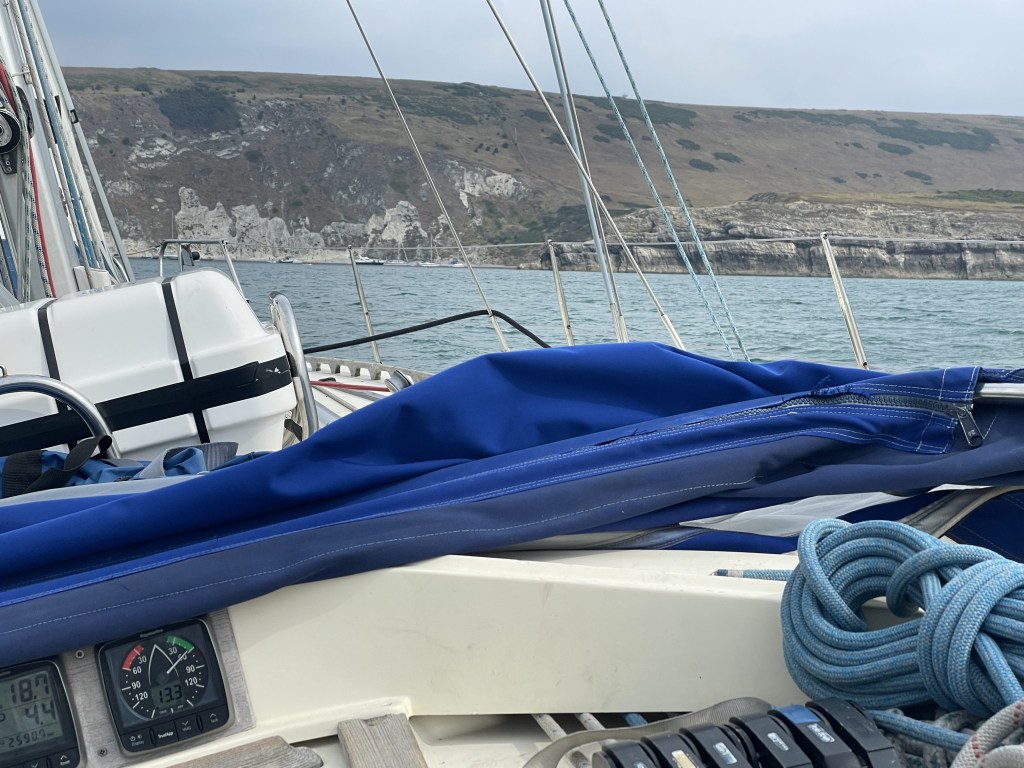
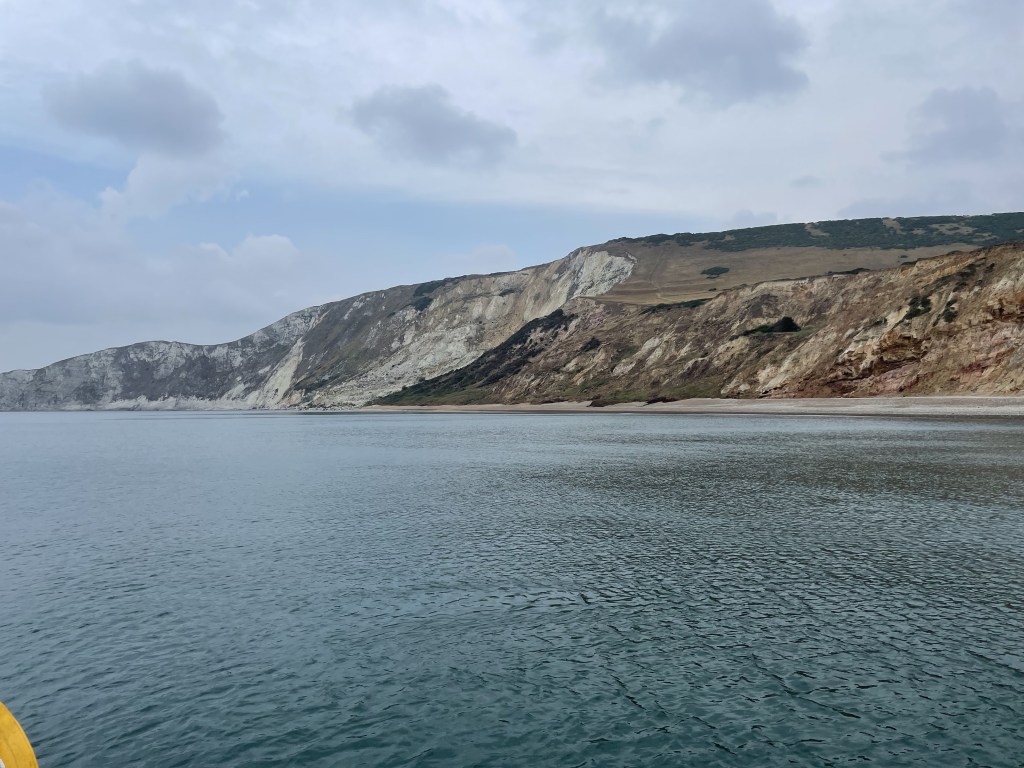
Out in the Bay we did some man overboard drills which they wanted to practice. Quite tricky in a boat this size as once the wind gets hold of the sails, dumping wind and taking speed off was quite tricky. But we had a few exercises some less successful than others! Shouts of joy or derision went up depending on whether the body was retrieved.
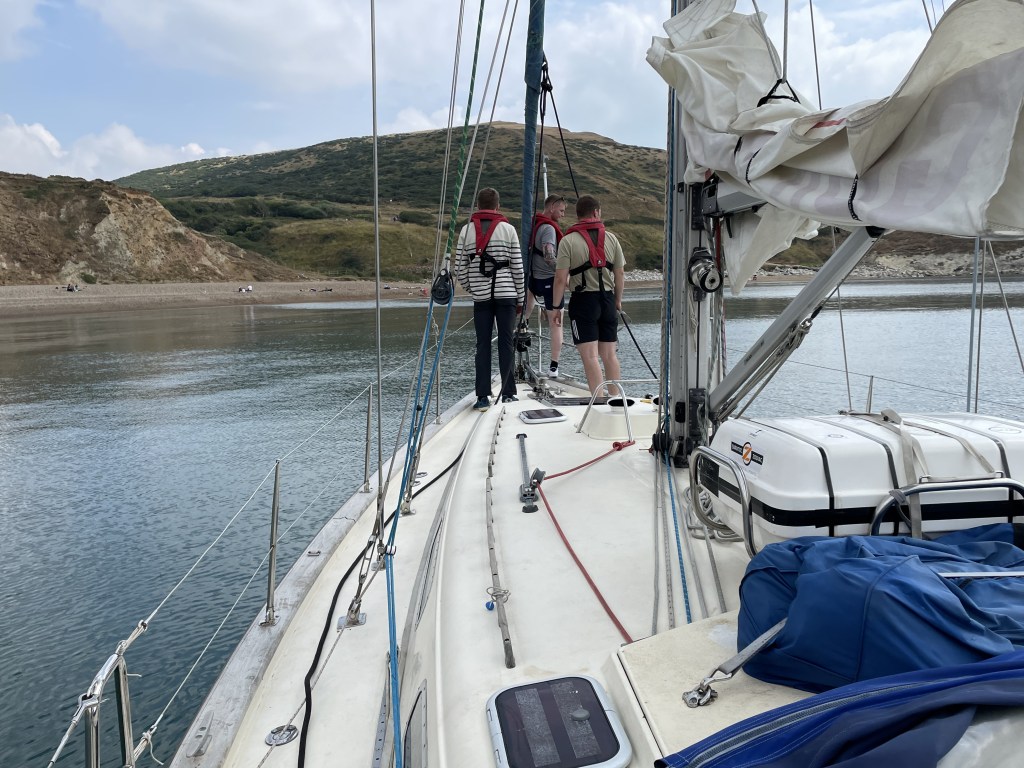
Once completed we set off for Poole with a request for a lunch time stop in Lulworth Cover. This is quite tight for a boat of our size when there are others anchored in the same bay so I suggested Worbarrow Bay just a little further east. I had not had the opportunity to anchor in any of these bays and it was fascinating looking at the rock strata as we sailed along the coast. Coming into the bay was relatively simple and we anchored close to shore. We did have 3 or even 4 attempts to get the anchor to bite but failed. As we were sheltered from the wind we in effect dumped 30m of chain plus anchor on the bottom and it was sufficient to keep us stationary in the water for lunch. I got the sextant out and we practiced a couple of noon time shots to calculate latitude. Surprisingly we were reasonably accurate.
Lunch over and we set off again aiming to use the inshore passage around St Albans Head. There had been forecasts of thunder and lightening coming through but until around 1500 we had not seen much. I was uptop and could see some rain clouds approaching. I let the others know I would get waterproofs on and take the helm and they could then go down and get ready. However the mini storm hit us much quicker. I could feel the wind rise as I got the trousers on and got up as fast as I could. At this point the heavens opened and we had a deluge just as we were passing Durlsdon Head. Wearing glasses I could hardly see. The other two were sent down to change. I had to call two back up quickly as we needed to take in a reef. Staying close hauled, we spilled the wind from the main to allow it to drop and put in a reef and then came up into wind to get the main back up. By which point both were soaked through and sent below to change and wait for it to pass. We must have looked an impressive sight just a couple of hundred metres offshore ploughing through the waves with rain and thunder around us. Sounds very dramatic but actually safe and under control.
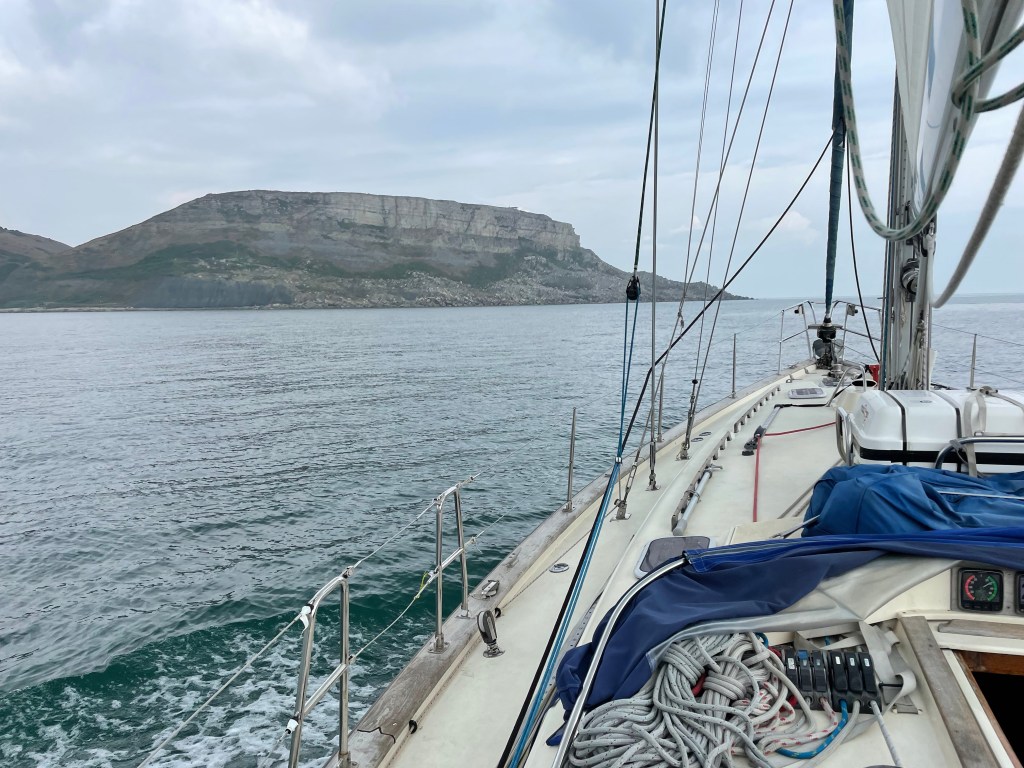
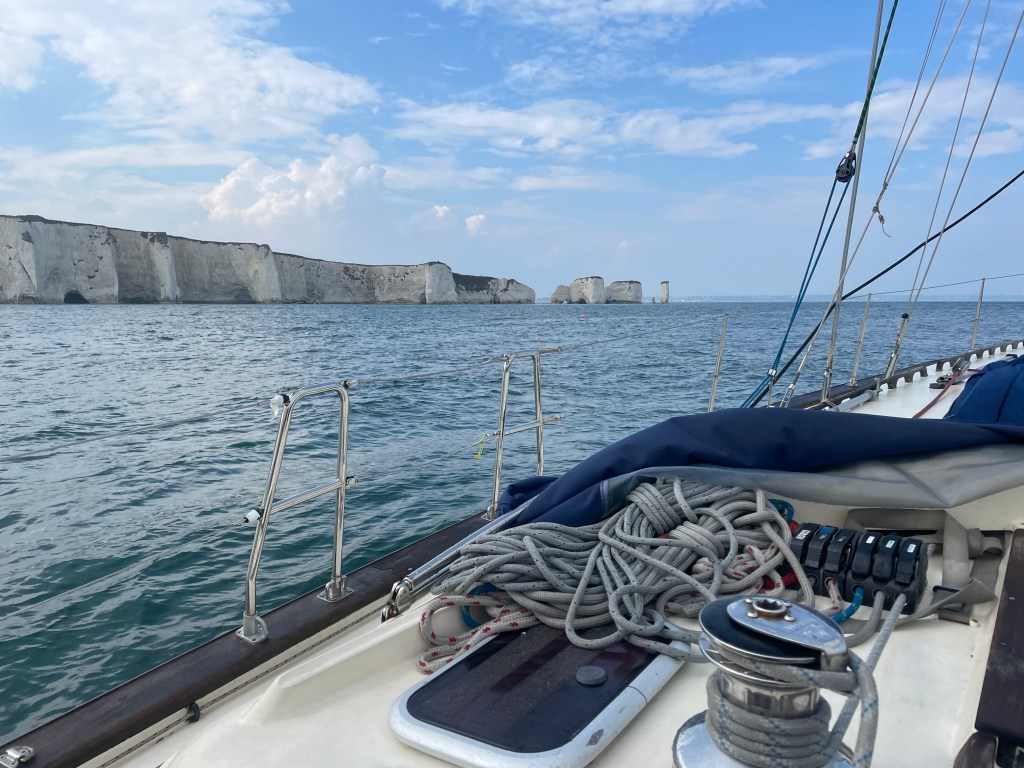
Once the storm had passed we were able to shake out the reef and sail on to Poole around Old Harry and down the Poole Fairway.
It is quite a long haul through Poole Harbour to Poole Town Quay which gave us plenty of time to sort out the boat. My expectation was that we would be on one of the long pontoons as you enter the marina and was therefore caught off-guard when they sent us to C pontoon. St Barbara V is a great sailing boat but not so easy to handle in manoeuvring around a tight marina. Liam had taken the helm and I talked him through the approach. What we had not been warned was that the boat we would moor next to was a catamaran. The space between the pontoon and the catamaran was such that it was not possible to have a set of fenders down each side without squashing them. Liam did extremely well as did the rest of the crew and I am still not sure how we got in without touching anything. A perfect berthing and once ashore I realised just how tight it was.

The evening was passed playing Secret Hitler – a game that was a bit challenging to follow which was pretty obvious to the crew! The board had been made up using the back of one of the celestial plotting sheets on board. Probably the first time anyone had used these for a very long time. After a party ashore the previous evening most got their heads down early. I wandered ashore for a pint in one of the pubs. Quite a contract between Poole and Weymouth with Weymouth coming out on top by a long way.
Thursday 18th August Poole to Gosport
This was to be our last day. We had thought of stopping in Cowes on Thursday evening but the mood music was for a return to Portsmouth for a night ashore before they dispersed for the remainder of their summer leave. I had spent a lot of time thinking through how we were gong to extract ourselves from a very tight berth. With a kick to port in reverse we would not get out without damaging the catamaran next to us or our own boat. The owner on the catamaran was giving a great impression of being extremely relaxed but I suspect he was not. There was also a bit of an audience watching our exfiltration from Poole! But the great thing about a big boat is you usually have a large crew. So we had two each side with roving fenders – as one fender popped out the end of the boat they would move forward and insert to protect boat as the other one rolled back. Then two on the shore who walked us back without engaging engine till we had miships clear. I could then put her into reverse and hopefully as the prop walk kicked in we would be clear of the catamaran. It would then be a 3-point turn to get us out. It worked! I was both surprised and relieved.
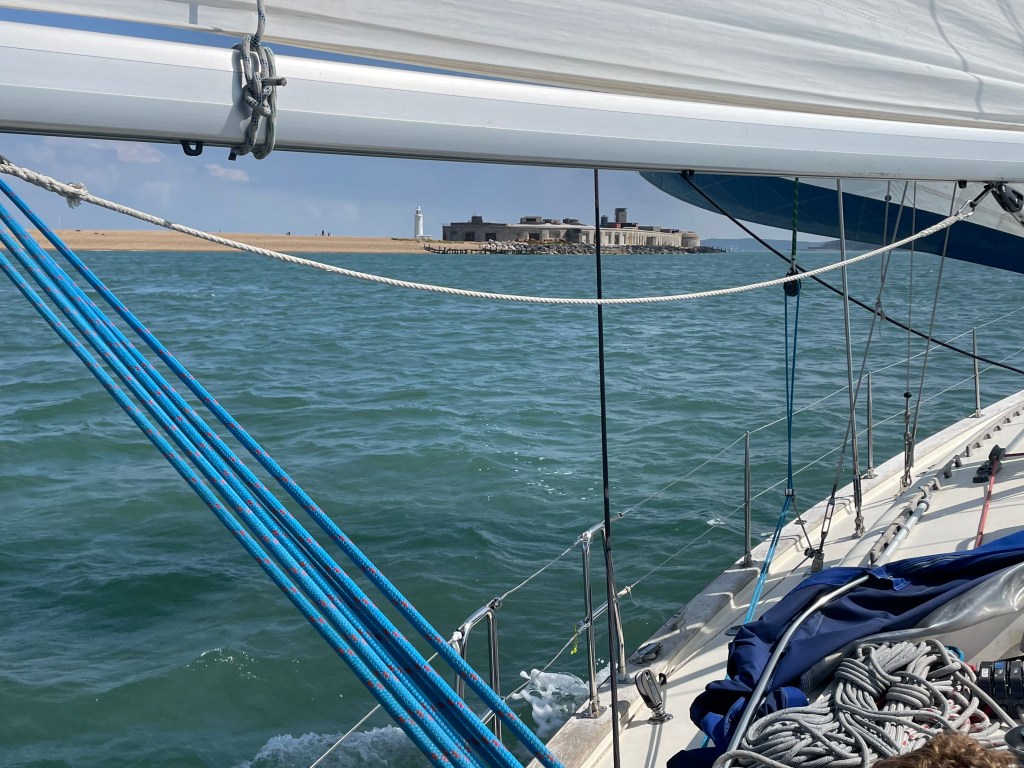
The sail back to the Needles channel was straightforward. There was a little wind to start with but that dropped off by mid-morning. We took the North channel through the Needles which takes you a couple of boat lengths off Hurst Castle. We had a SW wind which makes it a little awkward sailing down the Solent with the wind directly behind you. We sailed not quite on a dead run till after lunch which was a magnificent spaghetti carbonara – very impressed with the quality of chefing on the boat. Once lunch was over the mainsail came down and we used just the foresail all the way back to Gosport.
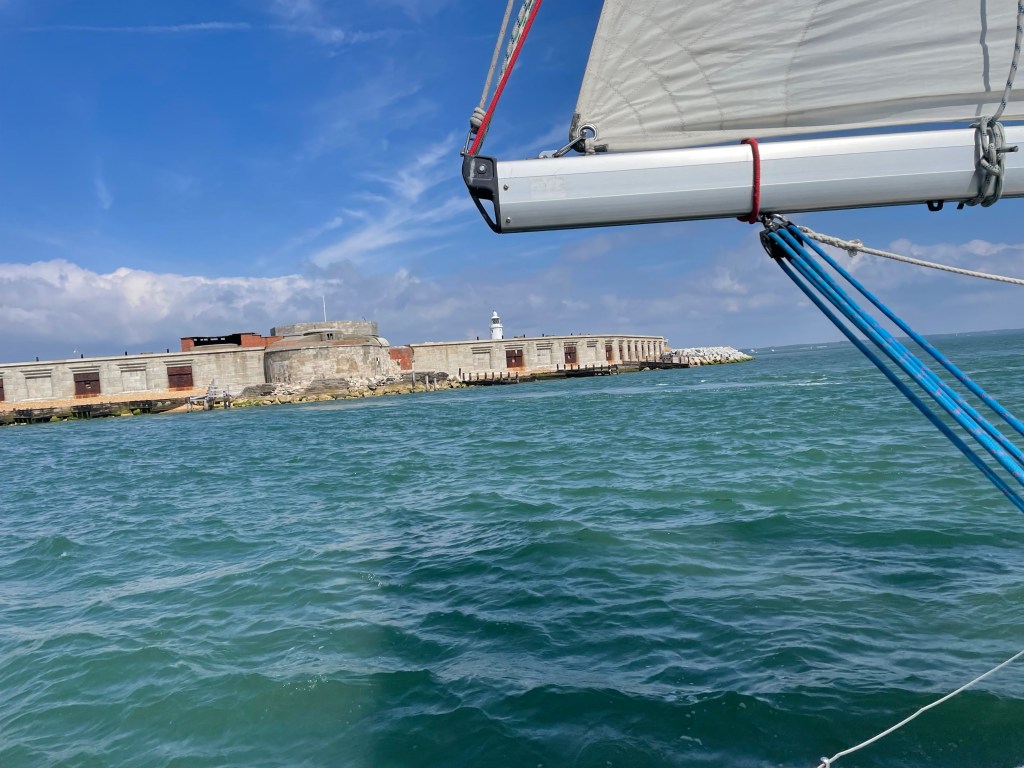
The wind had picked up as we went through Portsmouth entrance 15+kts. The foresail came down in Haslar Creek before refuelling. Liam took us into the pontoon. A very tricky manoeuvre as we had a strong wind blowing us off. It took a couple of goes to get us on but he did very well as did the crew in getting lines ashore quickly. Once refueled it was back to the boats berth. Liam again took the helm. Like the fuel pontoon it was going to tricky coming alongside with wind blowing us hard off. Liam had lined up just right but we were a little too much over to one side of the channel which would not have been a problem if we had not been passing a boat with davits on the back for a dinghy. This came very, very close which meant that Liam lost the line a little. Never mind we went around again and this time got it right. There was a suggestion from those going ashore that it would be better to do so without a line and then catch it from one of the other crew on board. This was not a great idea as we would loose time between getting ashore, a line being thrown and then tied. So with a little encouragement they leapt over the side holding the line. Just as well as we only got one ashore who quickly tied off and then grabbed the stern line. It took a little while to sort everything out using the motor and muscle to get us alongside the pontoon just right.
Time for a shower and then they all went ashore via the Gosport Ferry to Gun Wharf Key. There had been an earlier request to berth there for the night and then motor back in the morning. But this was vetoed – a) it is a terrible night to spend alongside, b) it is expensive c) getting up in the morning after a night out to move the boat to its berth and then clean seemed an unnecessary additional task.
It was an even later night than Weymouth with the last person back aboard around 0400! I wisely spent the night on board with a meal out at a Chinese Restaurant that did not look promising but proved to be excellent.
Friday 19th August – Handover
So the the final day. Again at the sound of reveille at 0900 they were all up and organised themselves to clean the boat. It was spotless with the Bosun commenting that he had not had such a clean boat all year! A great week sailing with a combination of light and medium winds, anchoring, picking up a buoy, man overboard drills, navigation and night sailing. Around 150 miles.
I wish all of them the very best for Term 3 and the start of their careers as commissioned offices in the British Army as it faces the new challenges of the future. It was a pleasure sailing with them.
 Purrfect Tale